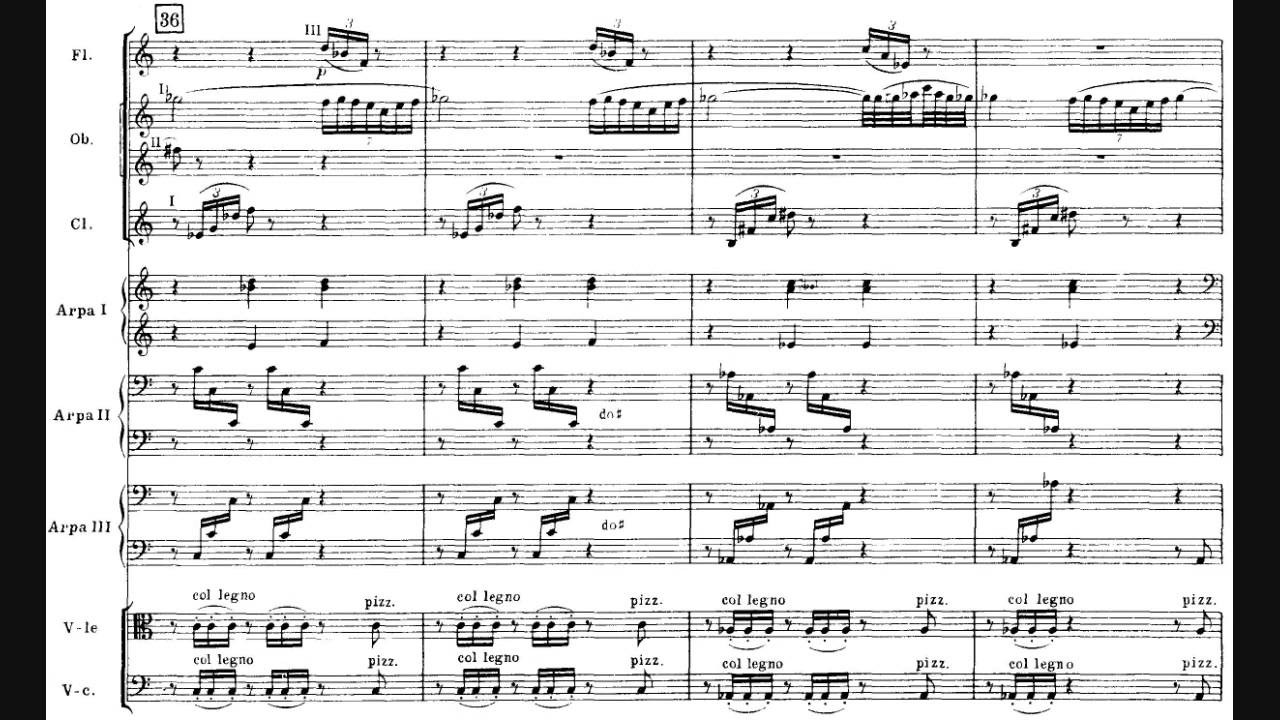
Igor Stravinsky - Chant du Rossignol {Song of the Nightingale}
Автор: olla-vogala
Загружено: 2015-12-26
Просмотров: 105307
Описание:
Composer: Igor Fyodorovich Stravinsky (17 June 1882 -- 6 April 1971)
Orchestra: Seattle Symphony Orchestra
Conductor: Gerard Schwarz
Year of recording: 1986
Le Chant du Rossignol {The Song of the Nightingale}, symphonic poem for orchestra, written in 1917.
00:00 - I.a) La fête au palais de l'empereur de Chine
02:32 - I.b) Marche Chinoise
05:53 - II.a) Les Deus Rossignols
09:42 - II.b) Jeu du Rossignol mécanique
12:45 - III.a) Maladie et guérison de l'empereur de Chine
18:40 - III.b) Marche funèbre
Le chant du rossignol is the symphonic poem Stravinsky extracted from his opera based on a story by Hans Christian Andersen, Le rossignol (The Nightingale) (1914). Stravinsky began composing Le rossignol in early 1908 while he was still a composition pupil of Rimsky-Korsakov, and the first act of the opera was substantially completed by 1909. But the commission that led to the composition of L'Oiseau de feu (The Firebird) (1910), Petrushka (1911), and then Le Sacre du printemps (The Rite of Spring) (1913) delayed the composition of the second and third acts until 1914. By that time Stravinsky's style had changed nearly beyond recognition, and although Stravinsky tried to recover the thread of the composition, the music of the latter two acts of Le rossignol is different and far more harmonically advanced than the music from the first act.
In 1919, Stravinsky reconsidered the opera and decided to transform the musically homogenous second and third acts into a three-part symphonic poem. In order to facilitate this structural transformation, he dropped some portions of the opera's score and repeated others to achieve a symphonically balanced form. Stravinsky divided the music of the two acts into three unequal parts: the shorter "The Feast in the Emperor of China's Palace" and "The Two Nightingales," and the much longer "Illness and Recovery of the Emperor of China," with its substantial epilogue in the form of a funeral march. And in order to adjust the work to an ensemble without voices, he transferred the lines of the live Nightingale and the mechanical Nightingale to the solo flute and the solo violin. The greater ranges of these instruments in turn allowed him to expand and extend the accompaniment's textures so that they become more open and spacious.
The result is is neither a true symphonic poem -- it's still far too loosely constructed for that -- nor a suite from the opera -- it's far too exclusive for that. Le chant du rossignol is a gorgeously coloured, melodically extravagant, and harmonically adventurous work that sounds unlike anything else Stravinsky had ever written and anything else he was ever to compose.
Повторяем попытку...

Доступные форматы для скачивания:
Скачать видео
-
Информация по загрузке:
![Igor Stravinsky - Symphony of Psalms [With score]](https://imager.clipsaver.ru/VUSfrgPQjRM/max.jpg)
![Igor Stravinsky - Agon (1954-57) [with score]](https://imager.clipsaver.ru/7TPS6TLKoBk/max.jpg)




![Igor Stravinsky - Symphony in 3 Movements [With score]](https://imager.clipsaver.ru/FB-NzpYwC3Y/max.jpg)