Beethoven: Sonata No.17 in D Minor, "Tempest" (Alfred Brendel)
Автор: Mallard
Загружено: 2026-11-10
Просмотров: 8
Описание:
00:00 - Mvt 1, Largo – Allegro
08:44 - Mvt 2, Adagio
16:58 - Mvt 3, Allegretto
Beethoven wrote the three Op.31 sonatas in 1802, the year of the Heiligenstadt Testament, around the time he reportedly said he wanted to take a "new path". The D minor sonata shows that path most clearly. It doesn't begin with a theme at all, but with a question: a single, quiet, rolled chord.
The nickname comes from Anton Schindler, who claimed that Beethoven, asked what the sonata meant, answered "Read Shakespeare's Tempest." Schindler is a famously unreliable witness, but the name stuck, and the music does behave like weather: it changes without warning, flares up, and moves on.
Three things to listen for: the rising arpeggio of the very first bar, which comes back in many disguises; the recitatives, where the piano suddenly sings like a lone voice in an opera; and the soft drumbeats in the slow movement's bass.
This is the second of Brendel's three complete recordings of the sonatas (Philips, 1970–77), a cycle Gramophone later called a "productive transition". When he re-recorded the Tempest in the 1990s, critics found his outer movements had become slower than they are here. He takes both written repeats, in the first movement and the finale. The Adagio is broad, at roughly 38 beats per minute. In the finale the pulse barely moves: about 75 bars a minute, held almost metronomically steady from start to finish. That steadiness is what makes the movement feel relentless rather than frantic.
MVT 1 - Largo – Allegro
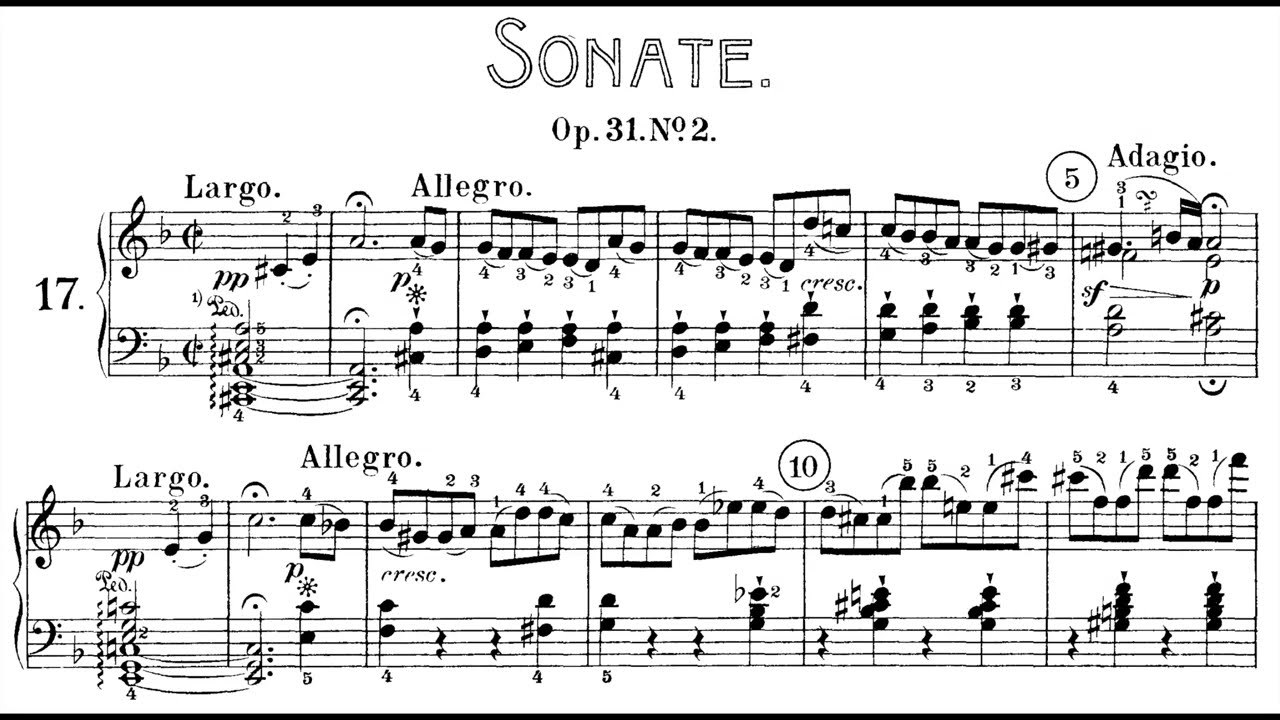
00:00 - A pianissimo rolled chord, not on D minor but on its dominant, so the piece starts off-balance. Two slow bars, a nervous Allegro of falling two-note sighs, a pause, then the whole thing again on a new chord.
00:49 - The main theme, forte. The opening arpeggio now charges up through the bass over a restless triplet tremolo, and the right hand answers with a pleading line.
01:12 - Second theme, in A minor instead of the usual major key: sighing two-note figures over a pulsing bass.
01:35 - Closing section. Hammered chords and sforzandi keep raising the tension.
02:12 - Exposition repeat
04:19 - DEVELOPMENT. The Largo comes back, and the arpeggio now climbs three times, each time on a different chord: the opening question, asked again and again.
05:00 - The Allegro bursts in fortissimo in F♯ minor. The rising arpeggio is driven through new keys over a churning tremolo.
05:42 - The storm drains away. Soft sustained chords over a long-held low A prepare the way home.
05:55 - RECAPITULATION. The opening chord returns, but this time it opens into a recitative marked "con espressione e semplice": a single voice singing with no accompaniment. Beethoven's pedal marking lets the notes blur and hang like an echo.
06:43 - A second recitative, darker and more searching. Brendel takes the recitatives unhurriedly: the first one alone lasts over half a minute.
07:20 - After more than three seconds of held silence, and instead of the expected main theme, a new and urgent passage of stamping chords and racing arpeggios.
07:36 - Second theme, now in D minor
08:00 - Coda
08:26 - The opening arpeggio murmurs again and again, deep in the bass, pianissimo, until the movement fades out.
MVT 2 - Adagio (B♭ major)
08:42 - The same gesture that opened the sonata, a rolled chord low in the bass, but now a calm melody high above answers it, like two voices in conversation.
10:00 - Transition. The left hand starts a muffled drumroll of rapid triplets, like distant timpani.
11:05 - Second theme in F major, marked dolce: a tender, ornamented melody over a gently rocking accompaniment.
11:44 - The drums return, and a falling run leads straight back to the opening.
12:04 - The opening theme returns.
12:43 - The answering phrase, now over rapid running notes in the left hand
13:18 - Drumroll transition
14:23 - Second theme, now in B♭ major
14:56 - The drums once more, pianissimo
15:51 - Coda: fragments of the opening theme
16:24 - Final bars. The drumbeats die away beneath the melody's last turns.
MVT 3 - Allegretto (D minor)
16:58 - A four-note figure, A–F–E–D, is set spinning in an almost unbroken stream of semiquavers. Legend has it that the rhythm came to Beethoven from a horseman galloping past his window. Note the tempo marking: Allegretto, not Presto.
17:34 - Second theme in A minor: ornamented figures riding on the ceaseless motion.
18:16 - Exposition repeat
19:32 - DEVELOPMENT. The theme wanders into darker, flat keys.
20:27 - Sharp off-beat accents raise the tension.
20:52 - The left hand falls silent. The right hand spins the figure alone, growing quieter, a single thread leading back home.
21:05 - RECAPITULATION
21:49 - Second theme, now in D minor
22:31 - Coda. It opens just as the development did.
22:41 - A long, hushed build-up over the dominant
22:53 - A fortissimo outburst
23:24 - The motion thins out, and the sonata disappears into a pianissimo low D.
Alfred Brendel, Recorded 1970-1977
Повторяем попытку...
Доступные форматы для скачивания:
Скачать видео
-
Информация по загрузке: