COMPLEXOMETRIC TITRATION (WATER HARDNESS DETERMINATION BY EDTA METHOD) FOR CSIR NET/GATE
Автор: TETRAHEDRON CHEMISTRY CLASSES
Загружено: 2020-02-27
Просмотров: 3652
Описание:
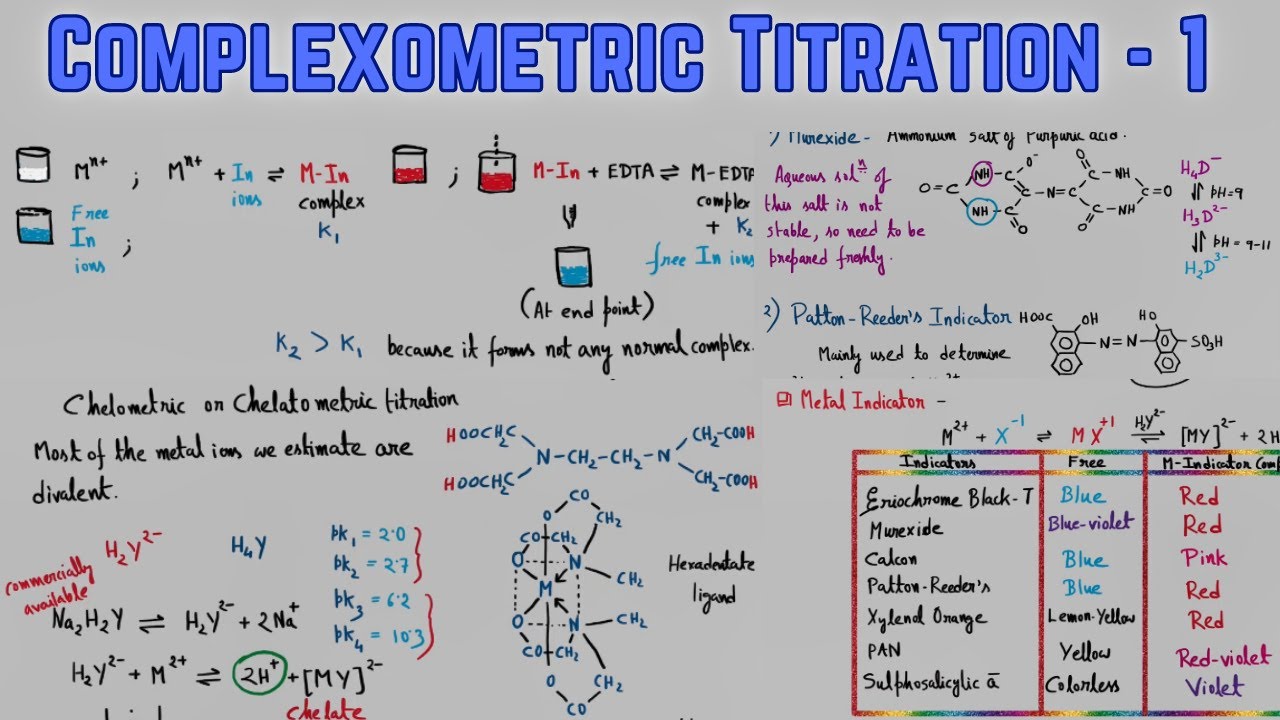
In this video I have explained the determination of water hardness by EDTA Method. EDTA is a large flexible molecule with a backbone of ethylenediamine. Two acetic acid groups are attached to each of the two nitrogen atoms in the backbone. Because EDTA has four acidic protons, it is a tetraprotic Brønsted-Lowry acid. In addition to being a Brønsted-Lowry acid, EDTA is also a Lewis base. In other words, it can donate at least one electron pair to a Lewis acid, forming a coordinate covalent bond. Each nitrogen atom and one oxygen atom in each acetic acid group has an electron pair that can be donated to a metal cation to form a coordinate covalent bond. Here, the metal cations is the Lewis acid.More specifically, EDTA is a hexadentate ligand when it donates six electron pairs A compound such as EDTA that can donate more than one pair of electrons at a time is more generally called a chelating ligand because it bonds with metal cations to make complexes called chelates. As shown above, this requires the ligand to wrap itself around the metal cation making a very stable cage-like structure. Because a molecule of EDTA can make only one ‘cage’ for a metal cation, it can only react with one metal cation at a time. This results in a stoichiometry of one EDTA molecule to one metal ion, making EDTA very convenient for analytical applications.The completely deprotonated form of EDTA only exists in significant quantities in quite alkaline solutions (pH of 10 or greater). At this pH, many metal cations, including zinc and magnesium, form insoluble hydroxides that will not react with EDTA. To eliminate this problem, auxiliary complexing agents can be employed. Ammonia is a popular choice because it forms complex ions with many metal ions, and EDTA can compete favorably with ammonia for metal ions. Further, ammonia and its conjugate acid, ammonium ion, can be used to buffer the solution to a pH at which a significant amount of EDTA is in the
deprotonated form. The equivalence point in EDTA titrations can be detected in a
number of ways. In this experiment, a visual indicator called Erichrome black T will be used. In this experiment, water samples will be brought to pH 10 by addition of an excess of an ammonia ammonium chloride buffer. The ammonia molecules will act as ligands and form complexes with the calcium and magnesium cations. Then, a few drops of Erichrome black T indicator will be added to this solution. As a stronger ligand than ammonia, the Erichrome black T will displace ammonia molecules from some of the metal ions, forming red Erichrome black T -metal complexes. Finally, the EDTA will be added dropwise. The EDTA will first react with the metal ions complexed by the weaker ligand, ammonia. When all of the metal-ammine complexes are broken up, the EDTA will then react with the Erichrome black T complexed metal ions, displacing Erichrome black T. This regenerates free HIn2–, and the solution turns from red to blue.
following is the water hardness link
• Part 1: Water Hardness
Link for titration
• Titration: Laboratory Glass Ware #DEVLOGMYVLOG
#complexometricTitration #WaterHardnessDetermination #EDTA #EriochromeBlackT #Numerical
Повторяем попытку...

Доступные форматы для скачивания:
Скачать видео
-
Информация по загрузке: