Voyager 2 PWS Saturn Encounter audio 1981 Aug 24 to Sep 7
Автор: Space Audio
Загружено: 2021-08-25
Просмотров: 9876
Описание:
The PWS plasma wave instrument on Voyager 2 recorded these signals as the spacecraft was passing Saturn from August 24 to September 7, 1981. These are the authentic "sounds of Saturn" unmodified and presented at their original frequency.
The PWS wideband waveform instruments on the two Voyager spacecraft sample the electric field on the dipole wire antenna at a rate of 28800 4-bit samples per second, using an automatic gain control. Consequently, the audio is just slightly better than telephone quality. Packets of 1600 samples are acquired, separated by the equivalent of 128 missing samples. Running these packets together results in the playback taking less than real-time (by a factor of 1600 / 1728), and also introduces a slight audible flutter. The amplitudes at the edges of these packets have been smoothed to reduce this flutter, but this is the only modification to the signal.
This is not a comprehensive sampling of all of the "sounds" that Saturn makes, but it does include all of the available waveform measurements during the time interval given. Due to limits on telemetry bandwidth and the fact that we had to share with the imagers and other instruments, only these seventy-one frames were acquired during this approximate two-week interval. Due to time gaps the total run time is only a little over fifty-two minutes.
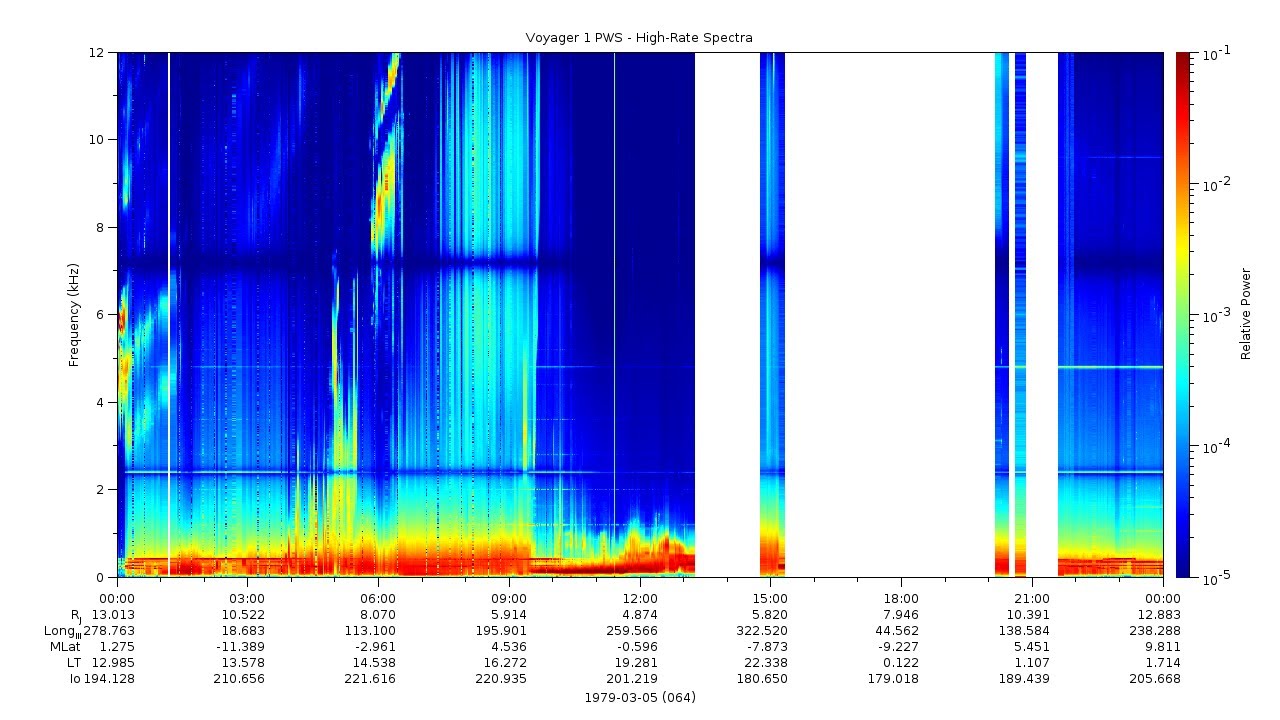
Many of the audible features unfortunately are the result of onboard interference. The constant tone at 2.4 kHz is caused by the spacecraft power supply. The occasional sound like someone banging a gong is produced by the stepper motor on the LECP experiment. The tones with harmonics that build slowly and end abruptly and appear as multiple horizontal lines in the spectrogram are due to the grid modulation of the PLS experiment. The occasional bass drum thumps are the result of spacecraft attitude thruster firings. The rest of the signals are the naturally-occuring plasma waves that this Voyager instrument was designed to detect: These are the genuine "sounds of Saturn".
Now, what do we mean by "sounds of Saturn"? First, the sounds are not typically produced at the planet itself, but in the magnetosphere, the magnetic bubble surrounding the planet. These waves are not the same as the pressure waves in the atmosphere that we normally think of as sound. However, they do have some similarities. Even though space is an excellent vacuum, it is "filled" with particles at a density of typically a few to several hundred particles per cubic centimeter near planets. Most of these are charged and constitute what we call plasma. Being charged, these particles interact with each other without the need to "collide" as they do in the atmosphere. Moving charged particles both produce electromagnetic fields and waves and also are moved by electromagnetic fields and waves generated elsewhere. These are "plasma waves". Many of these interactions occur at frequencies that are audible to humans. This doesn't mean that a human ear could hear them in space -- the pressures are far too small -- but it is conceivable that an ultra-sensitive microphone could measure them. In practice, however, it is far easier to measure the oscillations in the accompanying electric and magnetic fields with antennas, and that is just what we do. To produce sound we can hear, we simply do the equivalent of hooking our antennas up to an amplifier in order to drive speakers. Plasma waves can be considered "space audio".
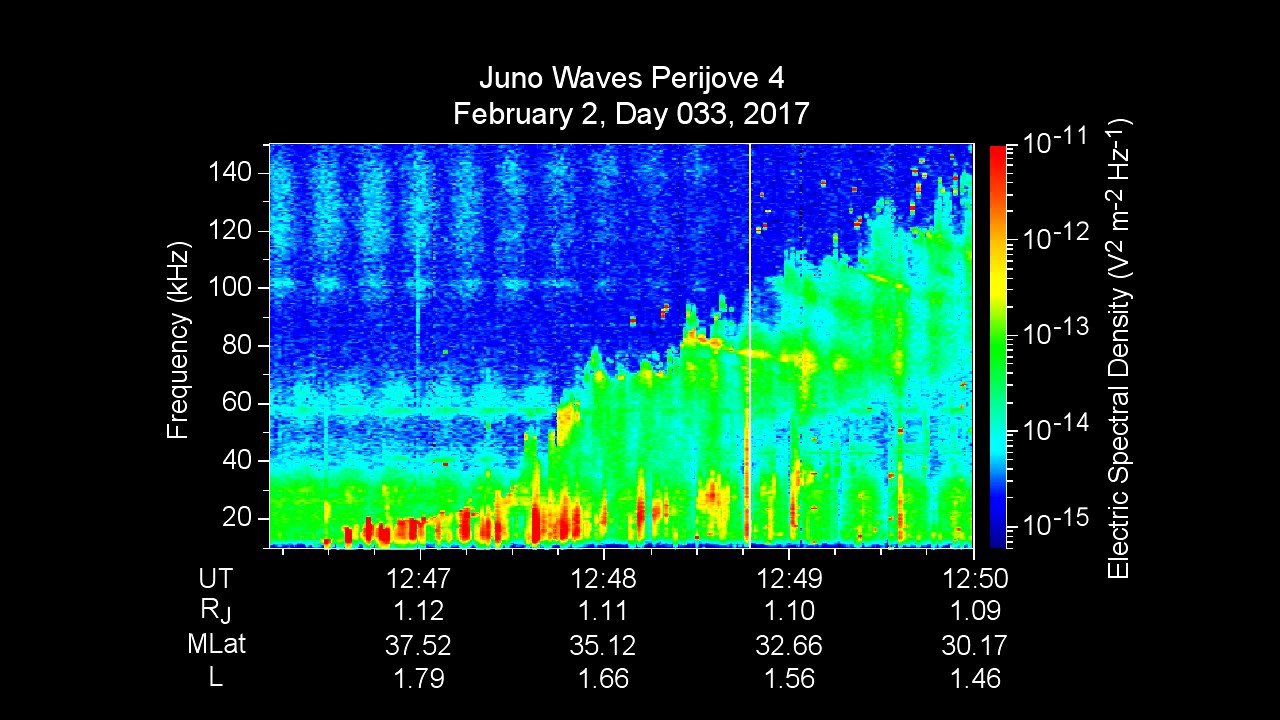
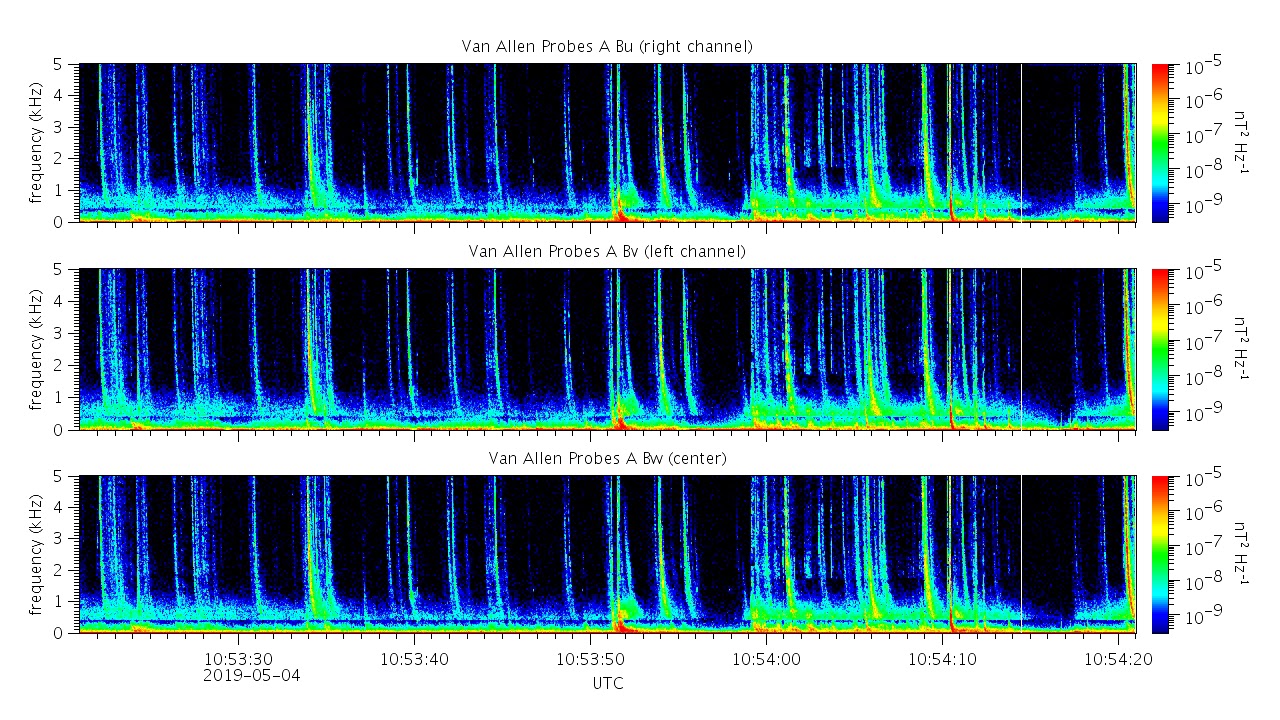
The video shows a series of 48-second-wide spectrograms with an animated cursor that tracks the audio. The amplitude of the signals is color coded with dark blue for the weakest and red for the strongest signals. Low frequencies are at the bottom of the plot and high frequencies are at the top. Time ranges from left to right.
For access to all audio data for the entire mission, including the specific data used to produce this video, see
https://space.physics.uiowa.edu/plasm...
https://voyager.jpl.nasa.gov/
https://space.physics.uiowa.edu/plasm...
https://space-audio.org/
/ voyagerpws
/ _space_audio
Disclaimer: I am not representing any organization and this is not a presentation of scientific findings.
/ voyagerpws
Повторяем попытку...

Доступные форматы для скачивания:
Скачать видео
-
Информация по загрузке: