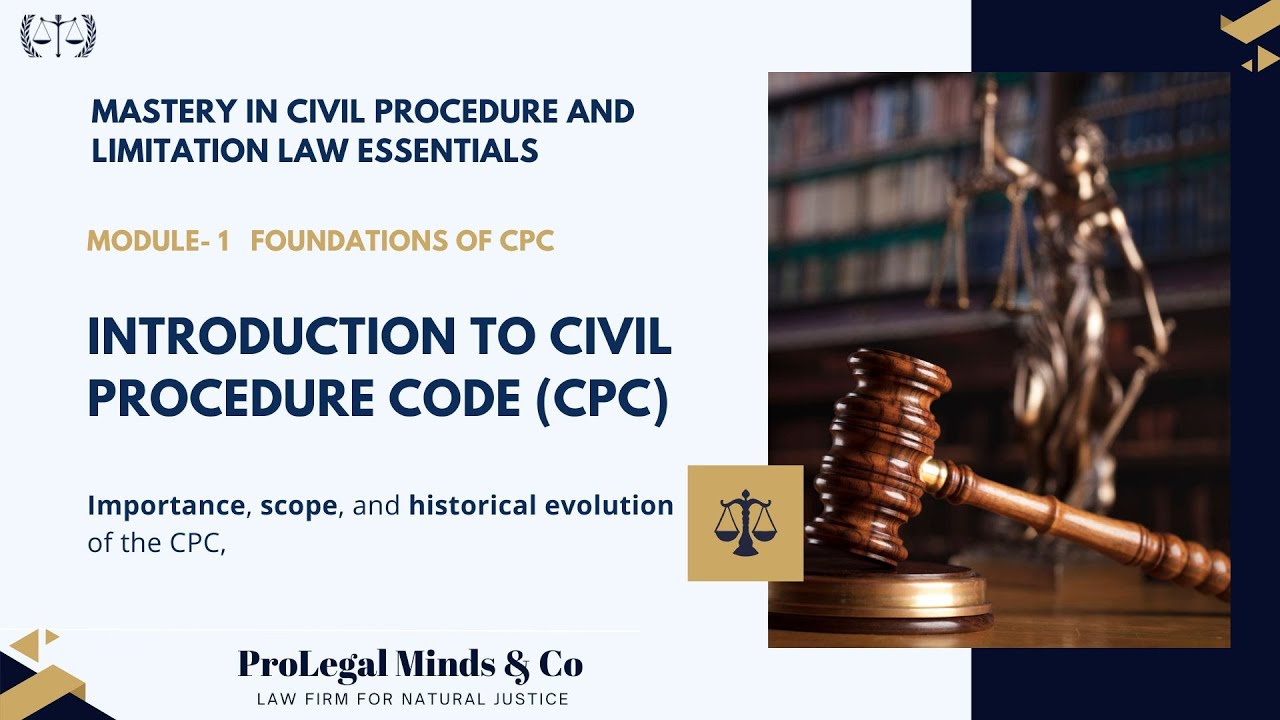
M1.1 Introduction to CPC - Prolegalminds
Автор: ProLegalMinds
Загружено: 2024-12-24
Просмотров: 121
Описание:
The Civil Procedure Code (CPC) of 1908 is a cornerstone of the Indian judicial system, governing the procedural aspects of civil litigation. It provides a systematic approach to ensure justice in civil disputes, serving as the foundation for adjudicating civil rights and liabilities. Below are key points highlighting its importance and scope:
Importance of CPC:
1. Uniformity in Procedure:
• CPC standardizes civil procedural laws across India (except for certain exceptions in Jammu & Kashmir and tribal areas), ensuring uniform application and consistency in civil proceedings.
2. Facilitates Justice:
• It provides a structured framework for filing, conducting, and resolving civil suits, ensuring fair and impartial adjudication of disputes.
3. Simplifies Litigation:
• The CPC aims to streamline the litigation process, making it accessible and comprehensible for both litigants and legal practitioners.
4. Protects Rights:
• The Code ensures that the rights of all parties are safeguarded by establishing rules for fair trial procedures, evidence presentation, and enforcement of judgments.
5. Efficient Resolution:
• By setting timelines, processes, and mechanisms for appeals and execution, it prevents unnecessary delays and ensures efficient resolution of disputes.
Scope of CPC:
1. Coverage of All Civil Matters:
• The CPC applies to all civil cases unless specifically excluded by statute, covering disputes related to contracts, property, family law, torts, and other non-criminal matters.
2. Substantive and Procedural Balance:
• While substantive laws determine the rights and obligations of individuals, the CPC ensures those rights are effectively enforced through appropriate procedural rules.
3. Jurisdiction and Applicability:
• It provides rules regarding the jurisdiction of civil courts, including territorial, pecuniary, and subject-matter jurisdiction.
4. Inclusive of Special Provisions:
• Special provisions such as orders for injunctions, summary suits, and execution proceedings address specific needs of litigants.
5. Facilitates Alternative Dispute Resolution (ADR):
• Section 89 of the CPC promotes mediation, arbitration, and conciliation, encouraging settlement without resorting to prolonged litigation.
2. Historical Evolution and Codification of CPC
Understanding the historical context of the CPC is crucial to appreciate its role in India’s legal framework. The evolution of the Code reflects the transition from colonial influences to an independent judiciary.
Historical Background:
1. Pre-British Era:
• Before the British era, civil disputes were governed by customary laws, local traditions, and religious texts, leading to inconsistencies and a lack of uniformity.
2. British Influence:
• The establishment of British rule in India brought significant changes to the judicial system. Early efforts to codify laws began with the Regulating Act of 1773, which set up Supreme Courts in Presidency towns.
3. First Civil Procedure Code (1859):
• The first comprehensive Civil Procedure Code was enacted in 1859, aiming to unify and standardize civil litigation procedures across British India. However, its limited scope and practical challenges led to subsequent amendments.
4. CPC of 1877 and 1882:
• These versions expanded the procedural framework but were criticized for their complexity and lack of adaptability to India’s diverse social conditions.
5. The CPC of 1908:
• The current Code was enacted to consolidate and amend previous laws. It was designed to be more comprehensive, systematic, and accessible, addressing procedural challenges and introducing provisions for appeals, execution, and costs.
Post-Independence Developments:
1. Adaptation and Amendments:
• Post-independence, the CPC underwent significant amendments to align with the constitutional values of equality, justice, and secularism.
• Notable amendments include provisions for alternative dispute resolution (Section 89), case management, and e-filing systems.
2. Integration with Special Laws:
• The CPC functions alongside special statutes like the Family Courts Act, Commercial Courts Act, and Arbitration and Conciliation Act, demonstrating its adaptability and relevance in diverse contexts.
3. Current Status:
• The CPC continues to evolve with judicial interpretations and legislative amendments to address emerging challenges like technology, globalization, and complex litigation.
Conclusion
The Civil Procedure Code is not merely a procedural law; it is the backbone of civil justice in India. Its systematic approach ensures the enforcement of substantive rights while maintaining procedural fairness. Understanding its importance and historical evolution lays a solid foundation for appreciating its role in the judicial system.
Повторяем попытку...
Доступные форматы для скачивания:
Скачать видео
-
Информация по загрузке:













![ARMIA PUTINA DRUGĄ ARMIĄ ŚWIATA? PRAWDZIWA SIŁA ROSJI [WOLSKI I BOJKE]](https://imager.clipsaver.ru/-0hLR4R3gvk/max.jpg)
