Time for discussion before taking a decision! European Parliament Rules on EU debates!
Автор: EU Debates | eudebates.tv
Загружено: 2023-11-23
Просмотров: 1907
Описание:
Subscribe here: https://bit.ly/eudebates Time for discussion before taking a decision
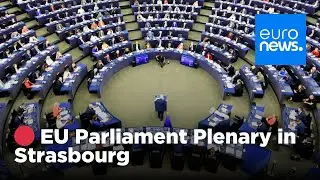
A parliamentary report put to the vote in plenary is generally the subject of a debate in which the Commission, the representatives of the political groups and individual MEPs express their views. Speaking time per person, often very short, depends on the number of Members who have asked for the floor.
Unlike the voting, which is sometimes held at a very rapid pace, the debates can last for several hours, depending on the number of Members who wish to speak. They usually speak in their own language, and what they say is interpreted simultaneously by the interpreters into the other official EU languages.
Speaking time in the Chamber is allocated according to the following criteria: a first fraction of speaking time is divided equally amongst all the political groups, then a further fraction is divided among the groups in proportion to the total number of their members. MEPs who wish to speak are entered on the list of speakers in an order based on the numerical size of their group. However, a priority speaking slot is given to the rapporteurs of the committees responsible and to representatives of other committees asked for an opinion.
Distinguished visitors regularly come to address Parliament, including Heads of State, who are normally received in formal sitting.
The high point of the European Parliament’s political activity, plenary sittings represent the culmination of the legislative work done in committee and in the political groups. The plenary sitting is also the forum in which the representatives of the citizens of the European Union - the Members of the European Parliament or MEPs - take part in the EU’s decision-making and express their standpoint vis-à-a vis the Commission and Council.
Plenary sittings are chaired by the President of the European Parliament. The President of the European Parliament is assisted in this task by the 14 vice-presidents, who can take over the chair. The President opens the sitting, sometimes with a tribute or a speech on a current topic. Parliament is in fact constantly concerned to respond to the latest developments in any major issue and has no hesitation in changing its agenda in order to call on the Union to act. The President’s influence can be decisive in this respect.
During the sitting, the President calls upon speakers and ensures that the proceedings are properly conducted. He or she also directs the voting procedure, putting amendments and legislative resolutions to the vote and announcing the results. The President's authority ensures that the votes, which can be long and complex, proceed at a rapid pace.
Most of the 705 MEPs belong to a political group, of which there are currently 7, representing all ideological tendencies in the EP. Some MEPs are not affiliated to any political group and are thus known as 'non-attached' Members. It is the political groups that decide which issues will be discussed in plenary. They can also table amendments to the committee reports to be put to the vote. However, Members cannot be obliged by their group to vote in a particular way.
The European Commission and the Council of the European Union take part in the sittings in order to facilitate collaboration between the institutions in the decision-making process. If Parliament so requests, the representatives of the two institutions may also be called upon to make declarations or to give an account of their activities in response to questions put to them by Members. These debates may be wound up with a vote on a resolution.
Plenary sittings bring together a large number of participants and thus cannot be improvised, but require thorough organisation in advance, in so far as possible. Thus the plenary agenda is drawn up in detail by the Conference of Presidents of the political groups.
In parallel, the Conference of Committee Chairs (composed of the chairs of all the standing and temporary parliamentary committees) can make recommendations to the Conference of Presidents regarding the work of the committees and the drafting of the plenary agenda.
Plenary business mainly focuses on debates and votes . Only the texts adopted in plenary and written declarations signed by a majority of Parliament’s component Members formally constitute acts of the European Parliament. These concern different types of text depending on the subject under consideration and the legislative procedure applicable:
Stay connected with us!
Facebook: / eudebates.tv
Twitter: / eudebates
Instagram: / eudebates.tv
#eudebates the unique initiative aiming to promote debate, dialogue, knowledge, participation and communication among citizens. #democracy #debates #EuropeanParliament #plenary #Brussels #Strasbourg #France #Belgium #MEPS #Members #Parliament #speech
Повторяем попытку...

Доступные форматы для скачивания:
Скачать видео
-
Информация по загрузке: