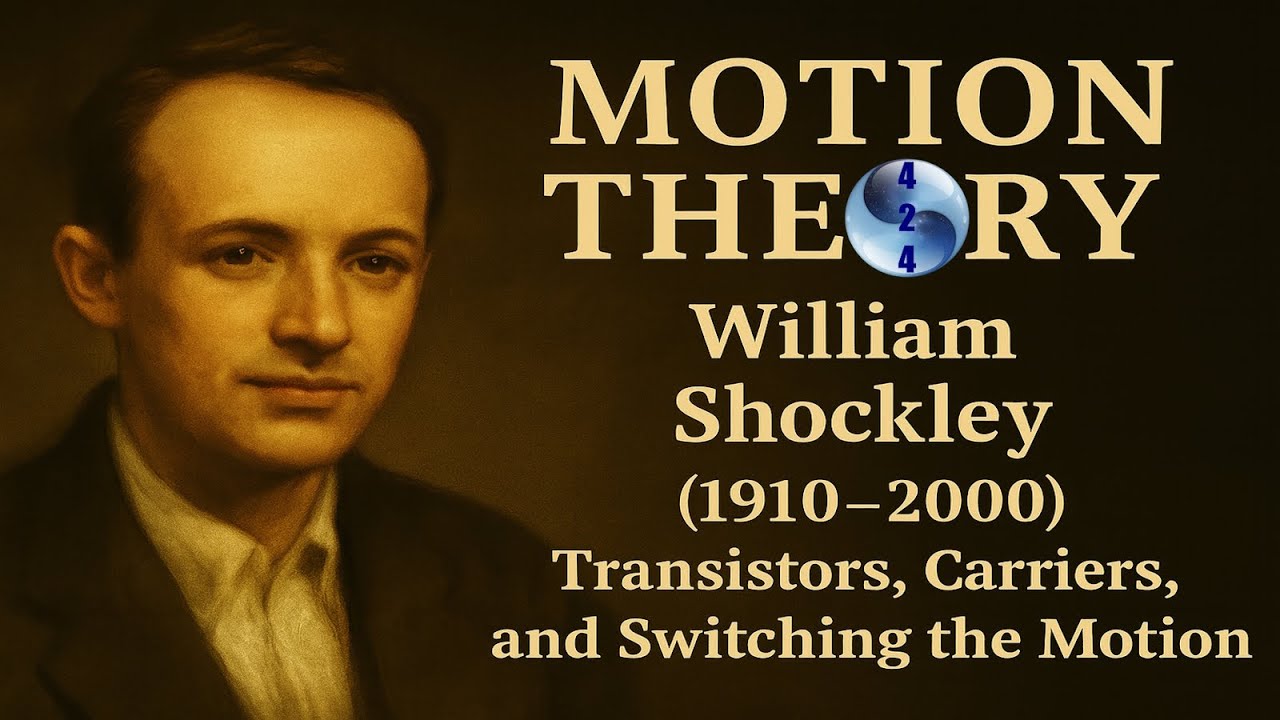
William Shockley (1910–1989) — Transistors, Carriers, and Switching the Motion
Автор: Motion Theory
Загружено: 2025-11-17
Просмотров: 16
Описание:
/ @themotiontheory
William Shockley, transistor history, Motion Theory analysis, MT physics, semiconductor motion channels, electron carriers, holes in valence band, conduction band dynamics, band gap Eg, doping donors acceptors, germanium crystal behavior, structured motion packets, lattice standing waves, Shockley diode equation, diode barrier physics, exponential I-V curve, Boltzmann carriers, p–n junction depletion region, forward bias motion flow, reverse bias leakage, motion gradient engineering, BJT emitter base collector, base current modulation, motion amplification, signal steering, coherent vs thermal entropy, S_th and S_coh, non-equilibrium carrier recombination, drift diffusion lifetimes, structured vs chaotic motion, transistor logic switching, symbolic motion patterns, synchronized motion loops, information encoding in motion regimes, noise as lost structure, shot noise correlation, 1/f noise mechanisms, nanoscale FET coherence, ballistic transport, switching sharpness, thermal dissipation signature, coherence ledger prediction, S_coh scaling, clock speed synchronization limits, oscillators at high frequency, coherence length threshold, MT falsifiable predictions, semiconductor physics foundations, ethical context of Shockley, separating science from ideology, impact of transistors on society, structured motion technology, amplifying motion patterns, motion valves in crystals, engineering constraints shaping computation, future device scaling via coherence, motion-based interpretation of electronics.
2) DESCRIPTION (≈2500 characters)
This script presents a deep Motion Theory interpretation of William Shockley’s work, reframing the invention of the transistor as the moment when humanity learned to intentionally sculpt motion inside solids. Instead of treating semiconductor physics as a collection of formulas, the narrative follows how Shockley identified ways to redirect electron motion patterns within a crystal lattice, turning raw thermal noise into controllable, structured flow. This perspective recasts metals, semiconductors, and devices as progressively refined landscapes for regulating motion—where electrons and holes become engineered participants in a vast choreography of gradients, barriers, and synchronized states.
The script explores how bands and gaps emerge as collective motion modes of electrons constrained by the lattice, and how doping recalibrates the balance of allowed patterns. The Shockley diode appears as a one-way gate that filters motion statistically through its built-in field, with the familiar exponential I-V relationship grounded in Boltzmann probabilities of carriers climbing a barrier. Transistors are then presented as motion valves: small, precisely shaped control motions in one region reorganize the internal structure of motion in another, enabling amplification and switching.
Non-equilibrium processes—drift, diffusion, recombination—are framed as the interplay between structured motion and the surrounding sea of thermal agitation. Logic emerges once these motion regimes are stabilized and linked, giving rise to symbols that persist long enough to compute. The script further incorporates Shockley’s contributions to understanding lifetimes, gradients, and internal ordering, while also acknowledging the ethical failures of his later life, emphasizing the distinction between scientific insight and harmful ideology.
Finally, the Motion Theory predictions offer testable ways to connect coherence, noise, dissipation, and switching speed in modern nanoscale devices. By treating coherence as a measurable form of structured motion, the script connects transistor performance to deeper physical limits, suggesting pathways toward materials and geometries that preserve order more effectively. Overall, the piece blends historical context, semiconductor physics, and MT conceptual tools to illuminate how organizing motion at microscopic scales became the foundation of computation—and how the future of device engineering will depend on mastering that organization even further.
Повторяем попытку...
Доступные форматы для скачивания:
Скачать видео
-
Информация по загрузке:


![Лампа накаливания — возможно, лучшее изобретение [Veritasium]](https://image.4k-video.ru/id-video/JstcTHp-IKM)

![Как сжимаются изображения? [46 МБ ↘↘ 4,07 МБ] JPEG в деталях](https://image.4k-video.ru/id-video/Kv1Hiv3ox8I)