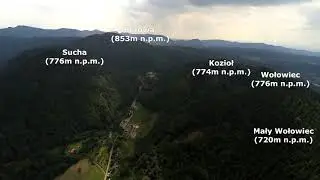
Solo hike to 853m peak in Poland
Автор: BAEV
Загружено: 2024-01-07
Просмотров: 460
Описание:
Borowa Mountain (Borowa Góra) is one of the most distinctive peaks of the Wałbrzych Mountains (Góry Wałbrzyskie), located in southwestern Poland in the Lower Silesian region. Although its elevation is modest compared to alpine giants, Borowa holds a deep historical, geological, and cultural significance. For centuries, it has stood as a silent witness to natural transformations, human migrations, political upheavals, and changing perceptions of nature itself.
The history of Borowa Mountain is not only a story of rocks and forests, but also a story of people — how they used the land, feared it, respected it, exploited it, and eventually returned to it in search of silence and meaning.
The Wałbrzych Mountains are part of the Sudetes, one of the oldest mountain ranges in Europe. Their origins date back hundreds of millions of years to the Paleozoic Era, shaped primarily during the Hercynian (Variscan) orogeny. During this period, massive tectonic forces caused the Earth's crust to fold, fracture, and uplift, creating the foundations of today’s mountainous terrain.
Borowa Mountain was formed through these same processes. Its geological core consists mainly of metamorphic and igneous rocks, including gneiss, schist, and volcanic formations. These materials give the mountain its solid, resilient structure and contribute to its rugged, uneven relief.
Over millions of years, erosion became the dominant force shaping Borowa Mountain. Wind, rain, frost, and seasonal temperature fluctuations gradually wore down sharper formations, smoothing the slopes and carving natural pathways. Unlike younger mountain ranges, Borowa lacks dramatic peaks, instead presenting a stable, grounded form covered in forest and stone.
This ancient erosion gives Borowa a sense of permanence. Many hikers describe the mountain as calm and timeless, as if it exists outside of human history.
Archaeological evidence from the Wałbrzych region indicates human activity as early as the Neolithic period. While no permanent settlements have been discovered on Borowa’s summit, nearby valleys and lower slopes were used for hunting, gathering, and temporary camps.
Borowa Mountain likely served as a natural landmark — a point of orientation in dense forests and rolling hills. For early humans, such landmarks were crucial for navigation and territorial boundaries.
In prehistoric cultures, elevated places were often associated with spiritual practices. Mountains and hills were believed to bring people closer to the sky, gods, or ancestral spirits. Although there is no direct archaeological evidence of ritual sites on Borowa, later folklore suggests that the mountain was regarded as a place of power.
The absence of clear material remains does not negate its symbolic importance; many sacred sites were defined by oral tradition rather than physical structures.
During the early Middle Ages, the region was inhabited by West Slavic tribes. Borowa Mountain lay near the fringes of their settlement zones, surrounded by dense, almost impenetrable forests. These forests offered both protection and isolation.
The mountain itself was likely used as a lookout point and a natural barrier against rival tribes or invaders. Its elevated position provided visibility over surrounding valleys and routes.
Ancient trade routes crossed the Sudetes, connecting Central Europe with the Baltic and Danube regions. Borowa Mountain stood near these paths and functioned as a geographical reference point for traders, messengers, and travelers.
From the 12th century onward, Lower Silesia experienced significant German colonization. New villages, towns, and infrastructure were established, and the landscape around Borowa Mountain changed dramatically.
Forests were cleared for agriculture, roads were built, and mining activities began in nearby areas. Borowa transitioned from a wild frontier to part of a managed environment.
It was during this period that many legends associated with Borowa Mountain emerged. Stories spoke of forest spirits, hidden treasures, and mysterious lights seen on foggy nights. Some believed the mountain concealed underground passages or ancient relics.
#solo hike
#poland
#853m
#borowa
Повторяем попытку...

Доступные форматы для скачивания:
Скачать видео
-
Информация по загрузке: