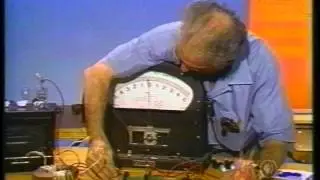
Julius Sumner Miller: Lesson 42 - Properties and Effects of Electric Currents
Автор: Matthew Bryant
Загружено: 2013-07-19
Просмотров: 20405
Описание:
A - The Oersted Frame: In 1820 Hans Christian Oersted - a Dane -
made an observation that stirred an avalanche in physical thought. He discovered that a current-bearing conductor gives rise to a magnetic field. We show this classic experiment. Faraday - an Englishman - heard of this great adventure and made a note in his notebook: "Make magnetism produce electricity". In 1831 Faraday did just this with his famous discovery of electromagnetic induction.
B - Metals are good electrical conductors - this we know. But how about liquids and solutions? We show a solution of copper sulphate with two lead electrodes. We "drive" a current through this solution from a storage battery and soon we see a marvelous thing: One of the lead plates has some COPPER ON IT. We thus show the conductivity in an electrolyte and the deposition of copper by electrolysis. This is copper plating.
C - How about conductivity in a "hot dog"? Sure enough - we impale a "cold" dog on two spikes - connect the system to the house line -110 volts AC - and we cook the dog! The conductivity is possible because of the salt in the meat which makes it a good conductor.
D - We connect a Cu wire to a dry-cell in a circular loop and present the wire to some iron filings. The filings gather tightly at the wire. Is the wire magnetized? No. It is not magnetized but the current-bearing wire produces a magnetic field which is strongest nearby the wire.
E - If two adjacent conductors carry a current the conductors may be pushed apart or pushed together depending on the direction of the current in them. So we suggest a demonstration using a coil known as Roget's Spiral. We avoid doing this experiment because it leads to the vaporization of mercury - which is very bad to breathe!
F - The Electromagnetic Gun: A coil of wire of HEAVY wire and few turns — this makes its Ohmic resistance low - is wound on an aluminum tube. In the tube resides an iron bar. We make connection for an instant to a 6-volt battery. The coil - now carrying a current -magnetizes the bar - draws the bar IN - AND - if we now open the circuit at the right instant the bar keeps going as a projectile. As can be seen - if the circuit is not closed and opened at critical times the weapon will not work!
G - We "short" a 6-volt storage battery by putting a Cu wire across its terminals. The current drawn momentarily may be as high as several hundred amperes.The heat developed burns the wire. What really happens is this: The wire is evaporated!
So - in these adventures - we see that an electric current can produce mechanical effects - magnetic effects - heating effects - chemical effects - optical effects - and so on. And we must not lose sight of Oersted and Faraday and scores of others whose genius made it all possible.
Повторяем попытку...

Доступные форматы для скачивания:
Скачать видео
-
Информация по загрузке:


![Всё, что вы хотели знать о салютах, но боялись спросить [Veritasium]](https://image.4k-video.ru/id-video/TOpbT0yuqQI)


