Understanding the Key Differences Between @ StateObject and @ ObservedObject in SwiftUI Child Views
Автор: vlogize
Загружено: 2025-09-02
Просмотров: 1
Описание:
Explore the crucial differences between `@ StateObject` and `@ ObservedObject` in SwiftUI child views, and learn how to properly manage state across your views for better app architecture.
---
This video is based on the question https://stackoverflow.com/q/64551792/ asked by the user '张黒猫' ( https://stackoverflow.com/u/14527688/ ) and on the answer https://stackoverflow.com/a/64552734/ provided by the user 'vacawama' ( https://stackoverflow.com/u/1630618/ ) at 'Stack Overflow' website. Thanks to these great users and Stackexchange community for their contributions.
Visit these links for original content and any more details, such as alternate solutions, latest updates/developments on topic, comments, revision history etc. For example, the original title of the Question was: What is the difference between @ StateObject and @ ObservedObject in child views in swiftUI
Also, Content (except music) licensed under CC BY-SA https://meta.stackexchange.com/help/l...
The original Question post is licensed under the 'CC BY-SA 4.0' ( https://creativecommons.org/licenses/... ) license, and the original Answer post is licensed under the 'CC BY-SA 4.0' ( https://creativecommons.org/licenses/... ) license.
If anything seems off to you, please feel free to write me at vlogize [AT] gmail [DOT] com.
---
Understanding the Key Differences Between @ StateObject and @ ObservedObject in SwiftUI Child Views
SwiftUI has revolutionized how developers build user interfaces by allowing for a declarative syntax and automatic state management. However, understanding how to properly manage state across your views can be a bit tricky, particularly when it comes to the @ StateObject and @ ObservedObject property wrappers. In this guide, we will dive into the key differences between these two wrappers, specifically in the context of child views in SwiftUI.
The Problem: Managing State in Child Views
You may find yourself confused when trying to decide between @ StateObject and @ ObservedObject in SwiftUI child views. For instance, consider a simple model class:
[[See Video to Reveal this Text or Code Snippet]]
In your parent view, Home, you create an instance of this model using @ StateObject:
[[See Video to Reveal this Text or Code Snippet]]
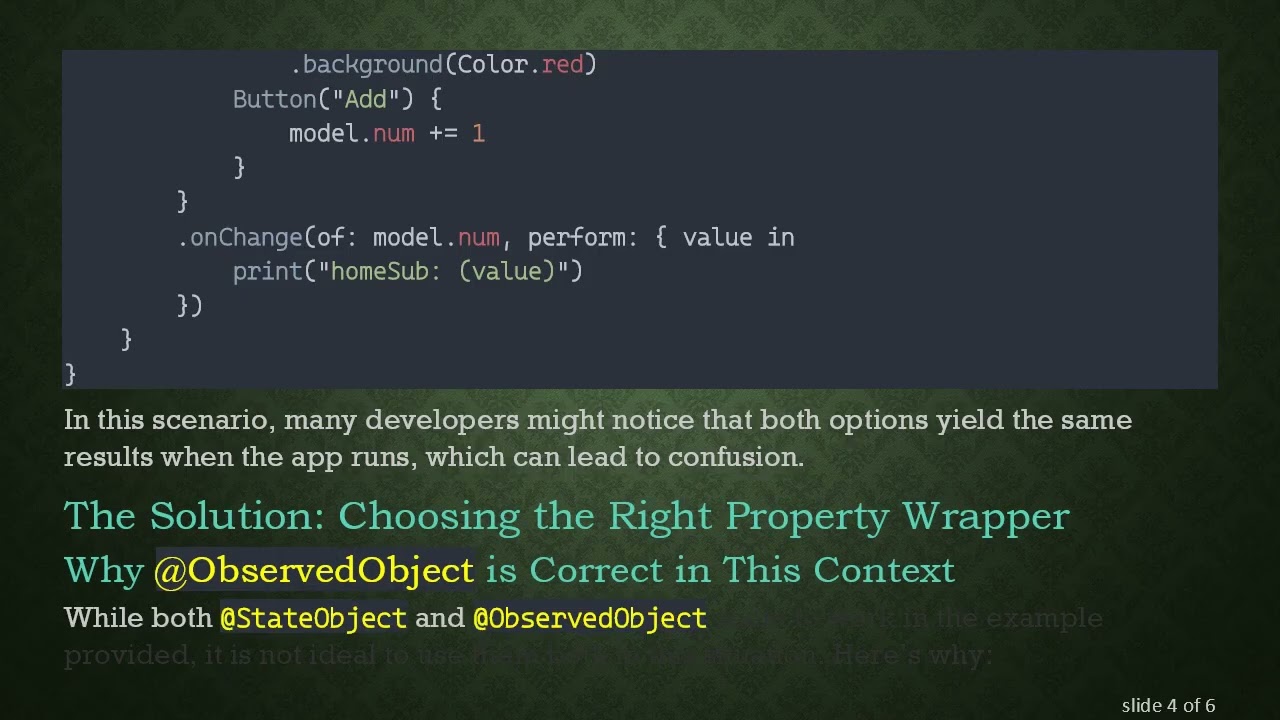
Next, you have a child view, HomeSub, with two different ways of declaring the model:
[[See Video to Reveal this Text or Code Snippet]]
In this scenario, many developers might notice that both options yield the same results when the app runs, which can lead to confusion.
The Solution: Choosing the Right Property Wrapper
Why @ ObservedObject is Correct in This Context
While both @ StateObject and @ ObservedObject seem to work in the example provided, it is not ideal to use them both in this situation. Here’s why:
@ ObservedObject: This wrapper is intended for cases where the instance is being passed from a different view. It does not create a new instance but observes an existing one. Therefore, it is appropriate to declare the model in the HomeSub view like this:
[[See Video to Reveal this Text or Code Snippet]]
@ StateObject: On the other hand, this is usually used when you want to create a new instance of a model within a view. Using it in the child view could be misleading and create unnecessary instances, which defeats the purpose of maintaining a single source of truth.
The Mistakes to Avoid
To reinforce this point, here are some key takeaways:
Avoid initializing the model in the child view. Instead, allow it to be passed in from the parent view. For example:
[[See Video to Reveal this Text or Code Snippet]]
It is also advisable to declare state variables, whether @ State or @ StateObject as private. This prevents external access and maintains encapsulation.
Final Thoughts
While it may be tempting to use both @ StateObject and @ ObservedObject interchangeably when working in SwiftUI, understanding their distinctions can lead to better code structure and enhanced functionality. By following these guidelines and keeping a single source of truth for your state, you can ensure your app behaves predictably and maintainably.
Ultimately, using @ ObservedObject for properties passed from parent views keeps your SwiftUI code clean, efficient, and easy to understand.
By internalizing these principles, you'll find building SwiftUI applications becomes a more satisfying experience!
Повторяем попытку...
Доступные форматы для скачивания:
Скачать видео
-
Информация по загрузке: