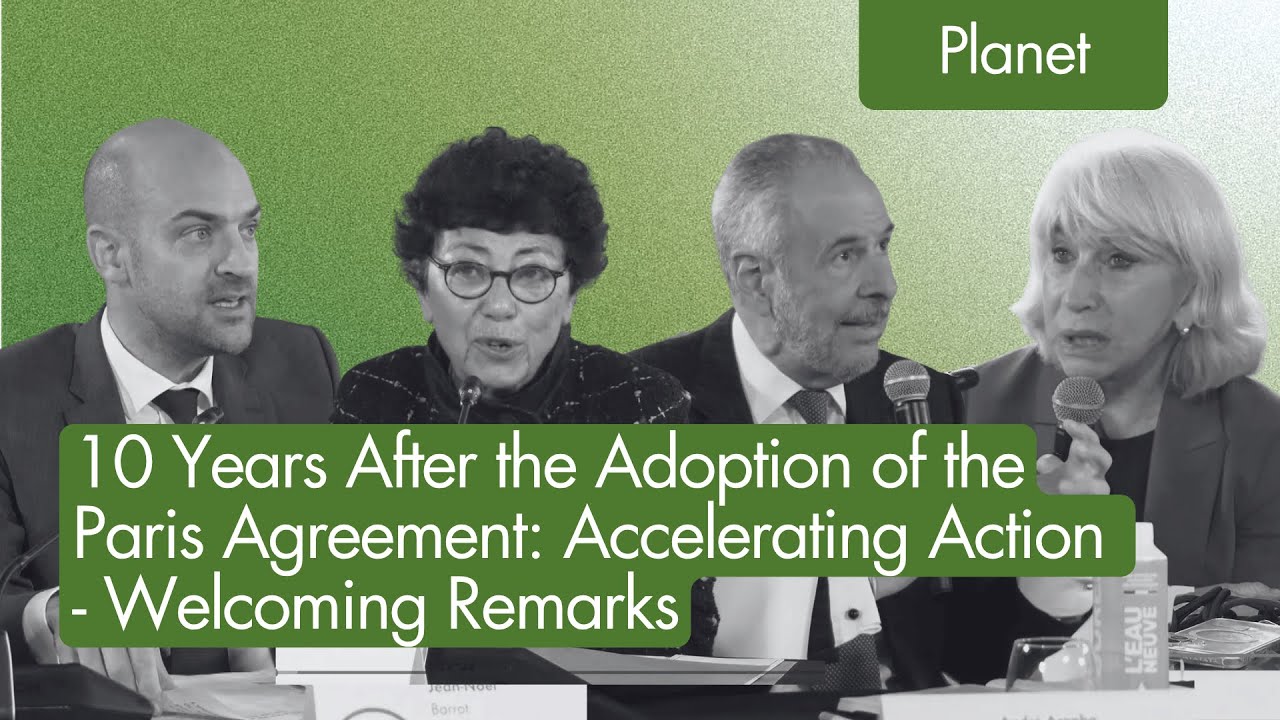
10 Years After the Adoption of the Paris Agreement: Accelerating Action - Welcoming Remarks
Автор: Paris Peace Forum
Загружено: 2025-10-29
Просмотров: 109
Описание:
A Decade After Paris: The Enduring Accord and the Imperative of Renewed Multilateralism
Held at the Paris Peace Forum, this high-level session served as a stark strategic assessment of its viability in a fractured world. While celebrating the accord as a landmark of science-based diplomacy, the discussion revealed a deep tension between the triumph of its creation and the profound challenge of its implementation amid resurgent geopolitical rivalries. The panel's core revelation was that the Paris framework, while essential, is now a vessel whose integrity depends entirely on reviving the very multilateral spirit that is currently under siege.
The Paris Agreement was consistently framed not merely as an environmental treaty but as a paramount achievement of international cooperation. French Minister for Europe and Foreign Affairs Jean-Noël Barrot lauded it as a "diplomatic prowess" that demonstrated "humanity was capable of finding an agreement" by setting aside differences for a common good. This success was attributed to a novel architecture built on three pillars: universality, solidarity, and a dynamic mechanism for ratcheting up ambition. Laurence Tubiana, a key architect of the accord, highlighted its innovative design, which combined a top-down global goal with bottom-up national contributions (NDCs), a structure that managed to reconcile national sovereignty with collective responsibility. The agreement’s genius, it was argued, lay in creating a durable yet flexible process, proving that multilateralism could deliver concrete outcomes on existential challenges.
However, this celebratory tone was systematically tempered by an urgent call to confront the current implementation deficit. The speakers made it clear that the geopolitical context has deteriorated significantly since 2015. Minister Barrot acknowledged that "international cooperation is challenged," even as global crises like climate change, pandemics, and food insecurity make interdependence "so blatant." The discussion pivoted from the past success of diplomacy to the present failure of collective action to meet the required pace and scale. The consensus was that while the Paris framework itself remains sound, the political will to use it effectively has faltered. The challenge is no longer one of design but of delivery, a task complicated by a global environment where cooperation is increasingly seen as a cost rather than an investment.
Central to bridging this implementation gap is the principle of a "just transition," a theme that underscores the unresolved tension between the Global North and South. Minister Barrot insisted that no country should have to "choose between fighting against poverty and protecting our planet." This sentiment was echoed by Monique Barbut, Minister for Ecological Transition, who emphasized the need for tangible "partnerships for a fair energy transition," citing initiatives in South Africa and Indonesia as models. The analysis here is clear: climate action cannot be decoupled from development and equity. Without robust financial and technological support for the most vulnerable nations—a core tenet of the Paris "solidarity" pillar—the entire accord risks collapsing under the weight of perceived unfairness, thereby undermining the universal commitment that is its bedrock.
Looking ahead, the upcoming COP30 in Belém, Brazil, was positioned as a critical juncture to translate rhetoric into reality. Ambassador André Aranha Corrêa do Lago, the incoming COP30 President, articulated a vision for a summit focused squarely on execution, labeling it a "COP of implementation." His remarks signaled a decisive shift away from negotiation toward action, with priorities centered on adaptation, nature-based solutions, and mobilizing finance. Laurence Tubiana reinforced this, arguing that the agenda for other actors—cities, businesses, and finance—must be fully integrated into the official process. The strategic intent for Belém is to make the "Agenda for Solutions," a pillar of the original Paris Agreement, the main event, thereby transforming the COP from a forum for pledges into a workshop for tangible progress.
The strategic implication of this discourse is that the next decade of climate action will be a proxy battle for the future of multilateralism itself. The Paris Agreement provided the world with a sophisticated tool, but its effectiveness is being eroded by geopolitical friction and a lack of political courage. Defending the accord now means defending the cooperative international order, proving that nations can still unite to address shared threats even in an era of intense competition.
Follow us on social media
• 𝗧𝘄𝗶𝘁𝘁𝗲𝗿 - / parispeaceforum
• 𝗟𝗶𝗻𝗸𝗲𝗱𝗜𝗻 - / parispeaceforum
• 𝗙𝗮𝗰𝗲𝗯𝗼𝗼𝗸 - / parispeaceforum
• 𝗜𝗻𝘀𝘁𝗮𝗴𝗿𝗮𝗺 - / parispeaceforum
• 𝗧𝗶𝗸𝗧𝗼𝗸 - / parispeaceforum_
Повторяем попытку...
Доступные форматы для скачивания:
Скачать видео
-
Информация по загрузке: