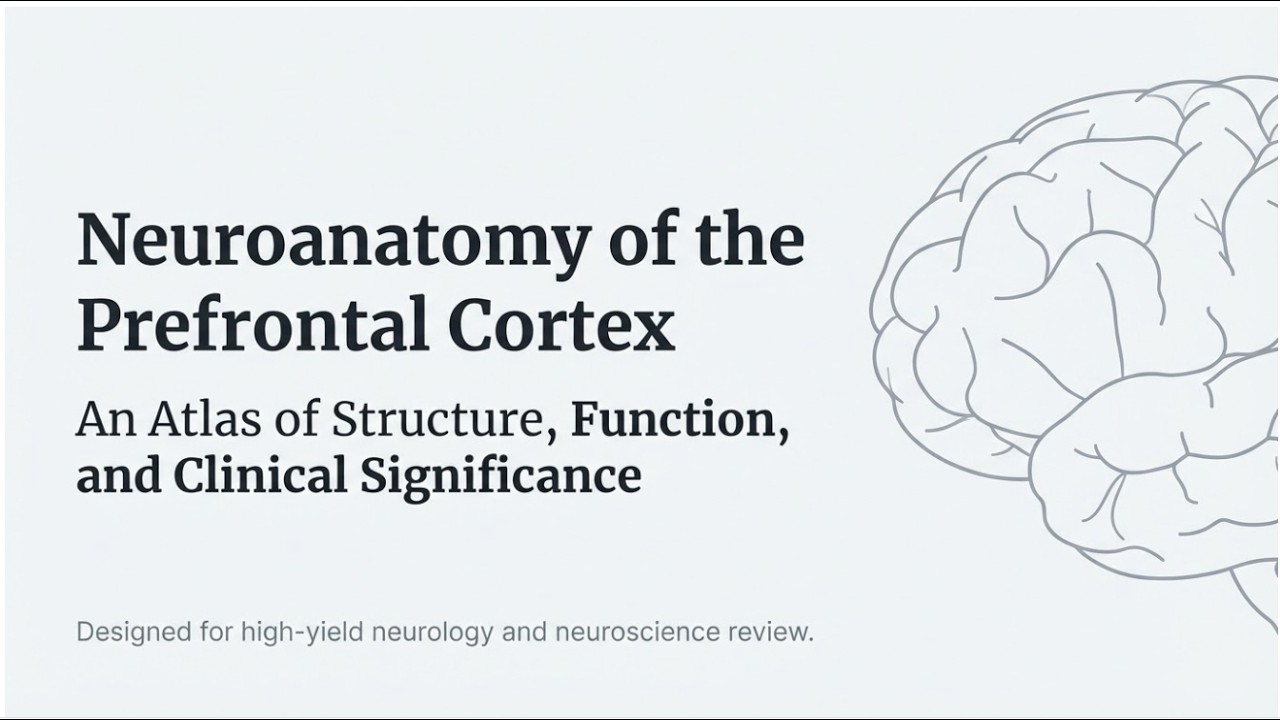
Psychedelic Neuroanatomy: Prefrontal Cortex (Hathaway & Newton, 2023 in StatPearls; 6 min)*
Автор: NourishED Research Foundation
Загружено: 2026-03-09
Просмотров: 9
Описание:
I. Introduction to the Prefrontal Cortex
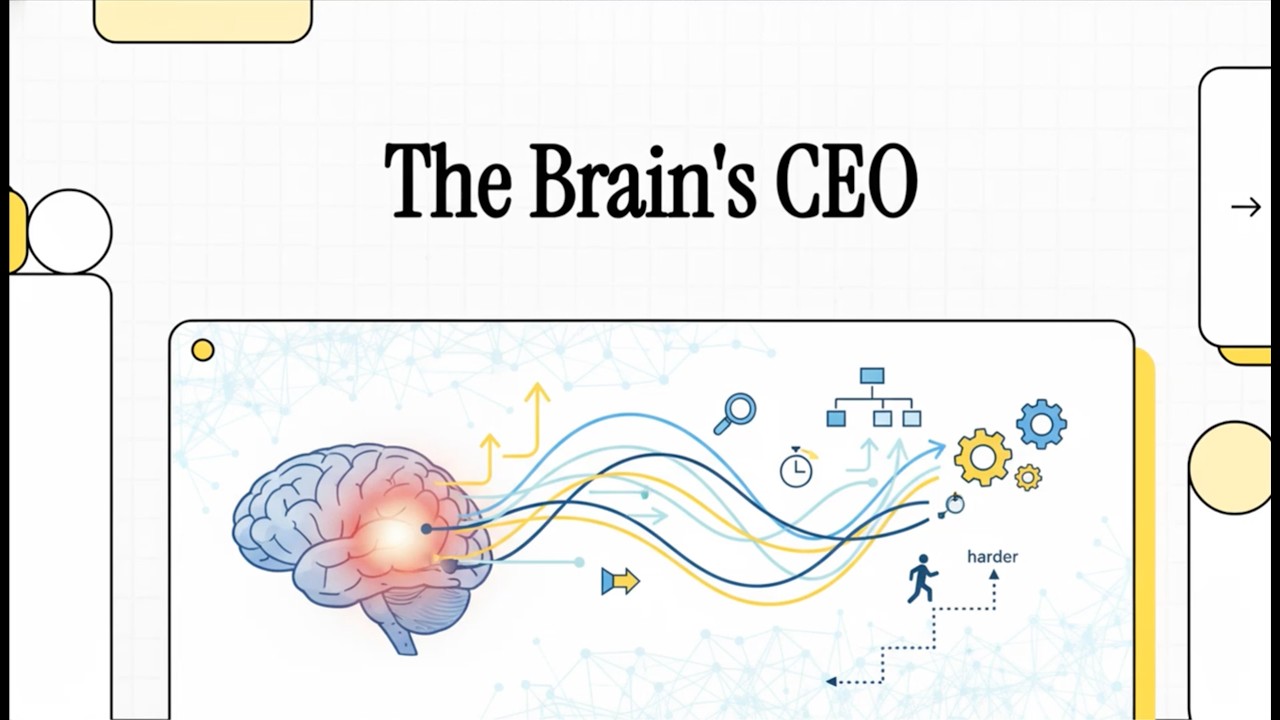
The prefrontal cortex is known as the personality center of the brain.
It is the cortical region that makes us uniquely human.
It processes moment-to-moment input from our surroundings.
It allows us to manifest insight, foresight, and planning capabilities.
II. The Case of Phineas Gage
Our understanding of the prefrontal cortex began with Phineas Gage.
An iron tamping rod pierced his orbitofrontal lobe in a rare accident.
He changed from a loving husband to a short-tempered, impulsive man.
This highlighted the area's role in personality and behavioral control.
III. Structure and Executive Function
The prefrontal cortex processes high-order executive functions.
The dorsolateral area is associated with planning and strategy.
The orbitofrontal region inhibits primal survival responses.
The ventromedial area plays a role in regulating our emotional state.
IV. Embryological Development
Development of the prefrontal cortex begins around week three.
It forms from the neural plate, which develops into the neural tube.
The prosencephalon bulges and differentiates into the cerebral cortex.
It involves an initial overgrowth of neurons and synaptic connections.
Extensive pruning occurs in utero and during early childhood.
V. Blood Supply and Glymphatics
The anterior cerebral artery supplies the medial and anterior regions.
The middle cerebral artery supplies the lateral and anterior aspects.
Venous drainage occurs via superficial cerebral veins to sinuses.
The brain utilizes a glymphatic system for lymphatic drainage.
VI. Neural Connections and Fasciculi
The prefrontal cortex receives no direct peripheral nerves.
It communicates via bundles of axons called fasciculi.
These include the superior and inferior occipitofrontal fasciculi.
It forms reciprocal connections with motor cortices and other areas.
VII. Physiologic Variants and Mental Health
Physiologic variants exist in those with neuropsychiatric disorders.
Depressed patients show decreased activity in the prefrontal cortex.
This includes down-regulation of glutamate transporter genes.
Schizophrenia patients often show reduced cortical inhibition.
VIII. Clinical Significance and Lesions
Dorsolateral lesions cause a loss of working memory and recall.
Patients may lose the ability to perform delayed response tasks.
Ventromedial lesions result in poor judgment and emotional lability.
Patients may also display inappropriate affect and distractibility.
IX. Psychiatric Disorders and the PFC
Dysfunction in the prefrontal cortex is linked to many disorders.
Dysregulation of local neurotransmitters is often a primary factor.
This impacts conditions like depression, bipolar disorder, and ADHD.
It is also heavily studied in obsessive-compulsive disorder.
X. Additional Resource Support
See NourishED RFI's NotebookLM Resource Support Page.
https://notebooklm.google.com/noteboo...
https://notebooklm.google.com/noteboo...
XI. AI Generation and Review Disclaimer
This content was generated by AI (NotebookLM).
Content generation was guided & reviewed by Brenna Bray, PhD.
Dr. Bray holds a PhD in Biomedical Science & Neuroscience.
She has postdoctorate training in Eating Disorders & Integrative Health.
Her training was NIH-funded (@NIHgov @NIDANIH @NIH_NCCIH).
Dr. Bray serves as a researcher; university professor; health, nutrition, & behavior change coach; & Founder, Director, and CEO of the NourishED Research Foundation (https://nourishedrfi.org).
XII. Source
Hathaway, W. R., & Newton, B. W. (2023). Neuroanatomy, Prefrontal Cortex. In StatPearls. StatPearls Publishing.
#PrefrontalCortex #Neuroanatomy #Neuroscience #BrainAnatomy #MentalHealth #executivefunction #phineasgage @neuroanatomy115 @operationprefrontalcortex1316 @cortex.prefrontal @neuroanatomy115 @Cortexfrontal182
Повторяем попытку...
Доступные форматы для скачивания:
Скачать видео
-
Информация по загрузке:



![[MyGap] Цифровой Аутизм: Как телефон влияет на мозг](https://imager.clipsaver.ru/NE2EVZr0bDU/max.jpg)








![Пожалуй, главное заблуждение об электричестве [Veritasium]](https://imager.clipsaver.ru/6Hv2GLtnf2c/max.jpg)