The Origin and Struggle Between the Authoritarian and Democratic Personalities - Rudolf J. Siebert
Автор: Rudolf J. Siebert Audio-Visual Archive
Загружено: 2026-03-08
Просмотров: 131
Описание:
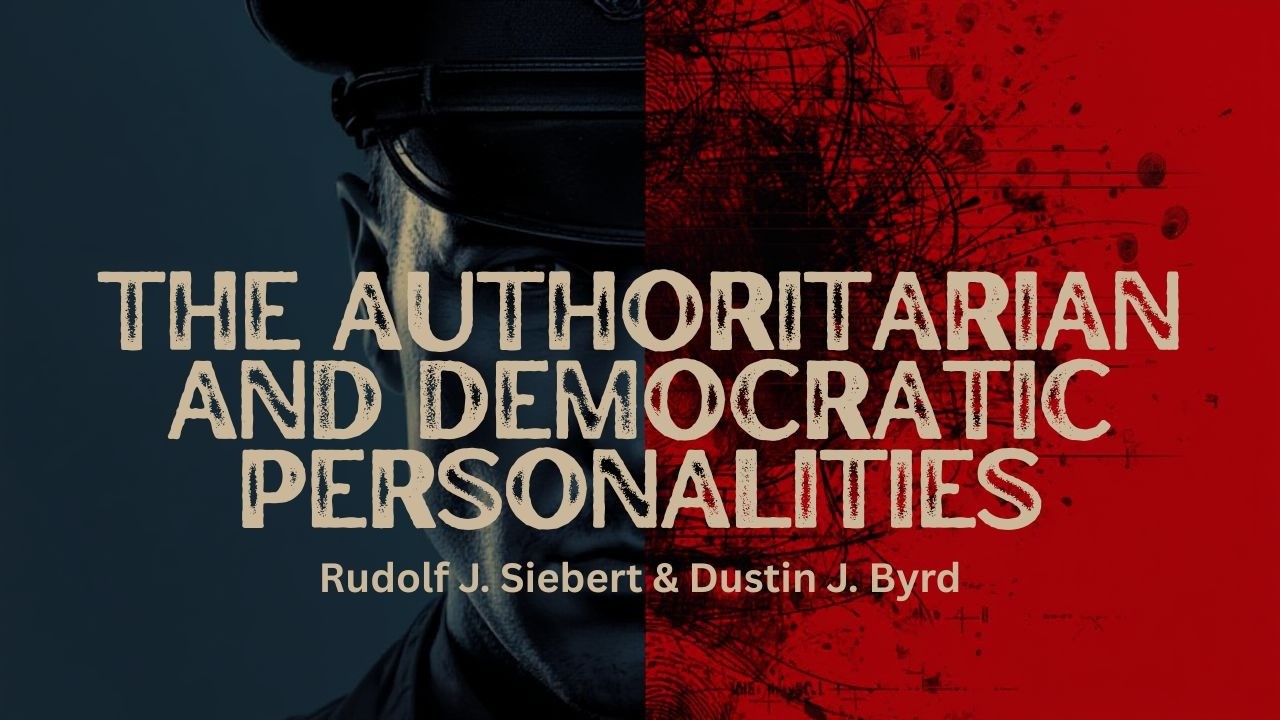
When Francis Fukuyama declared the “end of history” and the “last man” at the close of the Cold War, he did not foresee that the neoliberal hegemony of capitalism, accompanied by its weak cousin democracy, would engender a backlash in much of the world. Nor did he foresee how such a hegemonic condition would create deep-seated tensions within the West itself. The triumph of the West over the Rest, which was to bring about liberal emancipation for those ensnared into “authoritarian” ideologies and theologies, gave way to a “clash of civilizations,” at least in Samuel Huntington’s perspective – wherein the secular liberal West would struggle against resurgent religiosity and theocracy, most poignantly emanating from the Muslim world. The binaries of “us vs. them,” the “enlightened” modern vs. the “barbarian” pre-moderns, proved to be overly simplistic, as it failed to examine closely the inner-antagonisms of the West itself, especially the struggle between the authoritarian and democratic character types. These two competing personality types, rooted in both nature and Bildung, have come to the foreground of political and cultural struggles in recent years, expressing themselves within the contradictory visions for the future of West and the world. Does the West continue to open itself to the “others,” emphasizing inclusivity, multiculturalism, anti-racism, rooted in the Enlightenment’s notions of liberté, égalité, fraternité – the secularization of core religious ideals, or does it close itself off from the others, emphasizing nativistic identity, homogeneity, and the remarriage of ethnos and demos. Where the democratic personality sees freedom in openness, dynamism, and spontaneity – the global community, the authoritarian sees freedom in order, predictability, and stasis – the Volksgemeinschaft. Where the democratic personality tends to see beyond the horizon, the authoritarian cares little for what’s beyond, taking refuge in the familiar, the comfortable, an idealized past. In an age of social disintegration, wherein the norms of civilizations are not only questioned, but are vigorously undermined for the utopia beyond, one finds the growth of existential meaninglessness, social chaos, and extreme anxiety – the universal neuroticization of society.
In societies that are untethered from their traditional moorings, the authoritarian demagogue finds their followers – those who are willing to abandon the reality that causes so much existential pain and identity confusion and who adopt simplistic and binary worldviews conveniently provided to them by self-serving authoritarians. The struggle for democracy and the rise of authoritarian politics throughout the West has demonstrated that the “end of history” was wildly optimistic. The Kulturkampf continues, and as Russia’s attack on Ukraine, Israel’s attack on Lebanon, Syria, Yemen, and Iran, Trump’s attack on eight countries in one year, including Iran, as well as Israel’s ongoing genocide of Gazans, let alone the impoverishment of the global south and the precariat of the global north demonstrates, the slaughterbench of history, as Hegel called it, proceeds unimpressed with Fukuyama’s ill-fated diagnosis. Much like Marx’s claim about the ubiquity of the class struggle, it appears there will always be a struggle between the authoritarian personality and the democratic personality – but does there have to be?
Dr. Rudolf J. Siebert is Professor Emeritus of Religion and Society at Western Michigan University and member of the Institute for Critical Social Theory. He has authored over thirty books and well over a hundred articles and book chapters. Recently, he published the book, Hegel and the Critical Theory of Religion with Ekpyrosis Press. His latest article on the psychoanalyst Erich Fromm was recently published in the inaugural edition of the journal, Critical Perspectives: Journal of the Institute for Critical Social Theory. Over the course of sixty-plus years, Dr. Siebert has developed the Critical Theory of Religion and Society, or what is called “Dialectical Religiology.” For more information on Dr. Siebert, see the website dedicated to his work, dialectical-religion.org, and check out the 100+ video on the Rudolf J. Siebert Audio-Visual Archive on YouTube. And as always, don’t forget to like and subscribe to this channel.
More information on Rudolf J. Siebert:
https://www.dialectical-religion.org
More information on Dustin J. Byrd:
https://www.dustinjbyrd.org
More information on Ekpyrosis Press:
https://www.ekpyrosispress.com
More information on The Institute for Critical Social Theory:
https://www.criticalsocialtheory.com
Повторяем попытку...
Доступные форматы для скачивания:
Скачать видео
-
Информация по загрузке: