J.S. Bach: Brandenburg Concerto No. 6 in B flat major, BWV 1051 - 3. Allegro (Synthesized)
Автор: Carey R. Meltz
Загружено: 2015-02-20
Просмотров: 86989
Описание:
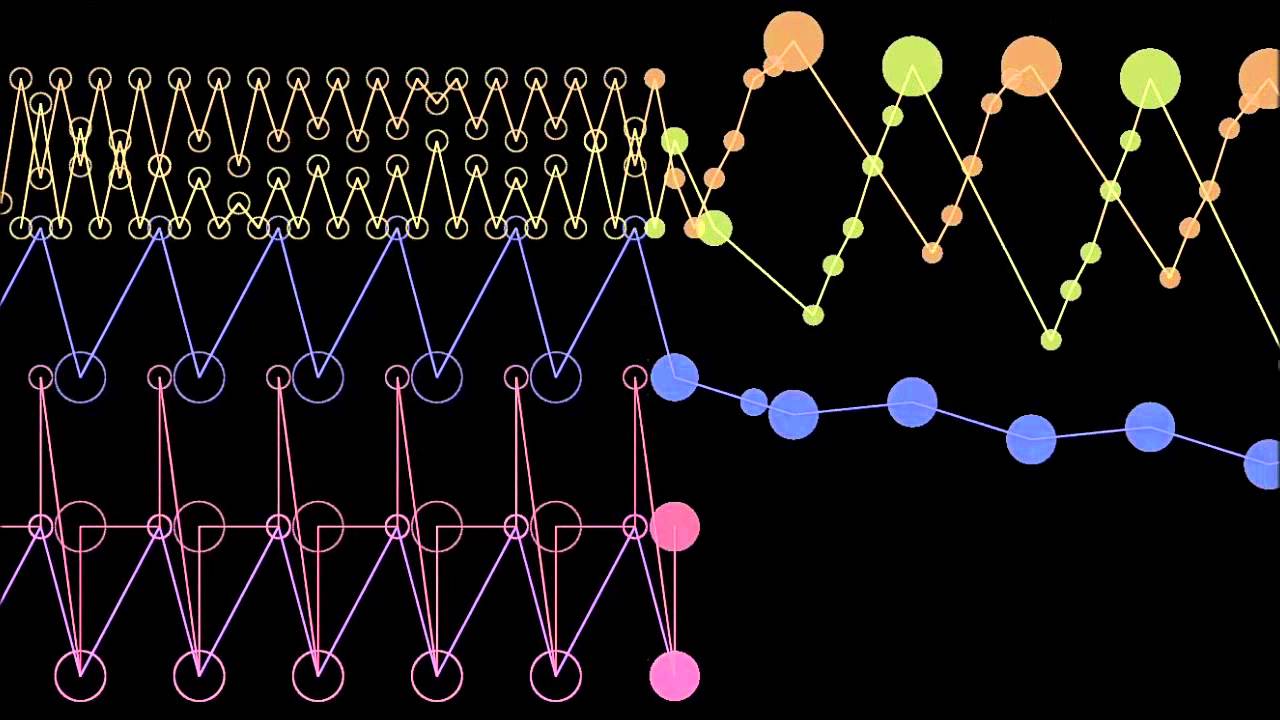
For those who enjoy the Music Animation Machine MIDI Player visualization, this version of the video is alternately presented so you are able to follow the music.
The voicing is listed as follows:
Viola da braccio I – Orange
Viola da braccio II – Yellow
Viola da gamba I – Green
Viola da gamba – Teal
Cello – Blue
Violone – Pink
Harpsichord – Mauve
Few musical works are as loved - and as often performed - as the six "Brandenburg" Concertos by Johann Sebastian Bach. These six works (BWV 1046-1051) display a lighter side of Bach's imperishable genius. Yet they came into being as an unexpected gift. That's what happened in 1721 when Bach presented the Margrave of Brandenburg with a bound manuscript containing six lively concertos for chamber orchestra, works based on an Italian Concerto Grosso style. The Margrave never thanked Bach for his work - or paid him! There's no way he could have known that this unnamed gift (later named the Brandenburg Concertos 150 years later when Bach's biographer, Philipp Spitta called them that for the very first time, and the name stuck) would become a benchmark of Baroque music and still have the power to move people almost three centuries later.
Even though he didn't call them the "Brandenburgs," originally, Bach still thought of them as a set. What he did was compile them from short instrumental sinfonias and concerto movements he had already written. Then he re-worked the old music, often re-writing and elaborating where he saw fit. In doing so, Bach created something of a dramatic arc from the brilliant first concerto to the last, which evokes a spirited chase.
Bach’s 6th Brandenburg is the least known and least performed of the six concertos - not because it is not a masterwork, but because of the instruments used in it. Bach's sonic imagination was seemingly boundless, and for this final concerto he chose to limit the work's scoring to strings and continuo, meaning that the only non-bowed instrument heard is the harpsichord. Every other concerto in the set made extensive use of contrasting timbres, balancing the strings with the winds, often in unprecedented ways. This limitation of timbre is also extended to register; there are no violins, just two “normal” violas (violas da braccio), two violas da gamba, a cello, and the violone, which is near the cello range and is from the gamba family.
When the work was written in 1721, the viola da gamba was regarded as a Chamber instrument and thusly received more difficult lines. The strong supposition that one viola da gamba part was taken by Bach’s employer, Prince Leopold (which points to a likely reason for the concerto's composition), as Leopold wished to join his Kapellmeister playing music. Other theories suggest that, since the viola da braccio (considered an Orchestral instrument, and usually given comparatively easy “supporting roles”) and typically played by a lower socioeconomic class (e.g., servants), the work sought to upend the musical status quo by reversing the level of difficulty, giving an important role to a "lesser" instrument. This is supported by knowledge that Bach wished to end his tenure under Prince Leopold. By upsetting the balance of the musical roles, he would be released from his servitude as Kapellmeister and allowed to seek employment elsewhere.
The final Allegro movement of the concerto assumes the character of a fugal gigue, but reveals itself to be a set of variations based on the initial ritornello, which is a much freer demonstration than the traditional spinning-out of the initial material. Initially the two violas play together in a lively dancing rhythm. Then the writing becomes faster, with the two violas chasing each other, giving and taking fragments of scales and parts of the initial theme, soon joined by the cello taking the same musical ideas in this quite virtuosic run. Then, after the repetition of the initial phrase, there is a new virtuosic episode between the two violas accompanied only by cello and bass (no gambas) followed by the cello showing off again its fast passage played earlier while the violas have a more melodic, sweet dialogue. Eventually the whole orchestra plays a ritornello, a complete repetition of the first 45 bars, thus completing the A-B-A structure of this beautifully joyful movement.
Overall, this last concerto is in many ways, the most various and striking among the six and is the perfect conclusion to a set of concertos that have justly become Bach's most popular compositions - thanks to the variety of musical imagination shown by his scoring and musical ideas as well.
This piece is scored with basic timbres reminiscent of Wendy Carlos’ style as found in her “Switched-On Brandenburgs” of 1979.
AS ALWAYS, THE USE OF HEADPHONES WILL GREATLY ENHANCE THE LISTENING EXPERIENCE.
Повторяем попытку...
Доступные форматы для скачивания:
Скачать видео
-
Информация по загрузке:

![J.S. Bach: Brandenburg Concerto No. 5 in D major, BWV 1050 - 1. Allegro [2022 Revisit] (Synthesized)](https://imager.clipsaver.ru/8JqI3m14PhU/max.jpg)