Structured Word Inquiry (SWI) and grapheme-phoneme correspondences
Автор: WordWorksKingston
Загружено: 2019-12-04
Просмотров: 6222
Описание:
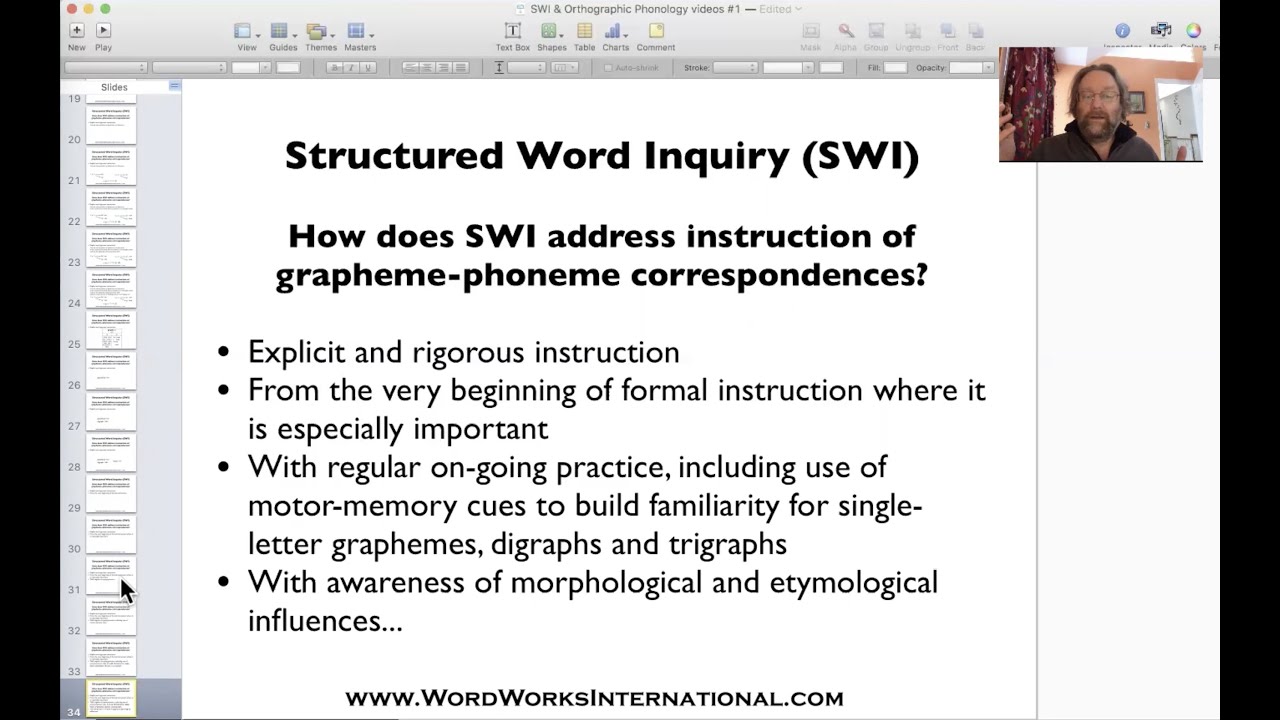
In this video I attempt to clarify a common misunderstanding about SWI and the teaching of grapheme-phoneme correspondences. I try to make it clear that there is NO underemphasis on explicit instruction of this crucial aspect of English orthography and the process of literacy instruction especially for younger and struggling readers. In fact the frame SWI brings is that grapheme-phoneme correspondences are so important, that instruction must teach how they work as explicitly and accurately as possible right from the beginning. This means not only do we need to teach what the potential grapheme-phoneme correspondences are, but also how they operate in the orthography system. Thus the phrase that best describes how we teach about grapheme-phoneme correspondences in SWI is "orthographic phonology". How phonology is represented in English orthography. This means instruction must be guided by teacher understanding of the influences of morphology and phonology.
This introductory video tries to give an overview of basic early instruction where grapheme-phoneme correspondences are a focus in the earliest formal literacy lessons. I plan to make more but for now I'm including links to other illustrations of orthographic phonology instruction and resources that can help teachers better understand this aspect of SWI:
1) Video of introducing word sums to kindergarten students including the grapheme-phoneme correspondence of the "S" in the words "chicks" and "eggs"
short 2.5 min vid: • Kinder intro of matrix & Word Sum for IDA
full 15 min vid: • Kinder intro of matrix & Word Sum
2) Resources on the process of "spelling-out-loud" and "writing-out-loud" word structure including announcing graphemes and orthographic markers in the base.
http://www.wordworkskingston.com/Word...
3) A video from 2011 in Skot Caldwell's public school classroom where he takes students through a lesson integrating morphology and phonology with a whole wall of grapheme-phoneme correspondences they are exploring scientifically.
• Investigating graphemes in Grade 1
4) A grade 2 teacher at Nueva walks us through structures in his classroom for investigating words including a chart on grapheme-phoneme correspondences they are studying including their positional constraints.
• SWI @ The Nueva School: A Grade 2 classroom
5) The LEX grapheme deck: I recommend Gina Cooke's grapheme deck at every workshop I ever give. The process of "spelling-out-loud" and "writing-out-loud" is one that forces teachers to discover when they themselves are not sure of what the graphemes are in a word that they are attempting to teach. Central to on-going learning is a process that keeps identifying what the learner does not yet know! But that process requires a reliable reference to draw on. I know of no other reference for grapheme-phoneme correspondences that is rigorously accurate linguistically, and which provides so much detail on morphological and etymological influences. I cannot recommend this resource enough. Which is why I point to it at every workshop I ever give.
https://linguisteducatorexchange.com/...
There are countless other places to point to where SWI emphasizes grapheme-phoneme correspondences, but this is a start. More to come.
email me at [email protected] if you have questions.
Повторяем попытку...
Доступные форматы для скачивания:
Скачать видео
-
Информация по загрузке: