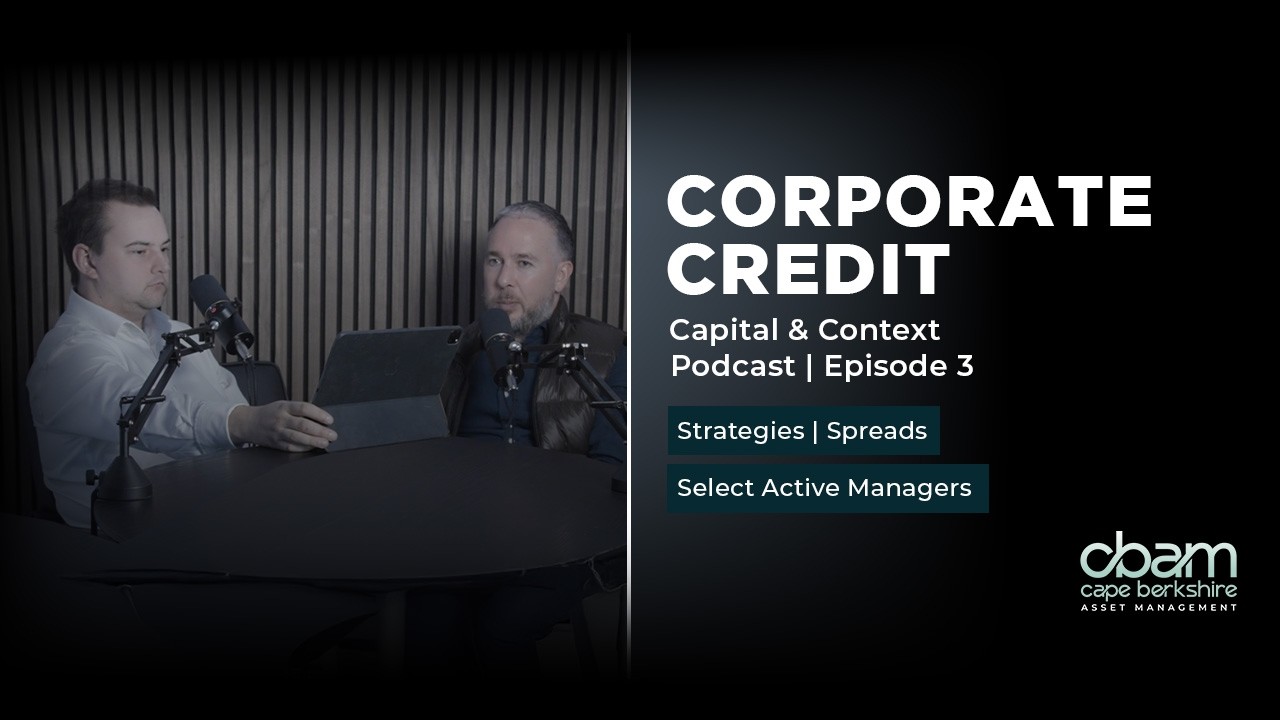
Capital and Context Podcast Ep.3: Corporate Credit: Strategies, Spreads, and Select Active Managers
Автор: Cape Berkshire Asset Management
Загружено: 2026-02-18
Просмотров: 6
Описание:
Episode 3 | Mark Insley & Sam Hallett
In this episode, Mark Insley sits down with Sam Hallett to peel back the layers of one of the most critical, yet frequently misunderstood, sectors of the global financial landscape: Corporate Credit. As we navigate the complex market conditions of 2026, Mark and Sam discuss why a "set it and forget it" approach to bonds no longer works. They explore the shift from government-backed debt to corporate instruments, the mechanics of credit spreads, and why active management is the only way to navigate a world where Western debt-to-GDP levels are soaring while emerging markets show surprising resilience.
Understanding the Basics: What is Corporate Credit?
Mark and Sam begin by defining the asset class. Unlike sovereign debt (issued by governments) or supranationals, corporate credit consists of debt instruments issued by private entities like BP, Shell, and Apple.
Key Concepts Explored:
Fixed vs. Limitless Returns: While equities offer theoretically infinite upside, the return on debt is legally defined by a contract.
Yields and Price Movements: The duo explains the inverse relationship between interest rates and bond prices. When rates rise, the value of existing bonds typically falls to align with new, higher-yielding issues.
Deconstructing the Yield: Every credit yield is a "blend" of the risk-free rate (linked to government gilts) plus the Credit Spread—the extra compensation investors demand for taking on the risk of a specific company.
The Case for Active Management in 2026
A major theme of this discussion is why passive indexing is currently a dangerous game in the credit space. Sam highlights several specific funds and managers who are finding "alpha" in areas that the broader market ignores.
1. Man Sterling Corporate Bond (Manager: Jonathan Golden)
Currently the largest holding in their lower-risk portfolios, Sam explains the "size advantage" here. Because the fund is nimble, Jonathan Golden can target smaller issuers ($30M–$50M in debt) that massive institutional funds are too large to touch. In 2024, this fund outperformed its benchmark by over 10%, largely due to pinpointing undervalued gems like specific Triple-B rated Romanian bank bonds.
2. Man Credit Alternative Opportunities (Manager: Mike Scott)
Mark and Sam discuss the transition away from traditional high-yield funds. With credit spreads at historic lows, the "easy money" has been made. They now favour Mike Scott’s Long-Short strategy, which allows the portfolio to benefit from "shorting" overvalued companies while staying "long" on high-quality debt, effectively smoothing out the volatility of the credit cycle.
3. Emerging Market Debt (EMD) & The Macro Tailwinds
Sam provides a compelling thesis for EMD in 2026. Many emerging economies are now run more prudently than their Western counterparts.
The "Weak Dollar" Play: As the US Dollar fluctuates, emerging markets in LATAM and Asia often see massive inflows.
Top Picks: The discussion covers the Vontobel Emerging Market Blend and PIMCO GIS Emerging Market funds as primary vehicles for this exposure.
The Macro Backdrop: A Tale of Two Worlds
The credit market is currently bifurcated:
Emerging Markets: These offer attractive spreads and disciplined fiscal management.
Developed Markets: Spreads in the West are incredibly "tight," meaning there is very little margin for error. With high debt levels in the US and Europe, holding long-term Western corporate debt requires extreme caution.
Key Takeaways for Financial Advisors
Mark and Sam conclude with actionable advice for those managing client capital:
Don't Mistake Yield for Safety: High yields aren't always "cheap" if the underlying credit risk (the spread) is expanding.
Duration Risk: Be wary of the "long end" of the curve (10-15+ years). Fiscal instability in the US could send yields higher, causing significant price drops in long-dated bonds.
Avoid the "Bad Apples": In a passive credit index, you are forced to own the debt of failing companies. Active managers provide the filter needed to avoid defaults.
Featured Holdings Mentioned:
Man Sterling Corporate Bond (Core UK Holding)
Man Credit Alternative Opportunities Fund (Long-Short Strategy)
Vontobel Emerging Market Blend Fund
PIMCO GIS Emerging Markets Bonds
Connect With the Show
Visit our Website: https://www.capeberkshire.co.uk/
#CorporateCredit #MarkInsley #SamHallett #Investing2026 #BondMarket #FinancialAdvisors #ActiveManagement #EmergingMarkets #ManGroup #PIMCO #CapeBerkshire
Повторяем попытку...
Доступные форматы для скачивания:
Скачать видео
-
Информация по загрузке: