The Hidden Architecture of Trauma BONDs!! Control, Chaos, and Self-Betrayal | Lacan + VG Creativity
Автор: Visceral Gravitas
Загружено: 2026-02-02
Просмотров: 87
Описание:
The Hidden Architecture Behind Hypocrisy: Control vs Chaos | Lacan Psychoanalysis + VG Creativity
Visceral Gravitas Community discussion forum https://www.visceralgravitas.com
Local Washington DC area In person & online Zoom meetings https://www.meetup.com/HealingNPDabuse
selected transcript:
There's a very specific psychological mechanism at play here
The root of this entire structure.
It's not really about the relationship itself.
It's about a conflict that's happening inside an individual
before they even get into that relationship.
And it all comes down to a concept called self- betrayal.
So what is self- betrayal?
Well, at its heart, it's a deep internal division.
Imagine, say, a manager who's always preaching
about work life balance to their team, right?
But then privately, they're working themselves
to the point of exhaustion and
secretly resenting anyone who takes time off.
See, they've created this split
between the values they say they hold
and how they actually live.
You know, a simpler way to think about this
is just a state of personal hypocrisy.
And look, it's one thing to have ideals
that you struggle to live up to.
That's just being human.
This is different.
This is about actively taking the moral high ground
while at the same time betraying those very morals
behind the scenes.
So, what fuels this kind of hypocrisy?
It isn't just a simple mistake or a moment of weakness.
It's actually driven by something psychologists call jouissance.
It's a French term, and it basically means
a kind of twisted enjoyment.
It's that secret little thrill a person gets
from breaking the very rules they demand everyone else follow.
Okay, so you've got this person with this major internal split.
How do they manage all that tension?
Well, there are two main strategies.
Let's start with the first one,
which we'll call the controller,
or what's known as the perverse structure.
This one is the more organized, focused,
and on the surface righteous of the two.
The controller manages their own internal hypocrisy
by basically projecting it outward.
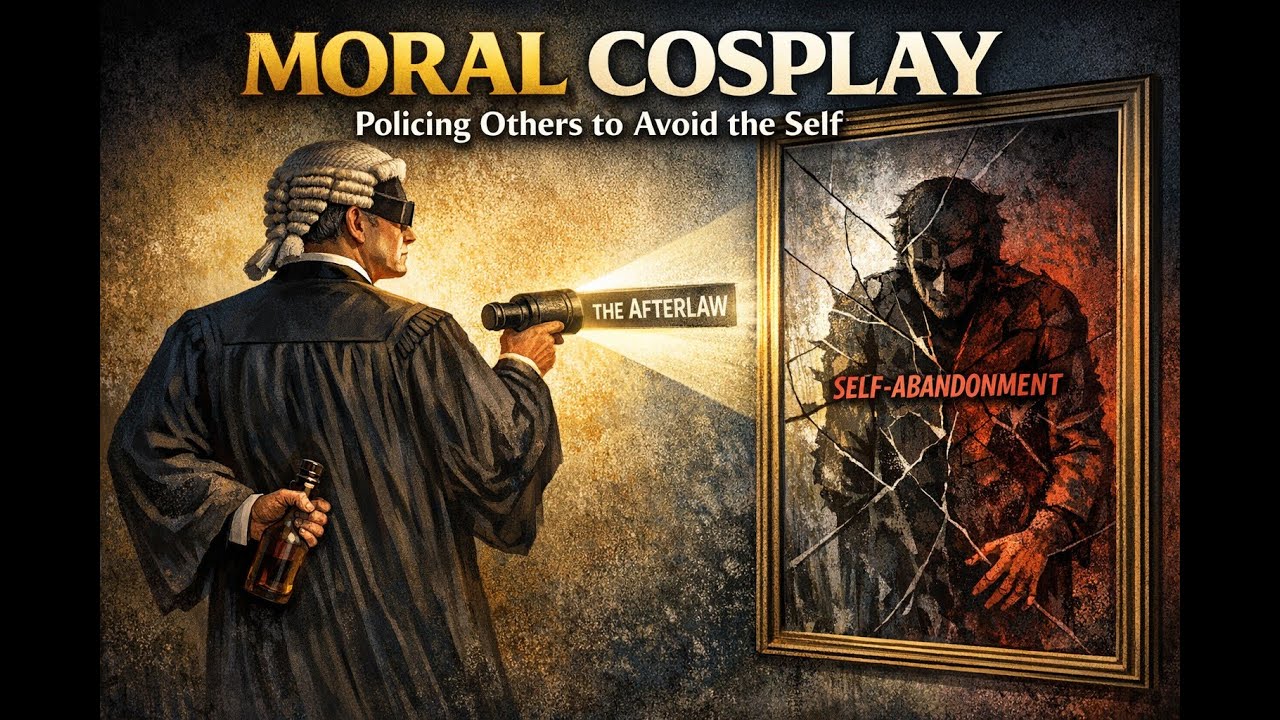
They get into what you could call moral cosplay.
You know, playing the role of the righteous judge
or the noble rescuer.
They become completely obsessed
with fixing or parenting one specific person,
making that person's morality their big personal project.
And of course, this lets them completely
ignore their own issues.
So, how do they do this?
Well, since they can't maintain their own inner law,
they create something called an afterlaw.
This is just a set of rules they impose
on a single external target.
They're essentially outsourcing
their own self-discipline onto someone else. Yeah.
They basically become a moral vigilante.
This hyperfocus on someone else's flaws,
on policing every little thing they do,
it creates a super powerful distraction.
It's like a full-time job that conveniently keeps them from ever,
ever having to look in the mirror.
So, are they even aware of what they're doing?
Well, just barely.
Their main defense mechanism is something
called disavowal.
For just a second, a faint flicker of their own
self- betrayal might pop into their head,
but it's so uncomfortable that they instantly snuff it out
by projecting this intense contempt onto their target.
Suddenly, the target's flaws become
the only problem in the room.
Now the second strategy for managing the self-betrayal is completely different.
If the controller uses focus policing,
this structure, well, it uses indiscriminate chaos.
It's known as the psychotic structure.
This structure manages its internal split
not by policing other people, but by
completely disowning its own internal world.
Inside, they are often deeply terrified and confused.
And when that terror becomes too much to handle,
their defenses fail in what's called a containment break,
and they just flood all of that internal chaos
onto whoever happens to be nearby.
It's not targeted. It's a desperate discharge.
During one of these breaks,
it's like a hostile takeover happens.
The person's own harsh inner critic
suddenly becomes an outer critic.
It's like they become temporarily possessed
by their own internalized abuser
and they turn all of that venom on the outside world.
So when they engage with others during these moments,
it's not about connection at all.
As this quote puts it so perfectly, they are socializing a trigger.
They're basically using social interaction
as a stage to act out all their unresolved internal conflicts
and to just discharge all that stored up terror.
Повторяем попытку...
Доступные форматы для скачивания:
Скачать видео
-
Информация по загрузке:

![GOSPODARKA WOJENNA ROSJI - CZY PUTIN JUŻ PRODUKUJE CZOŁGI ZAMIAST LODÓWEK [BOJKE]](https://image.4k-video.ru/id-video/g2t5npoRfBA)

![Massive Attack • Portishead • Morcheeba • Chet Faker - Special Coffeeshop Selection [Seven Beats]](https://image.4k-video.ru/id-video/3Vz-oMrXkRs)