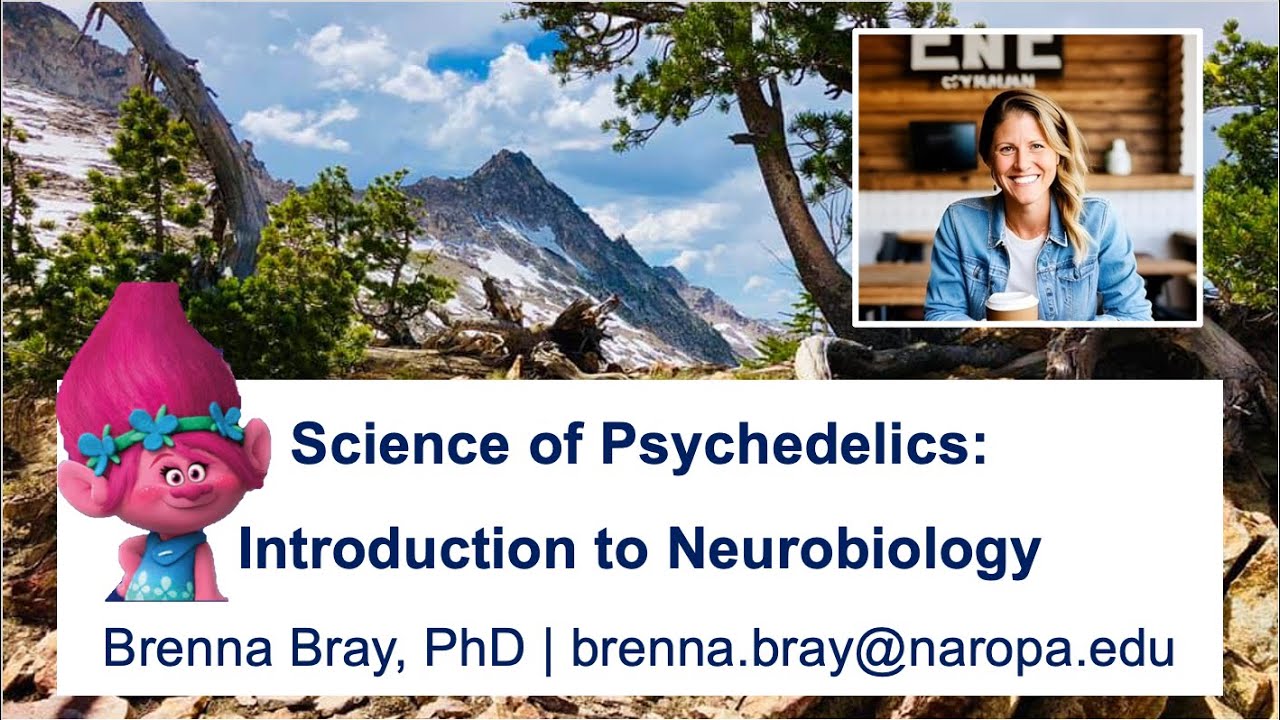
Psychedelic Neuroanatomy I: Introduction to Neurobiology (Brenna Bray, PhD, 2025)
Автор: NourishED Research Foundation
Загружено: 2025-08-26
Просмотров: 126
Описание:
I. Introduction to Psychedelic Science
This video introduces the basic science of psychedelics.
It uses a PowerPoint created by Brenna Bray, PhD.
The presentation is titled Storytelling in Science.
We explore basic neuroanatomy and neurophysiology.
II. The Brain's Natural Landscape
The brain is the natural landscape for psychedelic actions.
Neuroanatomy focuses on the key brain regions involved.
Neurotransmitters act as the main characters in the brain.
The movie Trolls is used as a storytelling analogy.
III. Conflict and the Stress Response
Conflict is introduced through exposure to external stress.
The amygdala stores memories of threatening stimuli.
When activated, the amygdala rings alarm bells in the brain.
This kicks off the body's natural autonomic stress response.
IV. The HPA Axis and Cortisol
The HPA axis regulates neuroendocrine stress responses.
The amygdala signals the hypothalamus during a threat.
The pituitary gland then secretes its own stress hormones.
These stimulate the adrenal glands to release cortisol.
Cortisol crosses the blood-brain barrier to act in the brain.
V. The Hippocampus and Resilience
The hippocampus is highly sensitive to stress hormones.
It is involved in learning, memory, and emotional responses.
It evokes negative feedback onto the entire HPA axis system.
It acts like a thermostat to turn the stress response off.
VI. When Balance Is Lost
Stress operates on an inverted U-shaped performance curve.
Optimal stress levels can actually help peak performance.
Chronic stress impairs our ability to bounce back and adapt.
This leads to exhaustion and nervous system dysregulation.
VII. The Rescue Mission and Neurogenesis
Healing often involves neurogenesis and neuroplasticity.
Neurogenesis is the birth of new cells in the brain.
This occurs in the cortex, hippocampus, and amygdala.
A new cell reaching maturity takes about one to two months.
VIII. Neurogenic Therapies
Psychedelics can stimulate neurogenesis in the brain.
Many other therapies also support this neural growth.
These include exercise, enriched environments, and learning.
Mindfulness, nutrition, play, and social interaction help.
IX. Healing Integration
Mature brain cells must integrate into new neural networks.
Psychedelic science emphasizes therapeutic integration.
This plastic period is crucial for lasting behavioral change.
Healing interventions activate our innate healing capacity.
X. Additional Resource Support
See NourishED RFI's NotebookLM Resource Support Page.
https://notebooklm.google.com/noteboo...
XI. About the Presenter: Brenna Bray, PhD
Dr. Bray is a Scientific Researcher, Professor, & creator of this source content.
She holds a PhD in Biomedical Science & Neuroscience.
She received postdoctorate training in Integrative Health & Eating Disorders.
Her training was NIH-funded (@NIHgov @NIDANIH @NIH_NCCIH).
She serves as a researcher; university professor; health, nutrition, & behavior change coach; & Founder, Director, and CEO of the NourishED Research Foundation (https://nourishedrfi.org).
She also teaches a Science of Psychedelic Course at @naropauniversity, which she designed, and which this video micro-lecture is a part of.
XII. Source
Bray, B. (2025). Introduction to Neurobiology of Psychedelics: Storytelling in Science [Video]. NourishED Research Foundation.
#psychedelicscience #psychedelicresearch #psychedelictherapy #stressresponse #neuroplasticity #neurogenesis #neuroanatomy #cortisol #5ht2a #bdnf @ThePsychedelicScientist @PsilocybinAssistedTherapyAssoc @PsychedelicsToday @naropaallianceforpsychedel7015 @neuroanatomy115 @psychedelicsupport
Повторяем попытку...
Доступные форматы для скачивания:
Скачать видео
-
Информация по загрузке: