The Technical Erosion Inflation & Purchasing Power
Автор: Build Your Future: Investing Basics
Загружено: 2025-12-03
Просмотров: 0
Описание:
Technical Erosion: Inflation and Purchasing Power
"Welcome to the first installment of our Economics Series. Today, we are examining 'The Technical Erosion: Inflation and Purchasing Power.' We’re going to move beyond the headlines to understand the specific mechanics of currency devaluation and exactly how inflation mathematically undermines the value of your money."
Core Definitions
"To begin, we need to rigorously define our two primary variables. First, we have Purchasing Power. Think of this not as the dollar amount in your wallet, but as the tangible 'work' that money can do—the actual quantity of goods it can acquire. Second, we have Inflation. This isn't just a price hike here or there; it is a sustained, broad-based rise in the general price level that systematically degrades that purchasing power."
The Inverse Relationship
"Visually, we can understand this as a strict inverse relationship. It is mathematically impossible for the general price level to rise without the purchasing power of a fixed currency unit falling. As you can see on the graph, as the cost of a standard basket of goods climbs, the value of the currency used to buy it must effectively travel in the opposite direction. Higher prices equal lower value."
Measuring the Price Level
"So, how do we quantify this 'price level'? Economists rely on the Consumer Price Index, or CPI. This is essentially a massive statistical basket containing the weighted costs of food, housing, transportation, and medical care. The Bureau of Labor Statistics tracks the aggregate cost of this basket to calculate the official inflation rate."
The Mathematical Link
"Let’s look at the math behind the erosion. Purchasing power is proportional to the reciprocal of the price index. As shown in the formula here, if $P$ represents the price index, purchasing power is one over $P$. Practically speaking, if the price index moves from 100 to 110—a 10% increase—your currency's value drops to roughly 0.909. You have mathematically lost nearly 10% of your real wealth."
Compounding Erosion Over Time
"The danger of inflation lies in its compounding nature. As this area chart demonstrates, inflation is not linear. Even a 'stable' inflation rate of 3% creates an exponential curve in prices over time. A basket costing $100 today doesn't just cost $3 more every year; the cost grows on top of the previous year's increase, accelerating the loss of value over a five or ten-year horizon."
Demand-Pull Inflation
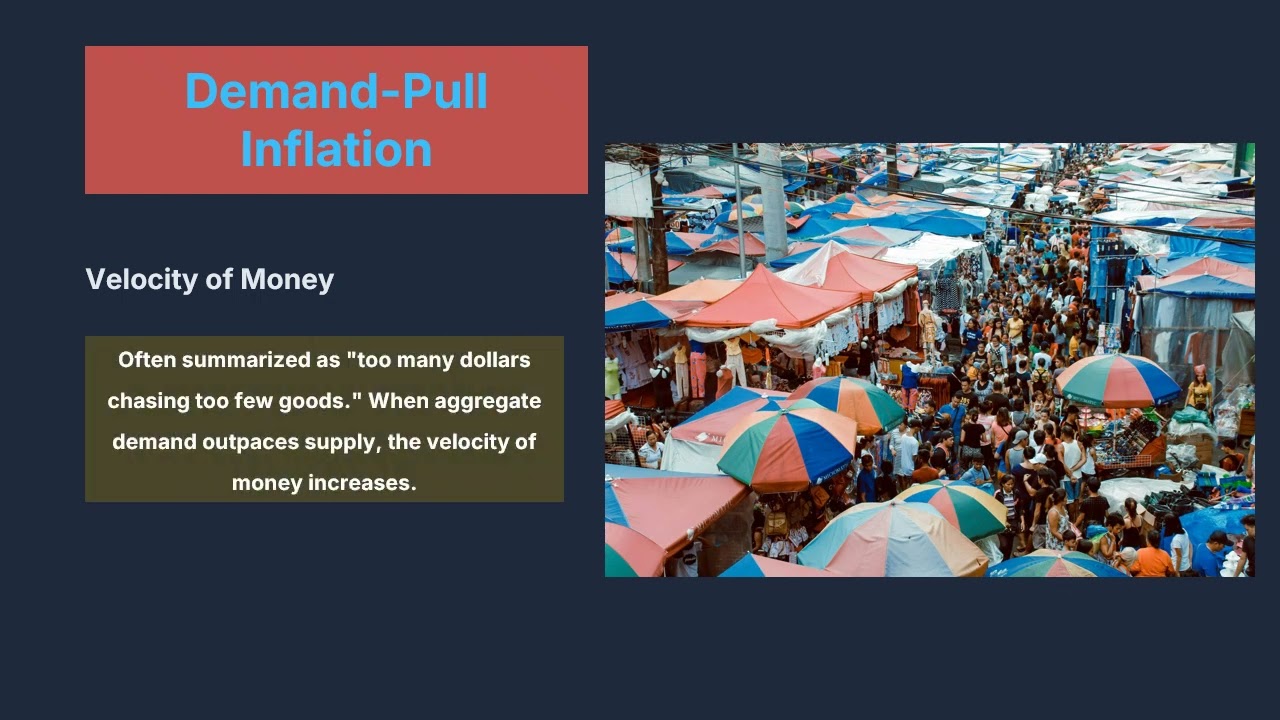
"Now, what drives this? The first driver is Demand-Pull Inflation. This occurs when the 'velocity of money' increases—essentially, too many dollars chasing too few goods. When aggregate demand outpaces supply, sellers naturally raise prices. This market reaction directly transfers wealth away from the buyer by reducing what their currency can secure."
Slide 8: Cost-Push Factors
"The second driver is Cost-Push Inflation. This is a supply-side shock. As we see in these images, if the input costs for energy, labor, or raw materials like steel spike, businesses cannot absorb those losses. They pass them on to the final consumer to protect their margins. The result is the same: the final price tag rises, and your currency buys less."
Impact on Fixed Income
"The human impact of this technical erosion is most severe for those on fixed incomes. We call this the 'Silent Tax.' If you are a retiree on a non-indexed pension, your nominal income—the number on your check—stays the same. But as prices rise, your real standard of living permanently drops. This also applies to workers whose wage growth fails to keep pace with the inflation rate."
Central Bank Intervention
"To combat this, central banks like the Federal Reserve step in. Their primary mandate is usually to keep inflation tethered to a target of around 2%. They utilize monetary tools—principally the manipulation of interest rates—to control the money supply. By raising rates, they attempt to slow down economic demand, thereby preserving the purchasing power of the currency."
Key Takeaways
"To summarize our technical deep dive: Remember the Inverse Relationship—when prices go up, currency value goes down. Respect the Compounding Effect; small percentages add up to massive losses over time. Understand that this is driven by both Demand and Supply factors. And finally, recognize that this erosion hits Fixed Income earners the hardest."
Q&A
"That concludes our technical overview of inflation and purchasing power. I’ll now open the floor for any questions regarding the specific mechanics or the data we’ve reviewed today."
Повторяем попытку...
Доступные форматы для скачивания:
Скачать видео
-
Информация по загрузке: