ycliper

Популярное

Музыка Кино и Анимация Автомобили Животные Спорт Путешествия Игры Юмор

Интересные видео

2025 Сериалы Трейлеры Новости Как сделать Видеоуроки Diy своими руками

Топ запросов

смотреть а4 schoolboy runaway турецкий сериал смотреть мультфильмы эдисон
Скачать

Plasmid as a cloning vector

Автор: Shomu's Biology

Загружено: 2013-10-25

Просмотров: 227082

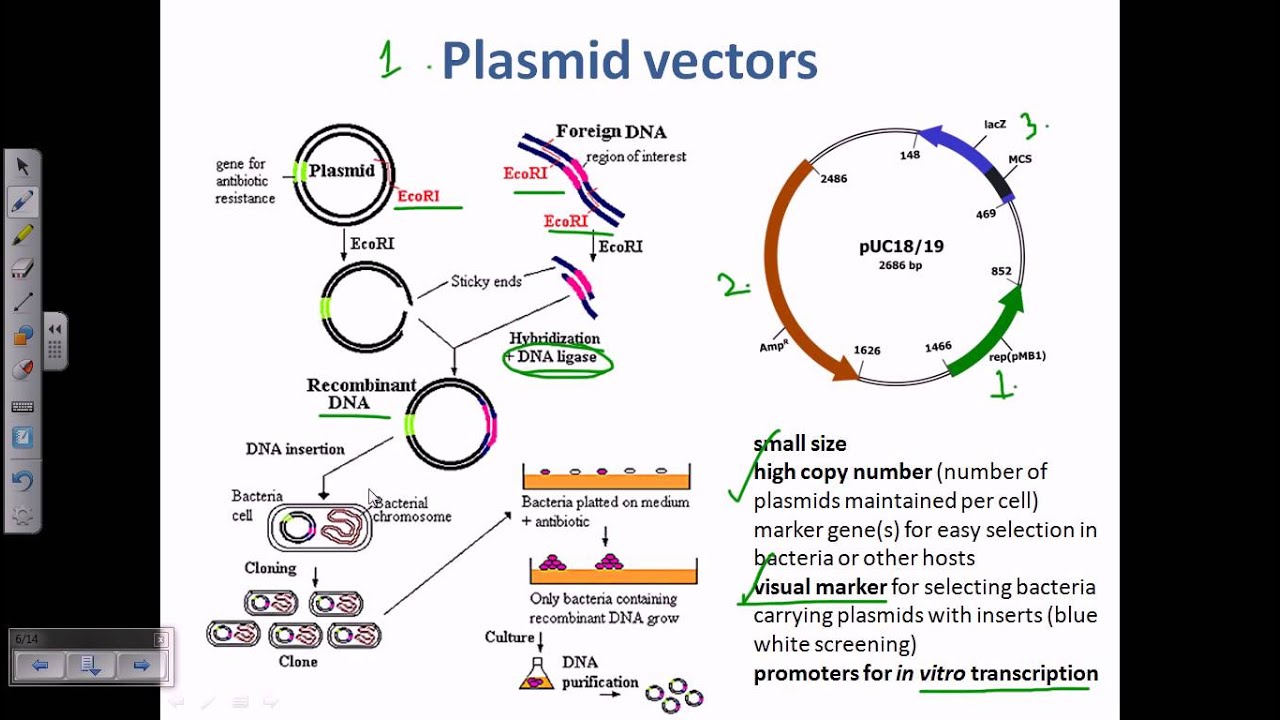
Описание: This dna cloning lecture explains use of plasmid as a cloning vector. http://shomusbiology.weebly.com/
Download the study materials here-
http://shomusbiology.weebly.com/bio-m...
A cloning vector is a small piece of DNA, taken from a virus, a plasmid, or the cell of a higher organism, that can be stably maintained in an organism, and into which a foreign DNA fragment can be inserted for cloning purposes.[1] The vector therefore contains features that allow for the convenient insertion or removal of DNA fragment in or out of the vector, for example by treating the vector and the foreign DNA with a restriction enzyme that creates the same overhang, then ligating the fragments together. After a DNA fragment has been cloned into a cloning vector, it may be further subcloned into another vector designed for more specific use.

There are many types of cloning vectors, but the most commonly used ones are genetically engineered plasmids. Cloning is generally first performed using Escherichia coli, and cloning vectors in E. coli include plasmids, bacteriophages (such as phage λ), cosmids, and bacterial artificial chromosomes (BACs). Some DNA however cannot be stably maintained in E. coli, for example very large DNA fragment, and other organisms such as yeast may be used. Cloning vectors in yeast include yeast artificial chromosomes (YACs).
Plasmid is an autonomously replicating circular extra-chromosomal DNA. They are the standard cloning vectors and the most commonly used. Most general plasmids may be used to clone DNA insert of up to 15 kb in size. One of the earliest commonly used cloning vectors is the pBR322 plasmid. Other cloning vectors include the pUC series of plasmids, and a large number of different cloning plasmid vectors are available. Many plasmids have high copy number, for example pUC19 which has a copy number of 500-700 copies per cell,[13] and high copy number is useful as it produces greater yield of recombinant plasmid for subsequent manipulation. However low-copy-number plasmids may be preferably used in certain circumstances, for example, when the protein from the cloned gene is toxic to the cells.[14]

Some plasmids contain an M13 bacteriophage origin of replication and may be used to generate single-stranded DNA. These are called phagemid, and examples are the pBluescript series of cloning vectors. Source of the article published in description is Wikipedia. I am sharing their material. Copyright by original content developers of Wikipedia.
Link- http://en.wikipedia.org/wiki/Main_Page

Не удается загрузить Youtube-плеер. Проверьте блокировку Youtube в вашей сети.
Повторяем попытку...
Plasmid as a cloning vector

Поделиться в:

Доступные форматы для скачивания:

Скачать видео

  • Информация по загрузке:

Скачать аудио

Похожие видео

Cosmid vector

Cosmid vector

Вектор клонирования плазмид и фагмид – селективный и скрининговый маркер

Вектор клонирования плазмид и фагмид – селективный и скрининговый маркер

Cosmids | What are cosmid vectors? | What is the difference between plasmid and cosmid?

Cosmids | What are cosmid vectors? | What is the difference between plasmid and cosmid?

Yeast artificial chromosome (YAC) | What are the components of yeast artificial chromosome?

Yeast artificial chromosome (YAC) | What are the components of yeast artificial chromosome?

Molecular Cloning explained for Beginners

Molecular Cloning explained for Beginners

Lambda Phage vector, Cosmid cloning vector - spi phenotype and in vitro packaged lambda virus

Lambda Phage vector, Cosmid cloning vector - spi phenotype and in vitro packaged lambda virus

Плазмидный вектор PBR322 | Вектор для клонирования

Плазмидный вектор PBR322 | Вектор для клонирования

Бактериальная генетика

Бактериальная генетика

Plasmids | Cloning vectors: Plasmids | Why do we use plasmids in RDT? | features of a plasmid

Plasmids | Cloning vectors: Plasmids | Why do we use plasmids in RDT? | features of a plasmid

Переговоры провалились / Срочная переброска войск

Переговоры провалились / Срочная переброска войск

DNA cloning and recombinant DNA | Biomolecules | MCAT | Khan Academy

DNA cloning and recombinant DNA | Biomolecules | MCAT | Khan Academy

ZIELIŃSKI Z GOLEM! CO ZA FORMA POLAKA! INTER PRĘŻY MUSKUŁY, PODPUŚCILI I SKASOWALI | SKRÓT

ZIELIŃSKI Z GOLEM! CO ZA FORMA POLAKA! INTER PRĘŻY MUSKUŁY, PODPUŚCILI I SKASOWALI | SKRÓT

What is a Plasmid? - Plasmids 101

What is a Plasmid? - Plasmids 101

Plasmids and Recombinant DNA Technology

Plasmids and Recombinant DNA Technology

Задача из вступительных Стэнфорда

Задача из вступительных Стэнфорда

Правда о клонировании SIM-карт

Правда о клонировании SIM-карт

Вектор плазмидной ДНК в клонировании генов | плазмидный вектор | вектор pbr322 | вектор puc 19

Вектор плазмидной ДНК в клонировании генов | плазмидный вектор | вектор pbr322 | вектор puc 19

Key Steps of Molecular Cloning

Key Steps of Molecular Cloning

Электрофорез в агарозном геле

Электрофорез в агарозном геле

DNA cloning

DNA cloning

© 2025 ycliper. Все права защищены.


  • Контакты
  • О нас
  • Политика конфиденциальности


Контакты для правообладателей: [email protected]