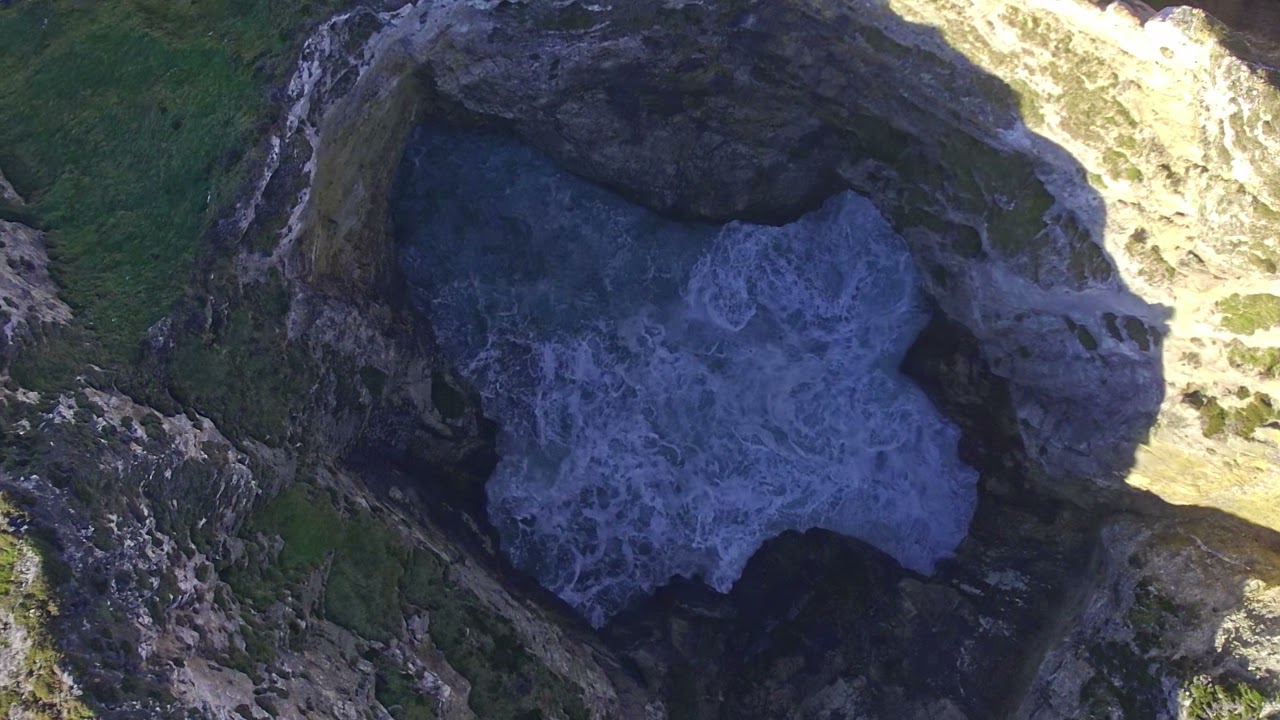
This IS The Prison at Hanover Cove, Nr Perranporth, North Cornwall. 20th Sept 2021
Автор: Views of Cornwall
Загружено: 2021-09-21
Просмотров: 918
Описание:
Thanks to Perrans Above (on Youtube & Instagram), I discovered that my clip from a week ago WASN'T The Prison at Hanover Cove. An easy mistake to make as I'd never been there before. So this clip is (hopefully!) the correct place. And what a place - a truly magnificent coastline.
The Prison is at Hanover Cove, near Perranporth, North Cornwall, UK, and is a dangerous, hidden beauty spot , usually only accessible by sea. It's a stunning site, but it is equally dangerous, and has earned its name ‘The Prison’ because of the real threat of getting trapped inside, with no way to escape as the tide floods in.
It is a massive collapsed sea cave, and upon entering through a dark tunnel, you find yourself inside a technicolour amphitheatre, surrounded by a ring of 100ft high stained cliffs giving way to a circle of blue sky above.
On calm days, when the tide is in, it fills this roofless cavern, and access can be made by experienced kayakers through a small gap to find what must be Cornwall’s most secluded beach.
Although it is generally not considered accessible by any other means, the lowest tides of the year allow brief visits to this amazing place by walking around the headland.
Stunning it may be, but it is equally dangerous, and has earned its name ‘The Prison’ because of the real threat of getting trapped inside, with no way to escape as the tide floods in.
The cove is close to a heavily mined site, and you can see various colourful minerals in the surrounding coastline.
The cove is named after a two masted ship, The Hanover, which operated between 1688 and 1852, and on 13 December 1763, en route from Lisbon to Falmouth, was driven ashore by a gale, leaving only three survivors out of 27 crew and 40 passengers. The location, near Perranporth has become known as Hanover Cove as a result. At the time she was carrying a large amount of gold and valuables, with historical evidence suggesting that this was mostly recovered around the time of the wrecking.
The wreck made legal history, when in 1765 an iron trunk containing bullion was recovered. The insurers had already paid out on the loss and the case established that where insurers paid out on cargo and the owners subsequently recovered their property, the insurers were entitled to a refund.
The wreck was discovered by a local diver in1994 following changes in the seabed and was identified by means of recovery of the ship's bell. The Post Office as owners of the wreck paid for an archaeological investigation and recommended in 1996 that it should be protected under the Protection of Wrecks Act. However, protection was not granted, and it was not until 19 July 1997, that the wreck site received emergency designation following the recovery of some fifty guns and the destabilisation of the wreck by a salvage rig set up next to it. The finder was subsequently licensed to excavate under archaeological supervision with the intention of displaying finds in a local shipwreck museum. Musket, shot, ship-fittings and the Captain's ring have also been brought to the surface. The wreck site has since been protected by return of the sand covering, and is now a Protected Wreck managed by Historic England.
The wreck made legal history, when in 1765 an iron trunk containing bullion was recovered. The insurers had already paid out on the loss and the case established that where insurers paid out on cargo and the owners subsequently recovered their property, the insurers were entitled to a refund.
The wreck was discovered by a local diver in1994 following changes in the seabed and was identified by means of recovery of the ship's bell. The Post Office as owners of the wreck paid for an archaeological investigation and recommended in 1996 that it should be protected under the Protection of Wrecks Act. However, protection was not granted, and it was not until 19 July 1997, that the wreck site received emergency designation following the recovery of some fifty guns and the destabilisation of the wreck by a salvage rig set up next to it. The finder was subsequently licensed to excavate under archaeological supervision with the intention of displaying finds in a local shipwreck museum. Musket, shot, ship-fittings and the Captain's ring have also been brought to the surface. The wreck site has since been protected by return of the sand covering, and is now a Protected Wreck managed by Historic England.
Повторяем попытку...
Доступные форматы для скачивания:
Скачать видео
-
Информация по загрузке: