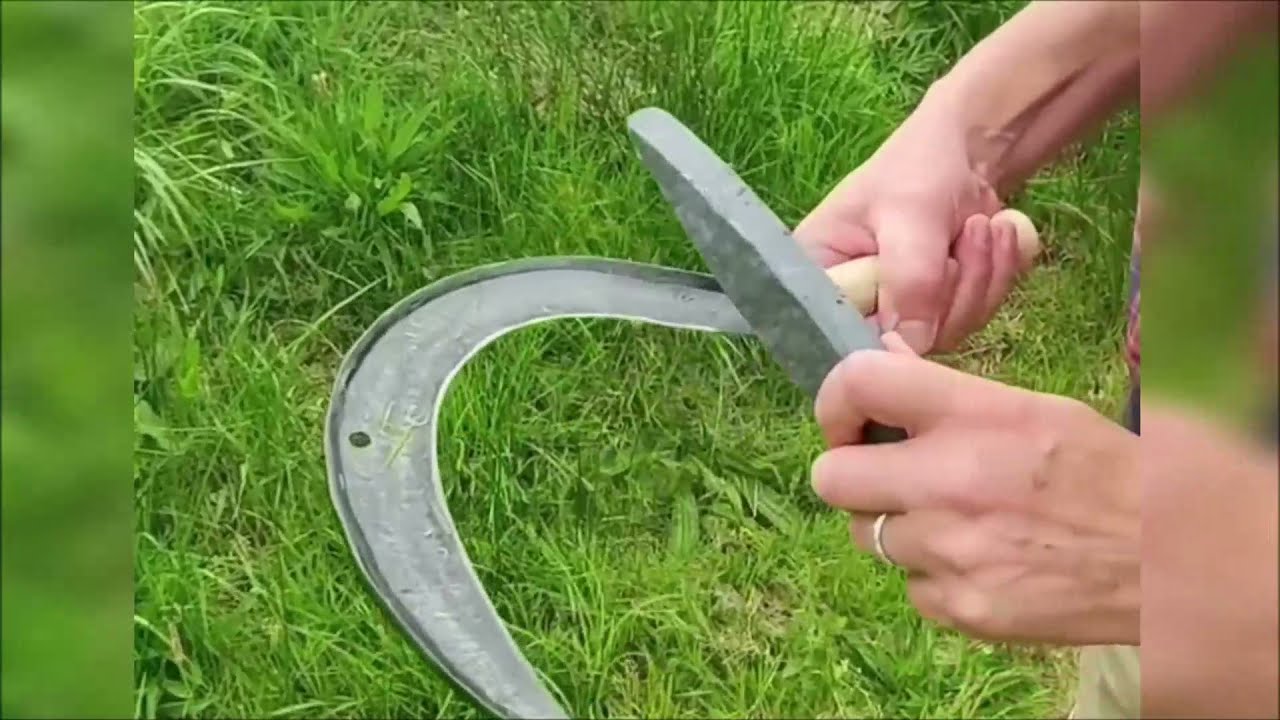
Sickle (Tool) Explained... 🌾🌻🪓🌙
Автор: All About Geology
Загружено: 2025-02-11
Просмотров: 541
Описание:
A sickle, bagging hook, reaping-hook or grasshook is a single-handed agricultural tool designed with variously curved blades and typically used for harvesting or reaping grain crops, or cutting succulent forage chiefly for feeding livestock. Falx was a synonym, but was later used to mean any of a number of tools that had a curved blade that was sharp on the inside edge.
Since the beginning of the Iron Age hundreds of region-specific variants of the sickle have evolved, initially of iron and later steel. This great diversity of sickle types across many cultures can be divided into smooth or serrated blades, both of which can be used for cutting either green grass or mature cereals using slightly different techniques. The serrated blade that originated in prehistoric sickles still dominates in the reaping of grain and is even found in modern grain-harvesting machines and in some kitchen knives.
The development of the sickle in Mesopotamia can be traced back to times that pre-date the Neolithic Era. Large quantities of sickle blades have been excavated in sites surrounding Israel that have been dated to the Epipaleolithic era (18000-8000 BC). Formal digs in Wadi Ziqlab, Jordan have unearthed various forms of early sickle blades. The artifacts recovered ranged from 10–20 cm (3.9–7.9 in) in length and possessed a jagged edge. This intricate ‘tooth-like’ design showed a greater degree of design and manufacturing credence than most of the other artifacts that were discovered. Sickle blades found during this time were made of flint, straight and used in more of a sawing motion than with the more modern curved design. Flints from these sickles have been discovered near Mt. Carmel, which suggest the harvesting of grains from the area about 10,000 years ago.
The sickle had a profound impact on the Agricultural Revolution by assisting in the transition to farming and crop based lifestyle. It is now accepted that the use of sickles led directly to the domestication of Near Eastern Wild grasses. Research on domestication rates of wild cereals under primitive cultivation found that the use of the sickle in harvesting was critical to the people of early Mesopotamia. The relatively narrow growing season in the area and the critical role of grain in the late Neolithic Era promoted a larger investment in the design and manufacture of sickle over other tools. Standardization to an extent was done on the measurements of the sickle so that replacement or repair could be more immediate. It was important that the grain be harvested at the appropriate time at one elevation so that the next elevation could be reaped at the proper time. The sickle provided a more efficient option in collecting the grain and significantly sped up the developments of early agriculture.
The sickle remained common in the Bronze Age, both in the Ancient Near East and in Europe. Numerous sickles have been found deposited in hoards in the context of the European Urnfield culture (e.g. Frankleben hoard), suggesting a symbolic or religious significance attached to the artifact.[citation needed]
In archaeological terminology, Bronze Age sickles are classified by the method of attaching the handle. E.g. the knob-sickle (German Knopfsichel) is so called because of a protruding knob at the base of the blade which apparently served to stabilize the attachment of the blade to the handle.
The sickle played a prominent role in the Druids' Ritual of oak and mistletoe as described from a single passage in Pliny the Elder's Natural History:
A priest arrayed in white vestments climbs the tree and, with a golden sickle, cuts down the mistletoe, which is caught in a white cloak. Then finally they kill the victims, praying to a god to render his gift propitious to those on whom he has bestowed it. They believe that mistletoe given in drink will impart fertility to any animal that is barren and that it is an antidote to all poisons.
Due to this passage, despite the fact that Pliny does not indicate the source on which he based this account, some branches of modern Druidry (Neodruids) have adopted the sickle as a ritual tool.
Indigenous sickles have been discovered in southwest North America with unique design. There is evidence that Kodiak islanders had for cutting grass "sickles made of a sharpened animal shoulder blade". The artifacts found in present-day Arizona and New Mexico resemble curved tools that were made from the horns of mountain sheep. A similar site discovered sickles made from other material such as the Caddo Sickle, which was made from a deer mandible. Scripture from early natives document the use of these sickles in the cutting of grass. The instruments ranged 13–16 in (330–410 mm) from tip to haft.
Повторяем попытку...

Доступные форматы для скачивания:
Скачать видео
-
Информация по загрузке: