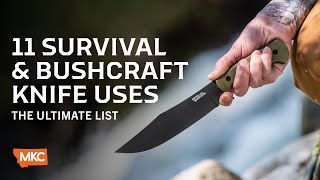
Essential Bushcraft Knife Skills
Автор: Wannabe Bushcrafter
Загружено: 2017-07-16
Просмотров: 69657
Описание:
The bushcraft knife is one of the most important tools that an outdoorsman can have. In an emergency, the bushcraft knife can provide a person obtain food, shelter, clothing, fire, and pottable water. In my outdoor adventures, I have observed a curious phenonmenon. In the hands of a skilled user, even the most common of bushcraft knives can unleash enormous capabilities. Yet expensive, high-end knives seems to deliver, at best, marginal performance gains when used by skilled bushcrafters. In unskilled hands, highend knives seems to deliver no performance improvements at all. So today that I want share with you some essential bushcraft knife skills that I routinely use. So let's get started.
Cross Grained battonning:
Cross-grain battoning is a technique used to fell small trees in the absence of an axe or saw. Select trees with a diameter of no more than 2 inches, you don't need anything thicker than 2 inches for survival purposes. You want to avoid battonning the blade at 90 degrees, because that dramatically increases the odds of chipping or rolling the knife's edge. Instead, batton at a 45 degree angle. You want to batton just a few times on each side of the tree. Once that is done, a light pull will take down the tree.
Straight grained battoning:
Straight grained battoning allows you to split a large billet of wood into smaller pieces. To avoid blade damage, do not split wood larger than 2 inches in diameter. You also want to check the wood for knots and avoid these knots when battoning.
Beaver Chew Cut:
The beaver chew cut is an efficient and safe way of cutting thick wood. Make concentric 45 degree cuts around a piece of wood and do this 1 to 3 times. Then break the wood in 2 with your hands. This technique can be used to cut precise lengths of wood in the absence of a saw.
Chest Lever Cut:
The Chest Lever Cut is a powerful and precise way of cutting wood that is under 1 inch in thickness. With both hands, leverage the muscles of your chest and back to make a single 45 degree cut that separates the wood. This technique is very useful for making prongs, spikes, and assmetric edges.
Leg Lever Cut:
The Leg Lever cut is a precise and safe way of removing large slices of wood. With your non dominant hand, brace the knife against your leg, and with your dominant hand, pull the wood against the blade, producing a spoke-shave like action. This technqiue is great for quickly removing bark and producing points.
Stop Cut and the Push Cut:
The stop cut and the push cut are 2 techniques that works well together A stop cut is made by pushing the blade down 90 degrees into the wood using your thumb. A pushcut is made by pushing the blade forward along the grain of the wood using the thumb. These 2 technique works together to create a range of notches highly useful for making toggles, trapp triggers and other small wooden parts.
Violin Cut:
The Violin cutting technique combines power, and control. Placing a piece of wood against your chest, you push the back of the blade with the 4 fingers of your dominant hand, while pulling the blade with your non-dominant hand. This technique is great for making smooth wooden surfaces, used in rabbit sticks and tool handles.
Feather Stick cutting technique:
Finally, there is the feather stick technique, here you take a stave of wood, and you use the weight of your body to push the blade down the length of the stave. This technique requires very little effort and can produce feather sticks quickly.
Now I am by now means an expert with the bushcraft knife. But I have been using these knife skills to great effect on my outdoor adventures. Anyways, thanks so much for watching, if you like what you are seeing, please like, share, and subscribe to my channel. Until next time!
Повторяем попытку...

Доступные форматы для скачивания:
Скачать видео
-
Информация по загрузке: