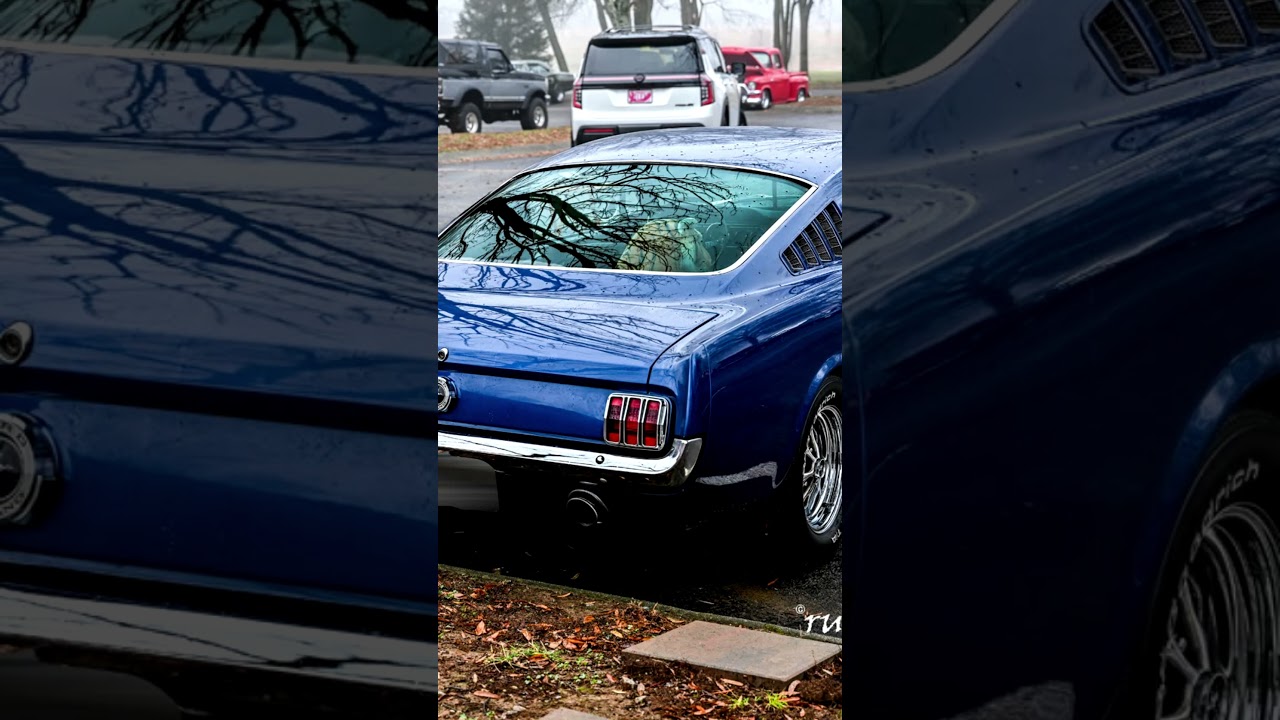
1965 Ford Mustang 2+2
Автор: rustedbumper
Загружено: 2026-02-06
Просмотров: 1157
Описание:
Take a look at this blue 1965 Ford Mustang 2+2, a true classic car with undeniable automotive appeal. This muscle car, specifically a 65 fastback mustang, captures attention with its exterior details, including the iconic grille and side profile. The video also gives a close view of the engine bay and the striking interior, showcasing the dashboard and steering wheel.
Fantastic job restoring the car. Yes I know it has a few upgrades but just look it.
Marketing slogan: The Ultimate Sports Car
Music: Heartfelt Echoes Rock Ballad
Artist: Harrison Miller from Pixabay
The Ford Mustang, introduced in 1964, became an overnight sensation & the most successful model launch in automotive history. Its styling was fresh & modern, & combined sporty performance w/personal luxury. Spawning a new 'pony car' market segment, the Mustang's appeal was further enhanced by its broad option list, allowing buyers to specify anything from a coupe to a fully equipped convertible. During Ford's 'Total Performance' era of the 1960s, the Mustang's options list included a wide range of powertrain combinations from inline sixes to the high-winding 289 V-8 engines in solid-lifter tune. Both manual & automatic transmissions were available to suit any driving style. With its shortened rear deck, an extended hood, & sporty bucket seats, the Mustang could be configured as a family sedan for grocery-getting purposes, or outfitted w/enough features to satisfy the performance enthusiast.
The first 121,538 Mustangs built had unique features that have earned them a distinction with purists as '1964½' Mustangs. The list includes horn rights with the 'Ford Falcon' logo covered by a trim ring with a 'Ford Mustang' logo. Later cars had alternators instead of generations, a larger 200 CID six-cylinder engine (up from 170 CID), & a larger 289 CID V8 (up from 260 CID). Early six-cylinder cars had 4 lug 4.5x13 inch wheels & 13x6.5 tires. Optional whitewall tires measured 7.00x13. All 8-cylinder engines used 5 lug pattern on their rims. Optional on V8 cars were 14 x 14.5 rim & 6.50x14 tires. Mustangs equipped with V8 engines, beginning in 1965, used 4.5x14 rim and use 6.95x14 tires. The 15x5 wheels were an option & used 5.90x15 tires. The 15-inch opti9on was later dropped & later-built HiPo cars were equipped w/14-inch rims & dual red line sidewall tires.
The base Mustang, a four-passenger hardtop coupe, sold for $2,368 & came w/a 170 CID six-cylinder engine developing 101 horsepower. The convertible pricing began at $2,614. The 260 CID V8 engine developed 164 horsepower & the base 289 CID overhead valve engine w/a four-barrel Model C4AF-9510-B carburetor had 210 horsepower. The Challenger High-Performance 289 CID version boosted power to 271 HP. Shortly after production began, in the fall of 1964, the 200 CID & 289 CID V8 became the standard powerplants.
The standard transmission as the three-speed manual w/floor lever controls. Other standard features included a heater, defroster, cigarette lighter, glovebox light, door courtesy lights, front bucket seats, sports steering wheel, & color-keyed carpeting.
During 1965, the Mustang received a mildly redesigned interior w/the original Ford Falcon-designed instrument cluster replaced by a five pod design w/the speedometer in the center flanked by two smaller gauges on each side.
The optional air conditioning system & nearly all of the bolt-on options could be installed by the factory or the dealer.
The GT option included GT gas cap, GT rocker paint stripes, GT side emblems, grille-mounted fog lights, & unique exhaust trumpets. The interior received a special 5 gauge instrument cluster. Mechanical upgrades included manual front disc brakes, F70x14 tires, & upgrades to the suspension. An additional Rally-Pac option consisted of a 5-dial instrument cluster or a 4 dial version.
Officially introduced on April 17th of 1965, the interior decor group added a five-dial instrument cluster w/full instrumentation, wood grain appliques on the instrument panel, galloping pony embossed seat covers, bright trim cap on hardtop quarter trim panel, vinyl-covered quarter trim panels, faux-walnut deluxe steering wheel, bright pedals, wood grain glove compartment door, & molded door panels w/pistol grip door handles.
The Name
The name of the Mustang is credited to executive stylist John Najjar, who was a fan of the World War II P-51 Mustang fighter plant. Najjar & fellow Ford stylist Philip T. Clark created the design of the first Mustang prototype in 1961, known as the Ford Mustang I.
Source of information: conceptcarz.com
https://www.conceptcarz.com/vehicle/z...
Music by a href="https://pixabay.com/users/harrisonmil..."Harrison Miller/a from a href="https://pixabay.com//?utm_source=link..."Pixabay/a
Повторяем попытку...
Доступные форматы для скачивания:
Скачать видео
-
Информация по загрузке: