Day 34 & 35: Coding Model 4 Safely + Full Optimal Start Model Review (0, 1, 2, 4)
Автор: TalkShopWithBen
Загружено: 2026-01-27
Просмотров: 5
Описание:
In this video, I combined Day 34 and Day 35 of the Optimal Start Math with Python Crash Course because these two lessons naturally close out a major chapter of the series.
Day 34 is all about implementation.
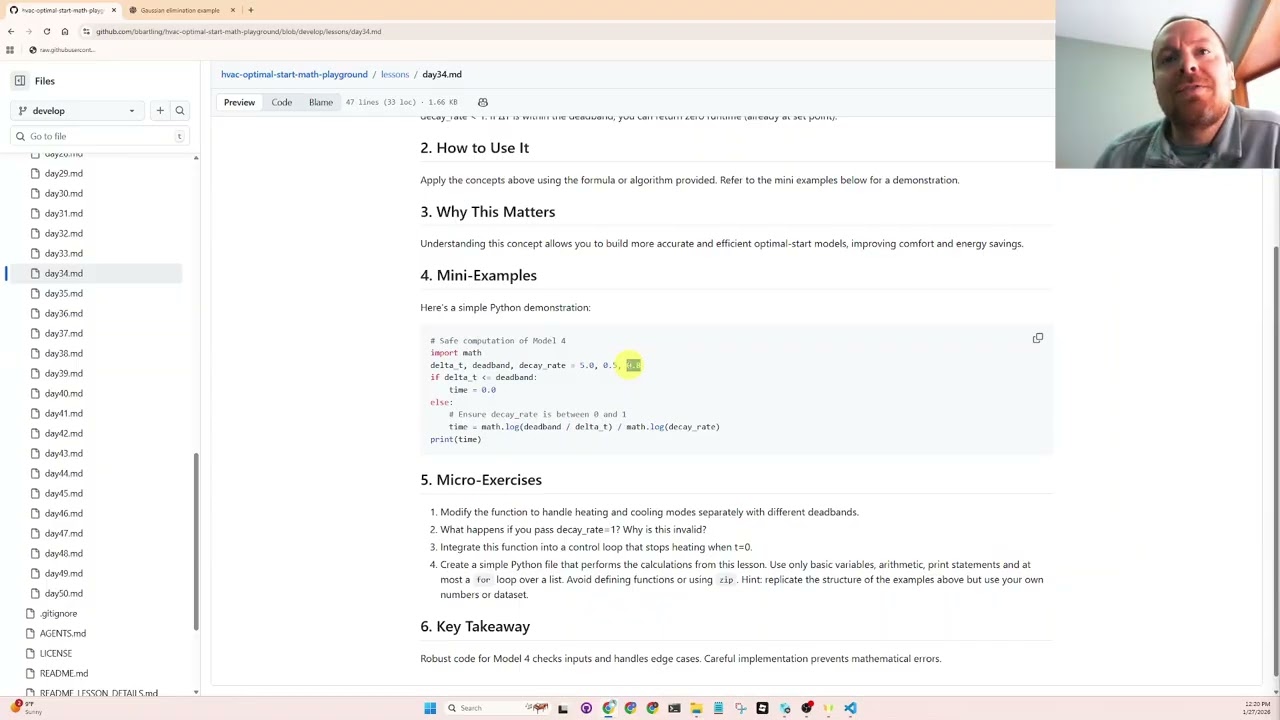
Up to this point, we’ve spent a lot of time building intuition for Model 4 — first-order response, exponentials, and logarithms. Now we focus on what it actually looks like to code Model 4 safely.
Logarithmic models are powerful, but they’re also unforgiving if you don’t handle edge cases correctly. In this lesson we walk through the practical guardrails needed to keep Model 4 from blowing up in real systems.
We cover:
• Why you must never take log(0) or log of a negative value
• Why decay rate must stay between 0 and 1
• Why runtime should immediately return 0 when inside deadband
• How to safely compute Model 4 using basic math only
• How this logic fits into BAS control loops
Lesson reference
https://github.com/bbartling/hvac-opt...
Then in Day 35, we zoom out and do a full Week 5 review.
At this point in the course, we’ve built a complete toolbox:
• Model 0 — linear
• Model 1 — quadratic
• Model 2 — weather-adjusted
• Model 4 — logarithmic, physics-inspired
This lesson is about engineering judgement. No model is “best” everywhere. Each one captures a different physical effect, requires different amounts of data, and has different failure modes.
We compare all four models side-by-side using the same Delta-T and talk through where each one shines — and where each one should probably not be used.
Lesson reference
https://github.com/bbartling/hvac-opt...
In this combined lesson you’ll learn:
• How to safely code Model 4 without math errors
• Why edge-case handling matters in production BAS systems
• The strengths and weaknesses of Models 0, 1, 2, and 4
• Why simpler models sometimes outperform complex ones
• How to think about model selection by zone type and data quality
All examples are shown with simple Python and basic math, reinforcing that everything here can realistically run inside BAS software, Niagara Program Objects, or lightweight edge environments.
This video wraps up a major milestone in the course. From here on out, it’s about refinement, comparison, and making smart decisions with the full optimal start toolbox.
HVAC Optimal Start Math Playground
https://github.com/bbartling/hvac-opt...
Vibe Coding (Niagara Program Objects)
https://github.com/bbartling/niagara4...
#hvac
#optimalstart
#buildingautomation
#niagaraframework
#smartbuildings
#hvacmath
#controlsystems
#engineeringeducation
#vibecoding
#hvaccontrols
#hvacoptimization
Повторяем попытку...
Доступные форматы для скачивания:
Скачать видео
-
Информация по загрузке: