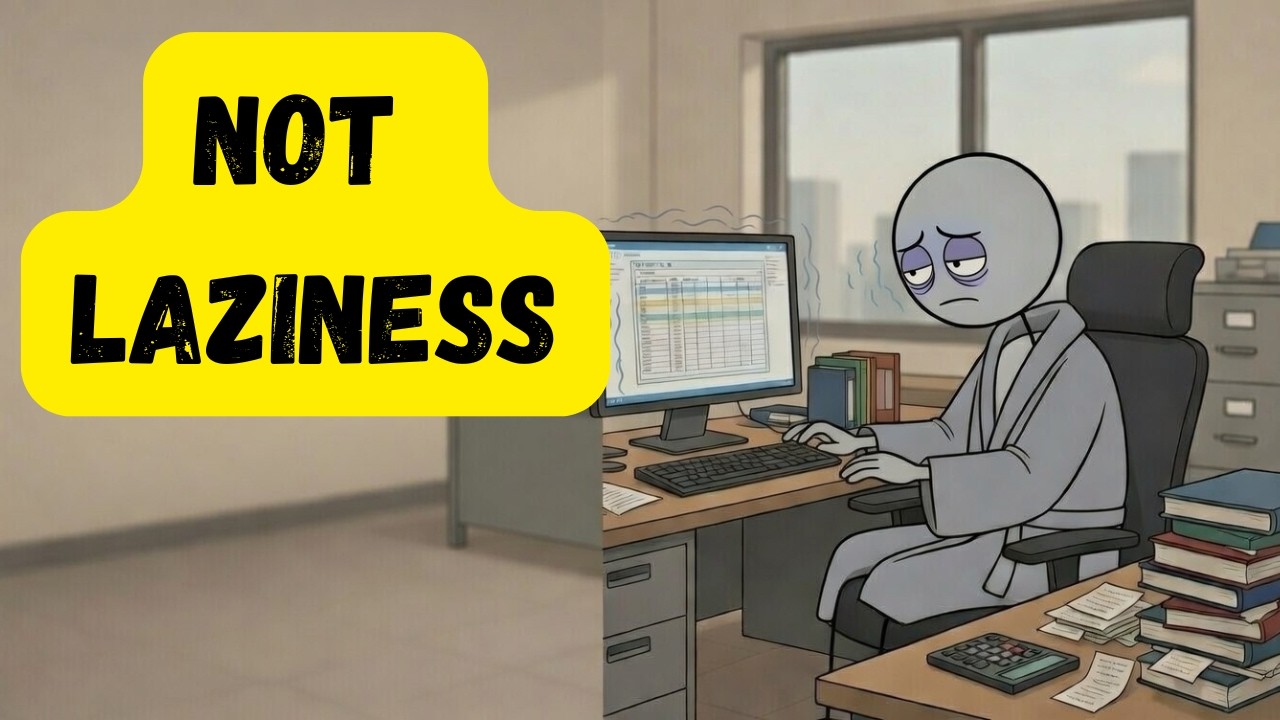
Why Caffeine Stops Working When You’re Chronically Tired
Автор: Stick Decoding
Загружено: 2026-02-16
Просмотров: 7
Описание:
If caffeine used to help, but now coffee barely touches your exhaustion, or just makes you jittery and worse, you’re not imagining it.
When you’re mentally exhausted, your brain and nervous system stop responding to stimulants the way they used to.
This video explains why caffeine stops feeling effective during burnout and chronic mental fatigue, why adding more coffee often backfires, and what caffeine “not working” is actually signaling.
This isn’t about quitting coffee or finding a stronger stimulant
What you’ll understand in this video:
Why caffeine doesn’t create energy, it only amplifies what’s already there
How mental exhaustion changes how your nervous system interprets stimulation
Why caffeine can feel jittery, hollow, or ineffective during burnout
The difference between tolerance and nervous system overload
Why stabilization has to come before stimulation
This video is for anyone experiencing chronic tiredness, burnout, or mental exhaustion who relies on caffeine just to function, only to feel more anxious, foggy, or drained. If coffee used to help but now feels unpredictable, ineffective, or even harmful, this video explains what’s happening beneath the surface without blaming your habits, discipline, or willpower.
References:
1. Caffeine, Adenosine, and Wakefulness
Fredholm, B. B., Bättig, K., Holmén, J., Nehlig, A., & Zvartau, E. E. (1999).
Actions of caffeine in the brain with special reference to factors that contribute to its widespread use.
Pharmacological Reviews, 51(1), 83–133.
→ Explains how caffeine works by blocking adenosine rather than creating energy.
2. Stress, Arousal, and “Wired but Tired” States
McEwen, B. S. (2007).
Physiology and neurobiology of stress and adaptation: Central role of the brain.
Physiological Reviews, 87(3), 873–904.
→ Describes how chronic stress alters nervous system responses to stimulation.
3. Burnout, Fatigue, and Altered Nervous System Function
van der Linden, D., Keijsers, G. P. J., Eling, P., & van Schaijk, R. (2005).
Work stress and attentional difficulties: An initial study on burnout and cognitive failures.
Work & Stress, 19(1), 23–36.
→ Supports reduced cognitive capacity and altered alertness under mental exhaustion.
4. Stimulants Under Conditions of Fatigue
Killgore, W. D. S. (2010).
Effects of sleep deprivation on cognition.
Progress in Brain Research, 185, 105–129.
→ Shows how stimulants increase alertness without restoring underlying capacity during fatigue.
5. Allostatic Load and Energy Regulation
McEwen, B. S., & Stellar, E. (1993).
Stress and the individual: Mechanisms leading to disease.
Archives of Internal Medicine, 153(18), 2093–2101.
→ Explains why chronically overloaded systems conserve resources and respond poorly to added demand.
If you’d like to support the channel and help me make more videos, you can do so by sending a Super Thanks or becoming a channel Member. Your support genuinely helps and is greatly appreciated. 😊
Explore the channel here: / @stickdecoding
This video is part of a short series on mental exhaustion, focus, and restoring energy without forcing change. I recommend exploring the playlist whenever it feels supportive: • Rebuilding Focus Gently
Disclaimer: This channel is for educational and informational purposes only. It is not meant to replace professional psychological, medical, or therapeutic advice.
Повторяем попытку...
Доступные форматы для скачивания:
Скачать видео
-
Информация по загрузке: