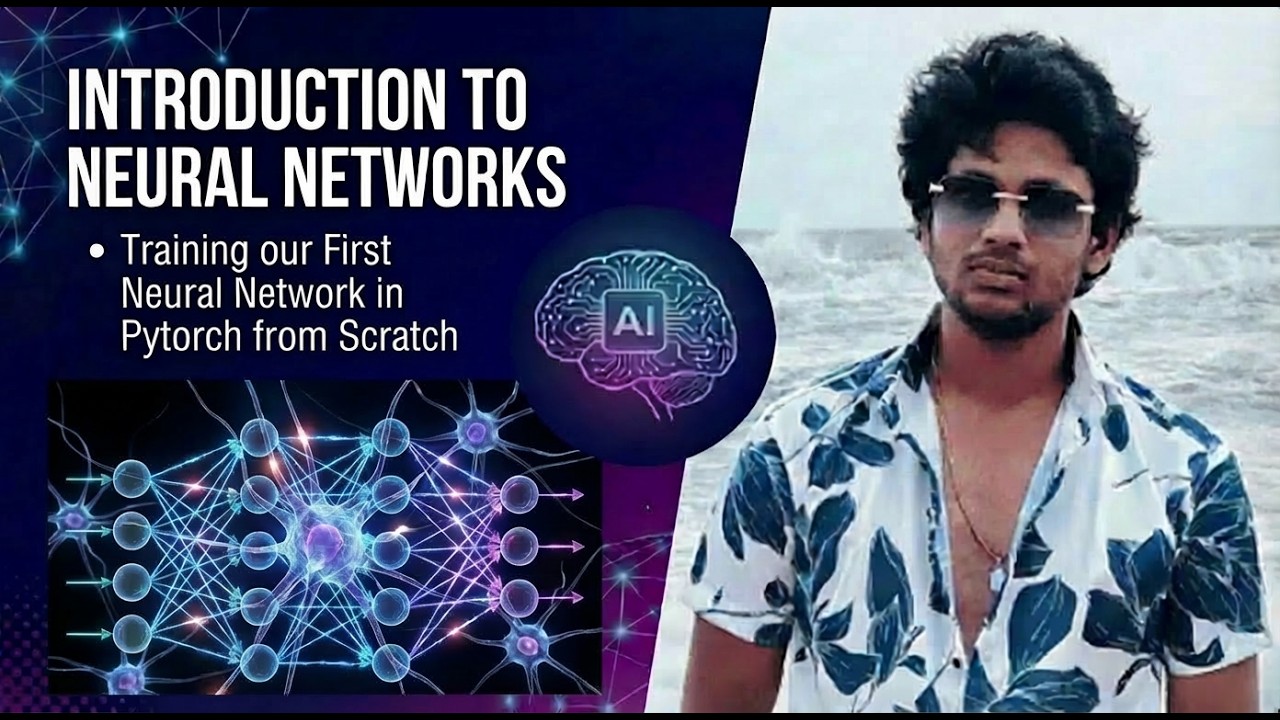
Introduction to Neural Networks (Lecture 25)
Автор: Gautam Goel
Загружено: 2026-02-22
Просмотров: 13
Описание:
Welcome to the twenty-fifth lecture of my Deep Learning series! 🧠🔥
In the previous lecture, we achieved a massive milestone by training a Neural Network using our own library built from scratch. Today, we level up. We are taking that exact same logic, dataset, and training loop, and porting it to PyTorch—the framework used by researchers at Meta, OpenAI, and Tesla.
The goal of this video is to prove that "Industrial Deep Learning" isn't magic. By recreating our simple MLP in PyTorch, you will see that it uses the exact same mathematical principles we have already mastered, just with more efficiency and helper functions.
We encounter and solve a very common bug regarding Tensor shapes and Broadcasting, which is a crucial concept for every Deep Learning practitioner.
In this video, we cover:
✅ PyTorch Tensors: We introduce torch.Tensor as the fundamental building block. We verify data types and shapes to ensure they match our input requirements.
✅ Defining the Architecture: Instead of our custom MLP class, we use nn.Sequential and nn.Linear to construct a 3-layer neural network (3→4→4→1) with ReLU activation.
✅ The Forward Pass: We feed our data into the model. We discuss the importance of tensor shapes (dimensions) and how PyTorch handles batch processing differently than our simple loops.
✅ Broadcasting & Shapes (Crucial): We debug a common error where subtracting tensors of different shapes (e.g., [4, 1] vs [4]) leads to incorrect loss calculations. We use .view() to fix this.
✅ Calculating Loss: We manually implement the Mean Squared Error (MSE) loss using PyTorch operations (pow, sum) to replicate our previous logic exactly.
✅ Backpropagation: We use loss.backward() to utilize PyTorch's Autograd engine (which replaces our custom Engine).
✅ Manual Gradient Descent: Instead of using a pre-built optimizer (like Adam or SGD) just yet, we manually update the weights (p.data -= lr * p.grad) to show that the underlying math is identical to what we derived by hand.
✅ The Training Loop: We run the loop, watch the loss plummet, and confirm that our PyTorch model learns the simple dataset perfectly.
By the end of this lecture, you will bridge the gap between "First Principles" and "Production Code," giving you the confidence to start using professional tools.
Resources:
🔗 GitHub Repository (Code & Notes): https://github.com/gautamgoel962/Yout...
🔗 Follow me on Instagram: / gautamgoel978
Subscribe and hit the bell icon! 🔔
Now that we have verified our understanding against PyTorch, in the upcoming lectures, we will explore standard optimizers, more complex loss functions, and visualize the "Brain" of the neural network. Let's keep building! 📉🚀
#PyTorch #DeepLearning #ArtificialIntelligence #NeuralNetworks #MachineLearning #DataScience #PythonProgramming #CodingTutorial #Broadcasting #Tensor #SoftwareEngineering #GradientDescent #Autograd #Faang #DeveloperCommunity #MathForML #HindiTutorial #GenerativeAI
Повторяем попытку...
Доступные форматы для скачивания:
Скачать видео
-
Информация по загрузке: