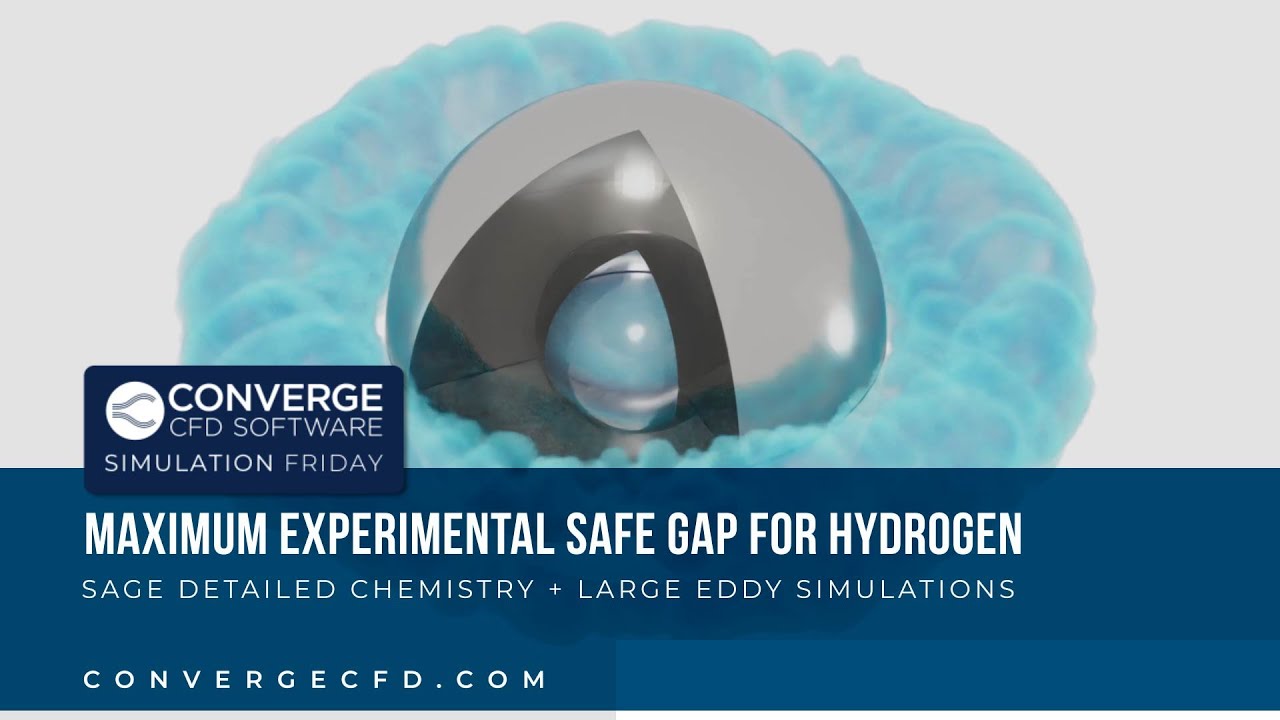
Simulating the Maximum Experimental Safe Gap for Hydrogen
Автор: convergecfd
Загружено: 2025-08-01
Просмотров: 421
Описание:
The maximum experimental safe gap (MESG) is a standardized measurement used to determine the maximum gap size that prevents the propagation of an explosion from one enclosed space to another. In the process industry, understanding the MESG for pure hydrogen is critical to ensuring safety. These studies are important for designing flame arrestors and flameproof enclosures that handle combustible gases.
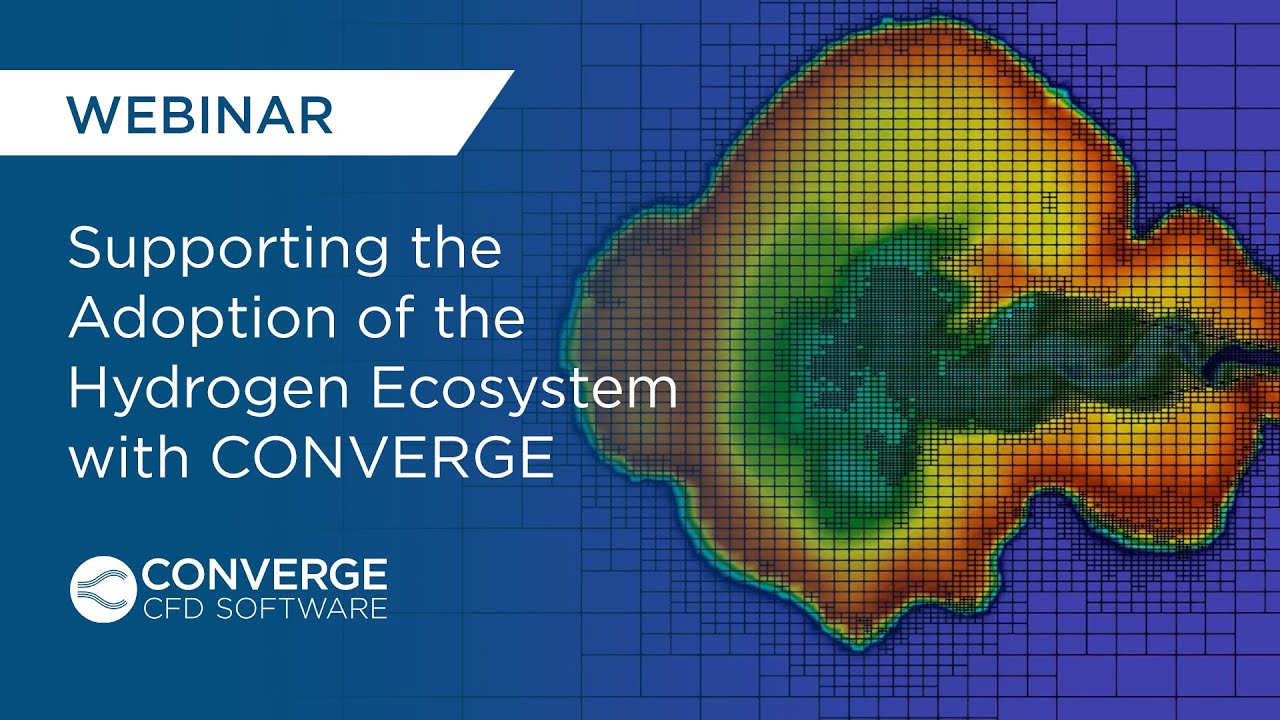
Simulating the MESG for hydrogen gas requires overcoming numerical challenges resulting from hydrogen’s low ignition energy, fast-moving flames, and high mass diffusivity. In this video, we simulate the MESG for hydrogen at two different gap sizes (0.4 mm and 0.5 mm). CONVERGE is able to model the combustion process using the SAGE detailed chemistry solver, which can predict ignition as well as flame propagation. CONVERGE’s autonomous meshing easily captured the complexity of the geometry by automatically generating a high-quality mesh at runtime. Temperature- and velocity-based Adaptive Mesh Refinement (AMR) kept the computational cost to a minimum by refining and coarsening the grid where and when it was necessary. We also captured turbulent flow effects with large eddy simulations (LES).
The first view (0:05-0:11) shows an isometric 3D view of the geometry—a metallic sphere with a small gap between the top and bottom hemispheres. The camera zooms in to highlight the gap. In the second view (0:12-0:19), one quadrant of the sphere turns transparent, revealing the inner enclosure. A blue hydrogen flame is propagated from the inner enclosure to the outer chamber through the gap. The next view (0:20-0:27) transitions to two side-by-side slices that are colored by temperature. The left slice shows results for the simulation with the smaller gap size (0.4 mm), while the right slice shows results for the simulation with the larger gap size (0.5 mm). This view shows that the flame propagates more in the larger gap than the smaller gap, indicating the flame is being cooled by the heat-absorbing metal that surrounds the smaller gap. The fourth view (0:28-0:33) shows two more side-by-side slices that are colored by OH mass fraction. In the last view (0:34-0:43), the video focuses on the results of the simulation with the larger gap size (0.5 mm) and shows the mesh. This view highlights the mesh adapting to the expanding flame front, which is colored by OH mass fraction.
Convergent Science's CONVERGE is an innovative computational fluid dynamics (CFD) software that eliminates the grid generation bottleneck from the simulation process through autonomous meshing.
Повторяем попытку...
Доступные форматы для скачивания:
Скачать видео
-
Информация по загрузке:

![Эффект Джанибекова [Veritasium]](https://imager.clipsaver.ru/N9HlQ-XVnFk/max.jpg)