What is an Emotion? (Hindi/हिंदी में)
Автор: SyllabuswithRohit
Загружено: 2026-03-12
Просмотров: 15033
Описание:
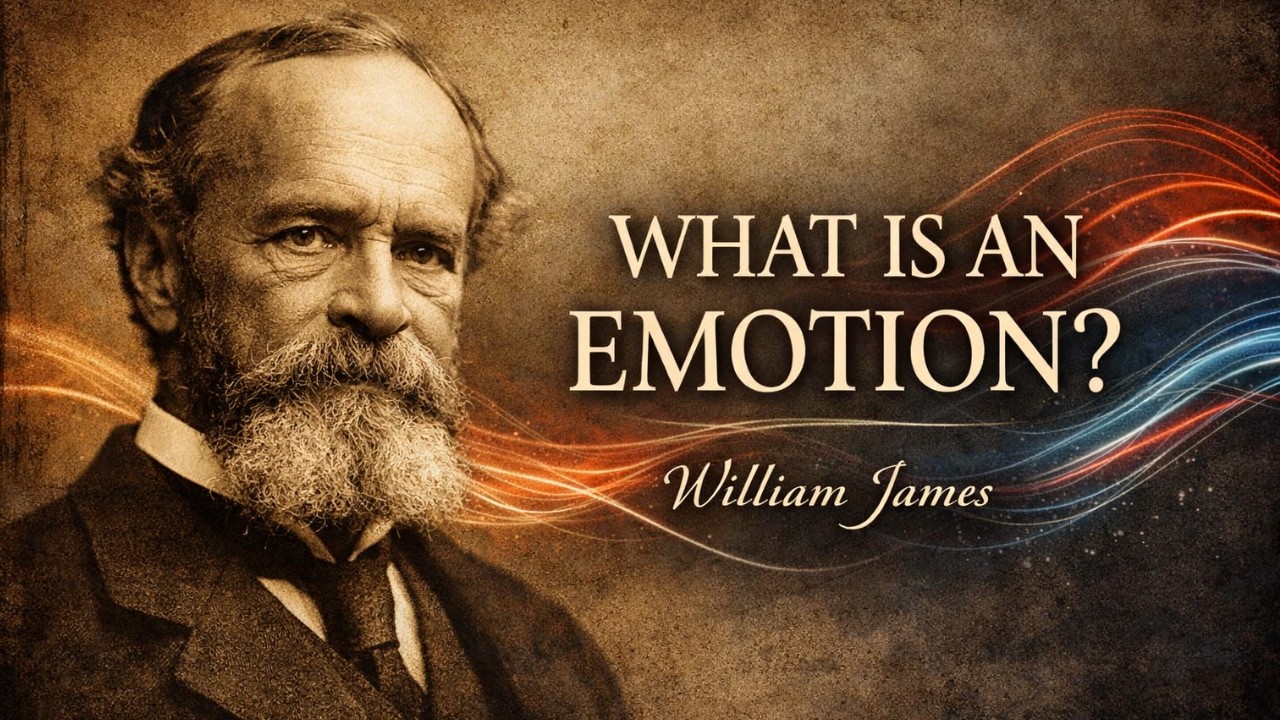
William James, the "father of American psychology," famously flipped our common-sense understanding of feelings on its head. In his seminal 1884 essay What is an Emotion?, he proposed a theory that remains one of the most debated and influential concepts in neuroscience and philosophy.
To understand James’s perspective, we have to look at how he challenged the status quo of the 19th century.
The Common-Sense View vs. The Jamesian View
Most people believe that emotions follow a linear, logical path: we see a stimulus, we feel an emotion, and then we react physically. For example:
You see a grizzly bear in the woods (Stimulus).
You feel terrified (Emotion).
You tremble and run away (Physical Response).
James argued that this sequence is completely wrong. He insisted that the "mental affection" (the feeling) is not the cause of the physical change, but rather the result of it. In his view, the body acts first, and the mind perceives that action as an emotion.
"My thesis on the contrary is that the bodily changes follow directly the perception of the exciting fact, and that our feeling of the same changes as they occur IS the emotion."
The Mechanics of Feeling
James believed that our bodies are finely tuned instruments that react instantly to certain stimuli through "pre-organized" reflex arcs. When we encounter something significant—a threat, a lover, a tragedy—our nervous system triggers a cascade of physical adjustments:
Increased heart rate and shallow breathing.
Contraction of specific muscle groups (the "lump in the throat").
Visceral changes in the gut.
Changes in skin temperature or perspiration.
According to James, if these physical changes didn't happen, our perception of the event would be purely cognitive—cold, intellectual, and "destitute of emotional warmth." You might look at the bear and conclude, "That is a dangerous animal," but you wouldn't actually feel afraid unless your heart started hammering against your ribs.
The Famous Examples
James used three primary examples to drive his point home:
The Bear: We don't run because we are afraid; we feel afraid because we are running (or because our heart is racing in preparation to run).
The Insult: We don't strike because we are angry; we feel angry because we have struck or because our muscles have tensed into a combative posture.
The Loss: We don't cry because we are sorry; we feel sorry because we are crying.
The Role of the Body
James emphasized that "emotion" isn't a single, ethereal thing. It is a mosaic of organic sensations. Because every person’s body is slightly different, and every situation triggers a unique cocktail of internal sensations, no two "fears" or "angers" are exactly alike.
This led to the James-Lange Theory (co-developed independently by Danish physiologist Carl Lange). While Lange focused specifically on the circulatory system (blood flow), James took a broader view, including the muscles, the skin, and the internal organs (viscera).
Criticisms and Legacy
James’s theory was met with significant pushback, most notably from Walter Cannon in the 1920s. Cannon argued that:
Visceral changes are too slow to account for the split-second "flash" of emotion.
Internal organs are relatively insensitive; we aren't always aware of our gall bladder or stomach shifting.
Artificial induction of physical symptoms (like injecting adrenaline) doesn't always produce a true emotion; it often just produces a "cold" feeling of "as if" one were excited.
Despite these critiques, James’s core insight—that the body is the theater of emotion—is the foundation of modern Embodied Cognition. Today, we see his influence in:
The Facial Feedback Hypothesis: The idea that smiling can actually make you feel happier.
Somatic Marker Hypothesis: Neuroscientist Antonio Damasio’s theory that bodily signals guide our decision-making.
Mindfulness and Yoga: Practices that focus on "listening" to bodily sensations to regulate emotional states.
Conclusion
William James stripped emotion of its mystical, purely "mental" status and grounded it firmly in biology. By defining emotion as the perception of bodily change, he turned the human experience into a feedback loop between the world and the flesh. He taught us that we are not just thinkers who happen to have bodies, but biological organisms whose very thoughts and feelings are woven from the fabric of our physical responses.
Повторяем попытку...
Доступные форматы для скачивания:
Скачать видео
-
Информация по загрузке:








![Роберт Сапольски — Биология религиозности [Vert Dider]](https://imager.clipsaver.ru/7l1NhZ4EbEE/max.jpg)