Chlor-Alkali process explained in 80 seconds! | Electrolysis of Brine | Class 10 | Acids Bases
Автор: G-Funk
Загружено: 2025-06-30
Просмотров: 1581
Описание:
In this video we look up to a 3d animation of Chlor-Alkali process
Script:
What happens when you pass electricity through salty water?
Welcome to the Chlor-Alkali Process — a fascinating industrial method that gives us chlorine, hydrogen gas, and sodium hydroxide, all from a simple solution of brine!
It all starts with brine — a concentrated solution of sodium chloride in water.
This solution is placed in a specially designed electrolytic cell, also called a diaphragm cell or membrane cell.
When electric current is passed through the cell, the water and salt begin to split into ions.
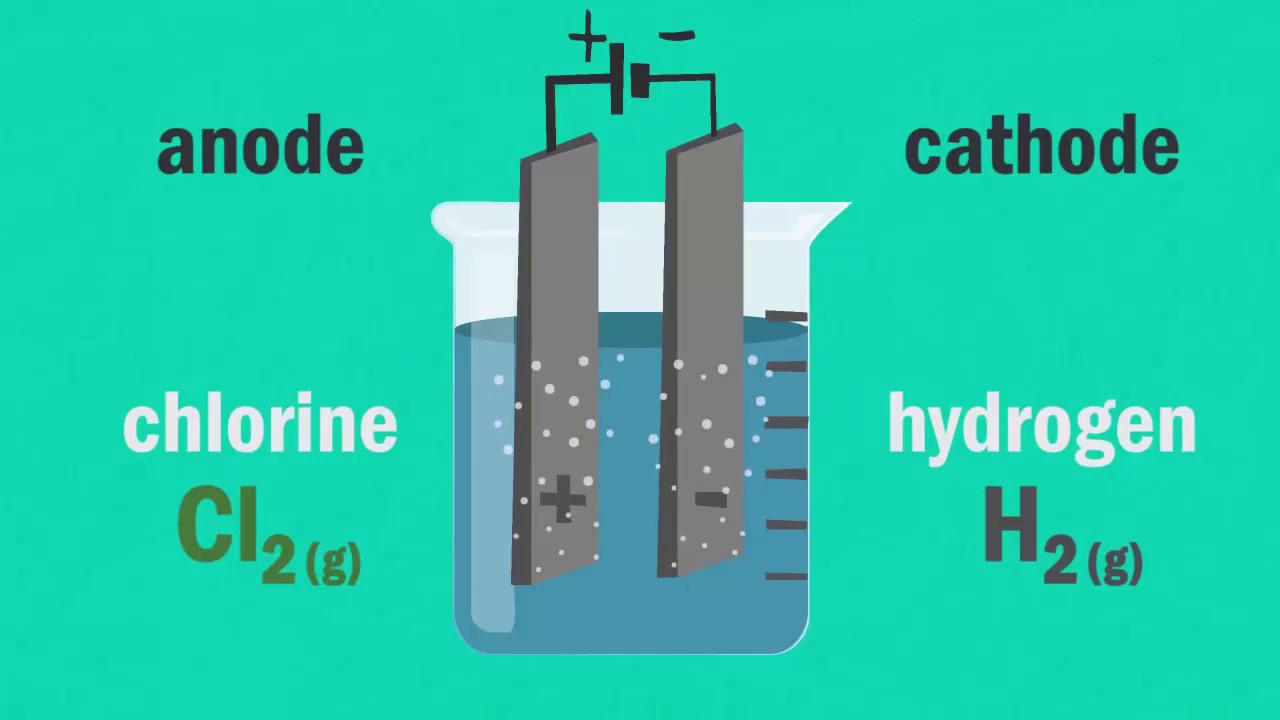
At the anode, chloride ions lose electrons and become chlorine gas.
At the cathode, water gains electrons and forms hydrogen gas, leaving hydroxide ions in the solution.
At Anode (oxidation): 2Cl⁻ → Cl₂ + 2e⁻
At Cathode (reduction): 2H₂O + 2e⁻ → H₂ + 2OH⁻
The chlorine gas is collected at the anode chamber.
The hydrogen gas is collected at the cathode chamber.
The remaining solution, now rich in Na⁺ and OH⁻, gives us sodium hydroxide (NaOH).
This setup ensures the products stay separate using a membrane that allows only certain ions to pass.
These products are incredibly important!
Chlorine is used in water purification, bleach, and PVC production.
Hydrogen fuels rockets and is used in making ammonia.
Sodium hydroxide is used in soap, paper, and textile industries.
So, the next time you clean your bathroom or drink purified water, thank the Chlor-Alkali Process — a perfect example of how science powers our daily life.
Like, Share and Subscribe for more animated science stories!
Повторяем попытку...

Доступные форматы для скачивания:
Скачать видео
-
Информация по загрузке: