This Olympiad Fluid Problem Forces You To Think Beyond Textbooks | INPhO 2019 PYQ
Загружено: 2026-01-30
Просмотров: 2106
Описание:
In this Physics video in Hindi for the chapter : "Mechanical Properties of Fluids" of Class 11, we discussed a Previous Years' Question of INPhO 2019 that plays a very important role in developing a deep conceptual understanding required for advanced examinations such as the Indian National Physics Olympiad, higher stages of the Indian National Physics Olympiad, and challenging entrance tests like IIT JEE Advanced, all of which extensively draw questions from the chapter "Mechanical Properties of Fluids".
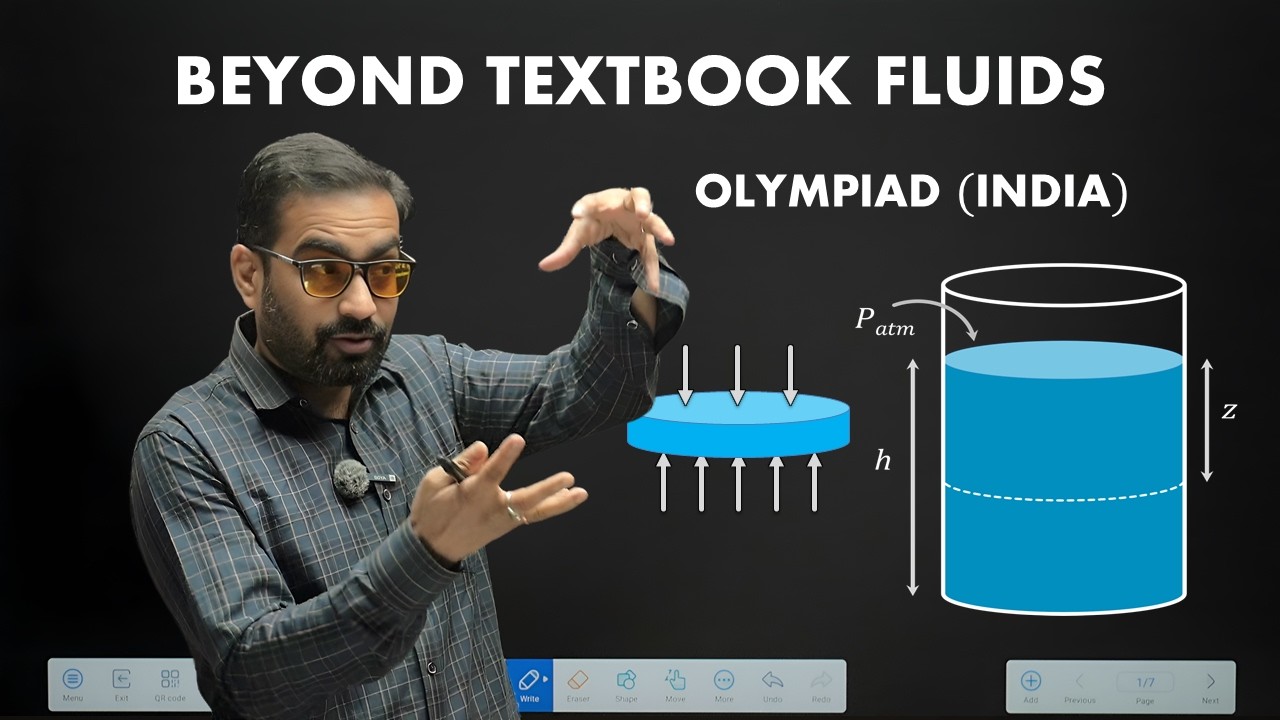
Question : Consider a long narrow cylinder of cross section A filled with a compressible liquid up to height h whose density ρ is a function of the pressure P(z) as ρ(z) = ρ₀/2 (1 + P(z)/P₀) where P₀ and ρ₀ are constants. The depth z is measured from the free surface of the liquid where the pressure is equal to the atmospheric pressure (P_atm).
(a) Obtain the pressure (P(z)) as a function of z. Obtain the mass (M) of liquid in the tube.
(b) Let P_i(z) be the pressure at z, if the liquid were incompressible with density ρ₀/2. Assuming that P₀ ≫ ρ₀gz obtain an approximated expression for ΔP = P(z) − P_i(z).
👇 👇 👇 👇 👇 👇 Related Playlists 👇 👇 👇 👇 👇 👇 👇 👇 👇
THIS Playlist : INPhO - PYQ
• Indian National Physics Olympiad - PYQ
Playlist on : Aptitude Test Problems in Physics, S.S. Krotov
• Krotov's "Mechanics"
Playlist on : Jaan Kalda's Handout for Mechanics
• Jaan Kalda's "Mechanics" for Physics Olymp...
Playlist on : Fluids - Pathfinder
• Fluids : Pathfinder
Playlist on : JEE Advanced PYQ (Mechanical Properties of Fluids)
• Fluids : JEE Advanced PYQ
☝️☝️☝️☝️☝️☝️☝️☝️☝️☝️☝️☝️☝️☝️☝️☝️☝️☝️☝️☝️☝️☝️
This problem from INPhO 2019 is a beautiful illustration of how the chapter "Mechanical Properties of Fluids" moves beyond elementary hydrostatics and introduces students to compressible fluids, which is a recurring theme in the Indian National Physics Olympiad. In the solution approach explained in the video, we begin by carefully understanding the physical setup of a vertical fluid column and identifying the reference point where the pressure equals atmospheric pressure. Using the condition for a fluid at rest under gravity, we relate the variation of pressure with depth to the local density of the fluid, keeping in mind that the density itself depends on pressure. This leads to a solvable relation between pressure and depth once the boundary condition at the free surface is applied. After obtaining the pressure as a function of depth, the mass of the liquid is calculated by conceptually slicing the column into thin layers and summing the contribution of each layer using the given density relation. In the second part, the video explains how to compare the real compressible liquid with an imaginary incompressible liquid of the same reference density, a comparison technique frequently used in the chapter "Mechanical Properties of Fluids" and repeatedly tested in the Indian National Physics Olympiad. By using the given assumption that the characteristic pressure constant is much larger than the hydrostatic pressure change, the pressure difference is approximated, allowing students to clearly see how compressibility modifies the pressure distribution. This detailed reasoning process reflects the analytical thinking expected in the Indian National Physics Olympiad and reinforces core ideas from the chapter "Mechanical Properties of Fluids".
Pressure is a physical quantity defined as the normal force exerted per unit area by a fluid on a surface in contact with it, and in fluid statics it increases with depth due to the weight of the fluid above, making it a central concept in solving problems from the chapter "Mechanical Properties of Fluids".
Density is defined as the mass per unit volume of a substance, and in this problem it is treated as a variable quantity dependent on pressure, which distinguishes compressible fluids from incompressible ones and is a key idea emphasized in Indian National Physics Olympiad problems.
The principle of hydrostatic equilibrium states that for a fluid at rest under gravity, the pressure at any point adjusts itself such that the net force on every small fluid element is zero, ensuring mechanical balance throughout the fluid column.
The approximation principle used in this problem states that when a physical parameter varies slowly compared to a dominant scale, higher-order effects can be neglected, allowing the system to be described accurately by a simplified expression, an idea that is frequently applied in advanced problems of the Indian National Physics Olympiad.
#olympiad #fluid #inpho
Повторяем попытку...
Доступные форматы для скачивания:
Скачать видео
-
Информация по загрузке: