Assumption of kinetic theory of gas class Xi physics ch kinetic theory of gas
Автор: Yashvendra Mithas
Загружено: 2026-01-16
Просмотров: 17
Описание:
This video discusses the assumptions of the kinetic theory of gases and the concept of pressure exerted by gases (1:24).
Here's a breakdown of the key points:
Assumptions of Kinetic Theory of Gases (4:48)
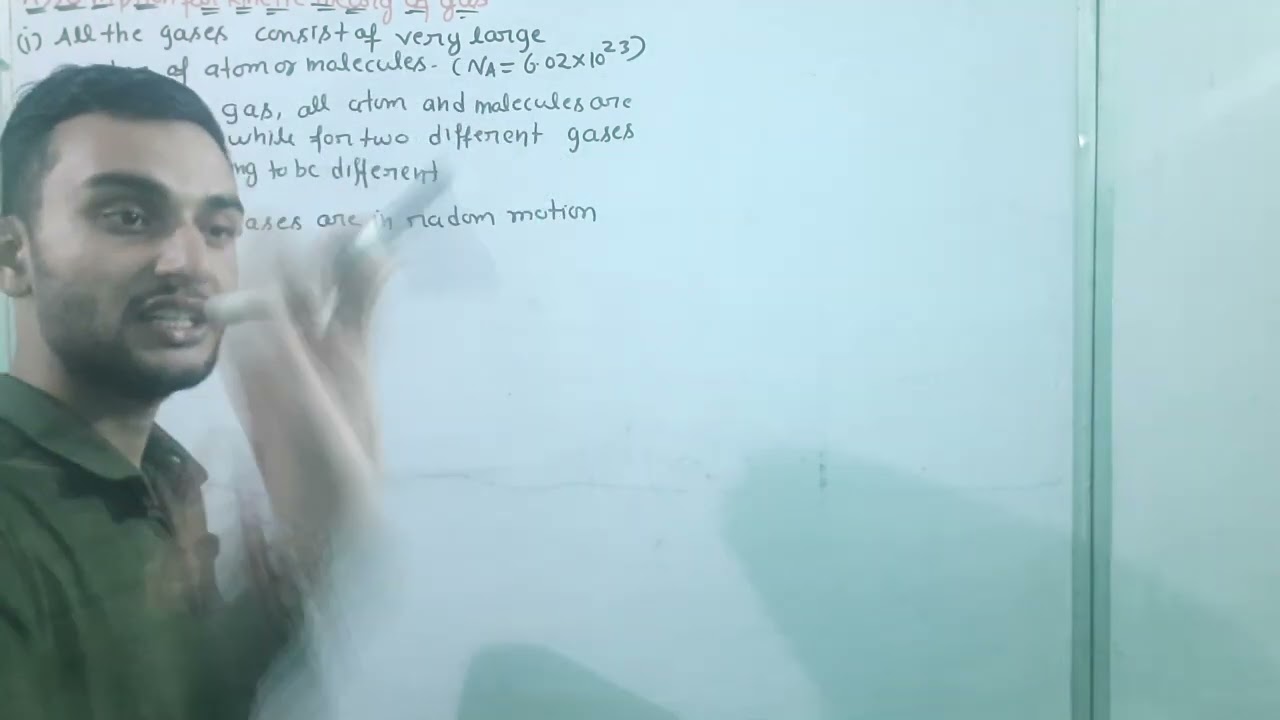
Composition of Gases: Gases consist of a very large number of atoms or molecules (5:23). For a given gas, all particles are identical, but particles of different gases are different (6:12).
Molecular Motion: Gas molecules are in continuous, random motion and travel in all directions (9:06). Their velocity can be around 500 kilometers per second (9:54), and they obey Newton's Laws of Motion (10:21).
Molecular Size and Volume: The size of gas molecules is very small compared to the distance they travel (11:47). For example, a molecule might be 2 Angstroms in size but travel 20 Angstroms (13:04). Consequently, the volume of the molecules themselves is negligible compared to the total volume occupied by the gas (14:40).
Intermolecular Forces: Gas molecules do not exert forces of attraction or repulsion on each other, except during collisions (16:25).
Mean Free Path: Molecules travel in a straight line between two successive collisions (19:01). The average straight distance between two successive collisions is called the mean free path (19:39).
Collision Duration: The time taken for a collision between two molecules is very small, almost instantaneous, compared to the time between collisions (21:22).
Molecular Density: The molecular density of gases is uniform at every point within the container, meaning there is no concentration of molecules at any single point (24:16).
Elastic Collisions: Collisions between gas molecules or between molecules and the container walls are perfectly elastic (27:18). This means there is no change in momentum or kinetic energy during these collisions, although the velocity of the molecules does change (28:55).
Concept of Pressure (33:29)
Pressure exerted by gases is due to the continuous bombardment of molecules on the surface of the container (38:13).
The video briefly introduces the formula for pressure as P = (1/3)ρc², where ρ is density and c is the root mean square velocity (39:24).
It also states that the pressure produced within a container is two-thirds of the kinetic energy of the gas (40:51).
Повторяем попытку...
Доступные форматы для скачивания:
Скачать видео
-
Информация по загрузке: