Solar PV Integration in IIT Roorkee Distribution system using Distributed Energy Storage
Автор: Narayana Prasad Padhy
Загружено: 2022-10-25
Просмотров: 7537
Описание:
The very first edition of the contest had dozens of applications from cities of all sizes and economic development levels from all continents. The submitted projects were evaluated by a jury composed of worldwide recognized experts in Smart Cities, and I am delighted to inform you that one of my projects, "D-SIDES," which began as an effort to make our IIT Roorkee campus smarter, has been selected as the winner of the 2022 IEEE Smart Cities Award Jury Award.
The proposed project aims to build future grids that are economical, dependable and powered by decentralised renewable energy sources. This will result in a decrease in the consumption of fossil fuels and savings for future generations. At first, the IIT Roorkee distribution network was without solar and entirely depends on a conventional grid system. To make a self-reliant distribution network, the IIT Roorkee has been performing pioneering work in recent years to develop an eco-friendly campus utilising renewable resources. The IIT Roorkee has installed solar PV systems in 36 different sites across campus with a total amount of 2.8 MW of solar power capacity. However, as solar installations proliferate, integration at the distribution level will be accompanied by significant challenges in the distribution network. These issues include overvoltage fluctuations, the unintended trip of solar inverters, the inability to use renewable energy during power outages, and additional issues that might occur during large-scale integration of renewable energy sources, such as peak energy deficit, system instability, etc. Furthermore, whenever power outages happen, the PV inverters are incapable of operating in islanding mode due to the absence of a strong grid which affects the critical and emergency loads. To address the aforementioned problem, smart grid technology must be integrated into the existing grid infrastructure. The ultimate goal is to build a self-sufficient, zero-emission green campus. Furthermore, the implementation of the energy storage system would allow for increased renewable energy utilisation while simultaneously lowering the carbon impact.
The literature stresses the perspective of the system from the component level with parameters distant from reality or a strong source. The ADMIRE lab is well-equipped for this, including RTDS, Opal-RT, and FPGA controllers. It aids in the real-time study of weak distribution networks with solar integration, as well as the development and implementation of a monitoring system. This focuses on real-time simulation and analysis by collecting real-time data from each bus in a network.
An advanced storage management algorithm is designed to optimise the selection, sizing, and placement of distributed storage systems while taking network configuration, probabilistic load variation, and solar generation into account in order to improve the efficacy and reliability of the distribution network with the least amount of investment. Prior to the actual deployment of BESS, a feasibility study and analysis will be carried out in the real distribution network utilising Power Hardware in Loop (PHIL) simulation. In this work package, the impact of the best-chosen BESS on the distribution network and vice versa is examined using inputs from optimization approaches. The PHIL study system consists of a reduced BESS prototype connected to the power amplifier. This is, in turn, connected to a weak distribution network simulated in real-time by considering inputs from various buses in the actual network. The PHIL study in this work package would help to visualise the actual performance of the BESS in the high PV integrated weak distribution network. Furthermore, the performance of the control system and its stability in real time can be studied under various practical conditions.
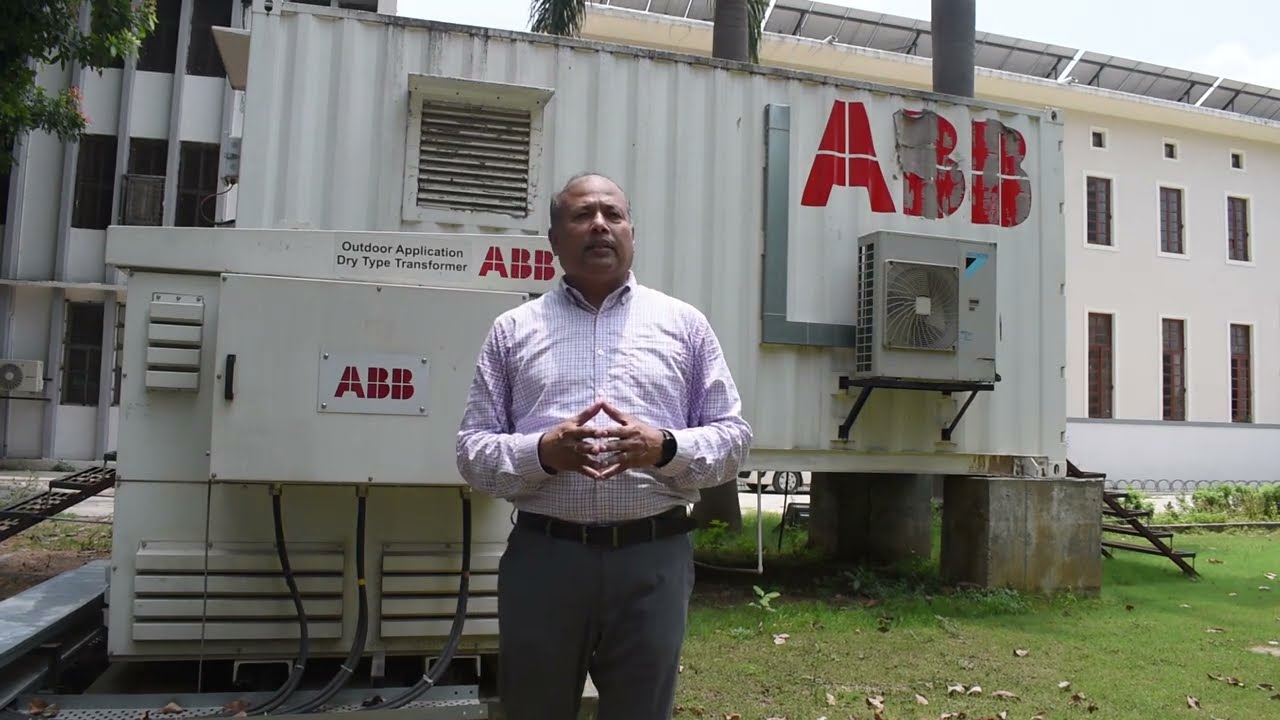
The developed technologies and innovative solutions are embedded in a practical IITR distribution network by integrating BESS at an optimal location with suitable mixing and sizing. A real-time command centre is built on the campus that can control, operate and monitor the IITR distribution grid with 50% of renewable installation under peak load and 90% renewable distribution grid during a few hours of the day. The command centre can shift the dispatchable loads, such as pumping stations, at a particular time of day based on energy management schemes deployed.
Повторяем попытку...
Доступные форматы для скачивания:
Скачать видео
-
Информация по загрузке: