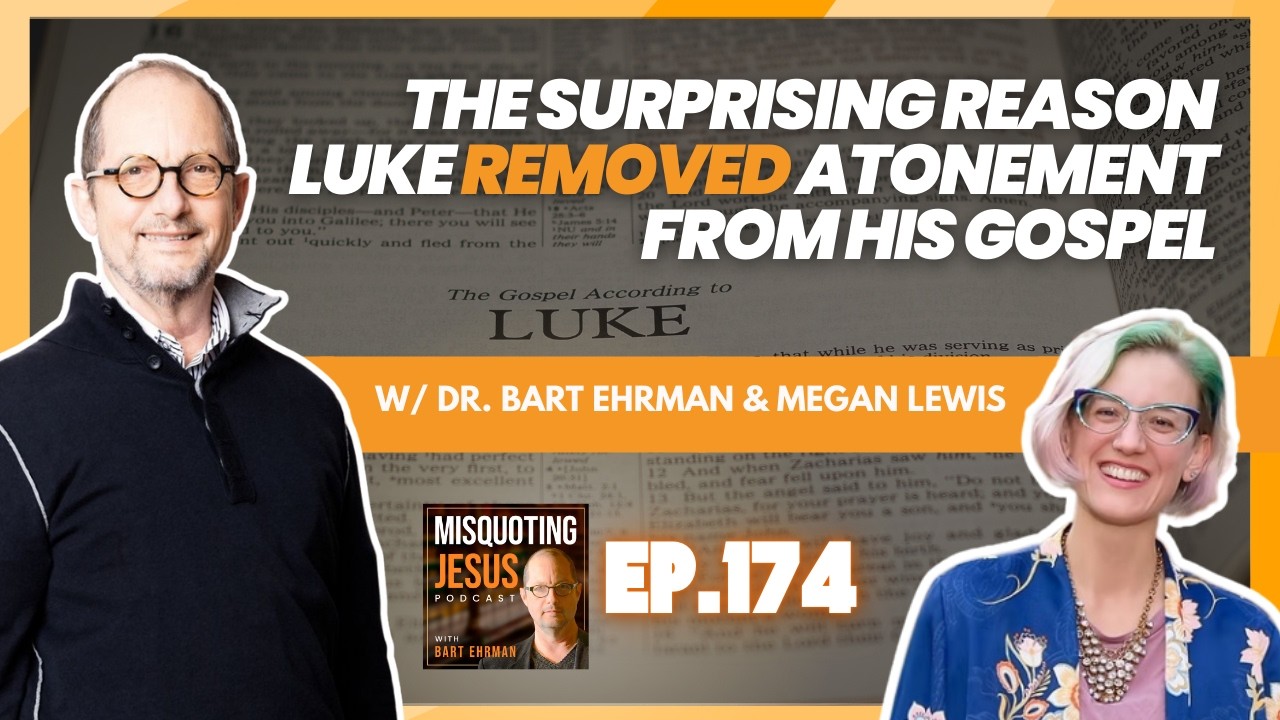
The Surprising Reason Luke Removed Atonement from His Gospel
Автор: Bart D. Ehrman
Загружено: 2026-02-17
Просмотров: 15771
Описание:
Links Mentioned in this Episode:
https://bartehrman.com/norway - Join Dr. Bart Ehrman on a Norway and Svalbard cruise, June 1-14, 2026
https://www.bartehrman.com/hbconference - our new conference New Insights into the Hebrew Bible – happening live on March 20-22. Get early-bird pricing through Feb 28th via this link.
Episode Description
Rewriting the Meaning of Jesus’ Death—Luke’s Unique Take
This episode opens with a compelling claim: The author of Luke’s Gospel borrowed heavily from Mark but was careful to remove every reference to atonement—that is, the core Christian idea that Jesus died “in our place” for the forgiveness of sins. If so much of Christian theology hinges on atonement, why would Luke set aside this concept? What did Luke think the death of Jesus actually accomplished?
Megan Lewis is joined by Bart Ehrman, a 6-time New York Times bestselling author and one of the world’s leading Bible scholars, to unpack this subtle but absolutely critical distinction. Their conversation moves from the meaning of “atonement” in Christian tradition and compares how Mark—and then Luke—describe Jesus’ death, Last Supper, and crucifixion. Throughout, Bart Ehrman explains not just what changes Luke made, but the far-reaching reasons for why he made them.
The episode also features insightful asides: from a story about the politics of academic publishing to practical examples like paying a parking ticket as a metaphor for atonement. There’s a bonus Q&A segment tackling the languages Jesus spoke and the language of the trial before Pilate, the ambiguity of Jesus’ words before Pilate in Mark’s Gospel, and even a playful discussion of why scholars still use Matthew, Mark, Luke, and John, when these names weren’t the actual authors.
Three Key Takeaways:
1. Luke’s Gospel Intentionally Removes Atonement Theology. Whereas Mark (and Paul, and most early Christian writers) see Jesus’ death as a sacrifice “for sins,” Luke excises every reference to Jesus dying for others. In Luke, Jesus’ death becomes the motivation for repentance.
2. Repentance, Not Sacrifice, Opens the Path to Forgiveness. In Luke–Acts, forgiveness is granted to those who genuinely repent and turn back to God—not because a price is paid.
3. This “Edit” Profoundly Affects Our Understanding of God and Salvation. The difference between a God who requires a sacrifice and a God who forgives those who repent is more than academic—it has shaped centuries of theological debate over divine justice, mercy, and the meaning of Jesus’ death.
Key Points
Luke uses Mark as a major source, frequently copying word for word.
Mark contains references to atonement: Jesus dies as a “ransom for many” and his body/blood are given “for you.”
Luke consistently removes or reworks these references when quoting Mark.
At the Last Supper, Luke’s earliest manuscripts omit the passage making Jesus’ body and blood “for you” and do not connect them to atonement—suggesting later scribes may have inserted it to align with Mark.
In Acts, Luke’s companion volume, forgiveness is always granted if people repent; never based on Jesus’ blood or sacrificial death paying a penalty.
The crucifixion scene is reworked: Mark’s “the curtain of the temple rips as Jesus dies”—signifying atonement—is instead, in Luke, ripped before Jesus’ death, marking a coming judgment on the Temple, not a new access to God.
Mark’s centurion, upon Jesus’ death, proclaims him “Son of God”; Luke’s centurion declares him “innocent”—shifting the focus from divine status to miscarriage of justice.
In Luke’s view, the purpose of Jesus’ death is to reveal the depth of human sinfulness and motivate repentance, not to be a substitutionary sacrifice.
Key Gospel passages—Mark 10:45, the Last Supper, the crucifixion—are dissected to show how Luke specifically edits or omits atonement language.
These changes reveal that core Christian beliefs, like penal substitution, are not as uniform in the earliest Christian literature as many presume.
Luke’s theology may actually be closer to Jesus’ own: that God is a forgiving Father, not a deity demanding sacrifice.
Understanding these differences helps you see the Gospels as living documents shaped by the theological debates of their time.
Questions Answered in the Episode
What is “atonement” and how is it understood in Christian tradition?
Where does Mark’s Gospel talk about Jesus’ death “for others”?
How does Mark use Old Testament themes (like the temple curtain) to link Jesus’ death with atonement?
How does Luke edit or remove references to atonement from his narrative and from Mark’s text?
Are there any exceptions—does Luke ever explicitly refer to atonement?
What’s the story with the disputed verses about Jesus’ body and blood “for you” at the Last Supper in Luke?
How did the crucifixion scene change from Mark to Luke, and why is this theologically important?
What does the ripped curtain symbolize in Mark versus Luke?
Повторяем попытку...
Доступные форматы для скачивания:
Скачать видео
-
Информация по загрузке: