India s Population Paradox
Автор: simplified biology
Загружено: 2026-02-23
Просмотров: 3
Описание:
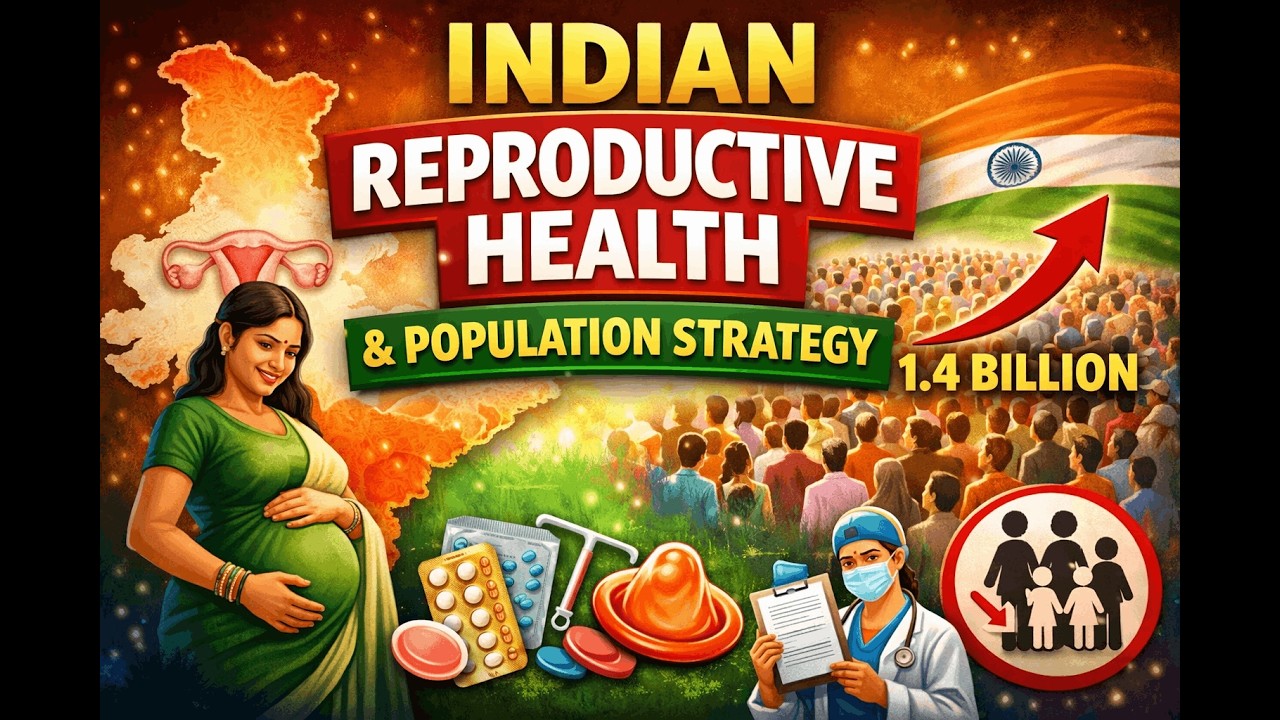
India was amongst the first countries in the world to
initiate action plans and programmes at a national level
to attain total reproductive health as a social goal.
These programmes called ‘family planning’ were
initiated in 1951 and were periodically assessed over
the past decades. Improved programmes covering wider reproduction-related areas are currently in operation under the
popular name ‘Reproductive and Child Health Care (RCH) programmes’.
Creating awareness among people about various reproduction related
aspects and providing facilities and support for building up a
reproductively healthy society are the major tasks under these
programmes.
With the help of audio-visual and the print-media governmental and
non-governmental agencies have taken various steps to create awareness
among the people about reproduction-related aspects. Parents, other
close relatives, teachers and friends, also have a major role in the
dissemination of the above information. Introduction of sex education
in schools should also be encouraged to provide right information to
the young so as to discourage children from believing in myths and
having misconceptions about sex-related aspects. Proper information
about reproductive organs, adolescence and related changes, safe and
hygienic sexual practices, sexually transmitted diseases (STD), AIDS,
etc., would help people, especially those in the adolescent age group to
lead a reproductively healthy life. Educating people, especially fertile
couples and those in marriageable age group, about available birth
control options, care of pregnant mothers, post-natal care of the mother
and child, importance of breast feeding, equal opportunities for the male
and the female child, etc., would address the importance of bringing up
socially conscious healthy families of desired size. Awareness of problems
due to uncontrolled population growth, social evils like sex-abuse and
sex-related crimes, etc., need to be created to enable people to think
and take up necessary steps to prevent them and thereby build up a
socially responsible and healthy society.
Successful implementation of various action plans to attain
reproductive health requires strong infrastructural facilities, professional
expertise and material support. These are essential to provide medical
assistance and care to people in reproduction-related problems like
pregnancy, delivery, STDs, abortions, contraception, menstrual problems,
infertility, etc. Implementation of better techniques and new strategies
from time to time are also required to provide more efficient care
and assistance to people. Statutory ban on amniocentesis for
sex-determination to legally check increasing menace of female foeticides,
massive child immunisation, etc., are some programmes that merit
mention in this connection. In aminocentesis some of the amniotic fluid
of the developing foetus is taken to analyse the fetal cells and dissolved
substances. This procedure is used to test for the presence of certain
genetic disorders such as, down syndrome, haemoplilia, sickle-cell
anemia, etc., determine the survivability of the foetus. In the last century an all-round development in various fields significantly
improved the quality of life of the people. However, increased health
facilities along with better living conditions had an explosive impact on
the growth of population. The world population which was around
2 billion (2000 million) in 1900 rocketed to about 6 billion by 2000 and
7.2 billion in 2011. A similar trend was observed in India too. Our
population which was approximately 350 million at the time of our
independence reached close to the billion mark by 2000 and crossed
1.2 billion in May 2011. A rapid decline in death rate, maternal mortality
rate (MMR) and infant mortality rate (IMR) as well as an increase in
number of people in reproducible age are probable reasons for this.
Through our Reproductive Child Health (RCH) programme, though we
could bring down the population growth rate, it was only marginal.
According to the 2011 census report, the population growth rate was
less than 2 per cent, i.e., 20/1000/year, a rate at which our population
could increase rapidly. Such an alarming growth rate could lead to an
absolute scarcity of even the basic requirements, i.e., food, shelter and
clothing, in spite of significant progress made in those areas. Therefore,
the government was forced to take up serious measures to check this
population growth rate.
The most important step to overcome this problem is to motivate smaller
families by using various contraceptive methods. You might have seen
advertisements in the media as well as posters/bills, etc., showing a happy
couple with two children with a slogan Hum Do Hamare Do (we two, our
two).
Повторяем попытку...
Доступные форматы для скачивания:
Скачать видео
-
Информация по загрузке: