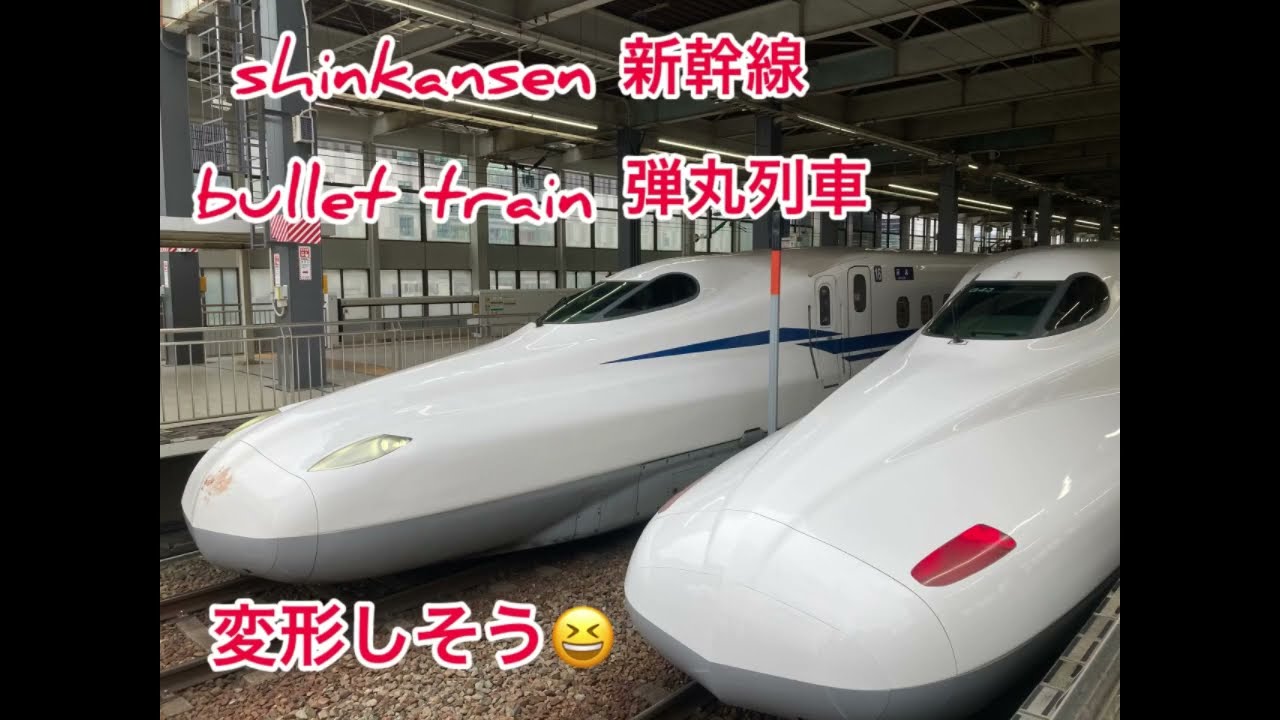
Riding the Japan's Bullet Train [Shinkansen HSR]‼️First Experience in Japan 4K❗Kereta Cepat Jepang
Автор: Walking Around
Загружено: 2024-06-03
Просмотров: 1225
Описание:
Route maps : https://maps.app.goo.gl/juVu6n3o3UxAz...
The Shinkansen (Japanese: 新幹線, [ɕiŋkaꜜɰ̃seɴ], lit. 'new main line'), colloquially known in English as the bullet train, is a network of high-speed railway lines in Japan. Initially, it was built to connect distant Japanese regions with Tokyo, the capital, to aid economic growth and development. Beyond long-distance travel, some sections around the largest metropolitan areas are used as a commuter rail network. It is owned by the Japan Railway Construction, Transport and Technology Agency and operated by five Japan Railways Group companies.
Starting with the Tokaido Shinkansen (515.4 km; 320.3 mi) in 1964, the network has expanded to currently consist of 2,951.3 km (1,833.9 mi) of lines with maximum speeds of 260–320 km/h (160–200 mph), 283.5 km (176.2 mi) of Mini-Shinkansen lines with a maximum speed of 130 km/h (80 mph), and 10.3 km (6.4 mi) of spur lines with Shinkansen services. The network presently links most major cities on the islands of Honshu and Kyushu, and Hakodate on the northern island of Hokkaido, with an extension to Sapporo under construction and scheduled to commence in March 2031. The maximum operating speed is 320 km/h (200 mph) (on a 387.5 km (241 mi) section of the Tōhoku Shinkansen).Test runs have reached 443 km/h (275 mph) for conventional rail in 1996, and up to a world record 603 km/h (375 mph) for SCMaglev trains in April 2015.
The original Tokaido Shinkansen, connecting Tokyo, Nagoya and Osaka, three of Japan's largest cities, is one of the world's busiest high-speed rail lines. In the one-year period preceding March 2017, it carried 159 million passengers,and since its opening more than five decades ago, it has transported more than 6.4 billion total passengers. At peak times, the line carries up to 16 trains per hour in each direction with 16 cars each (1,323-seat capacity and occasionally additional standing passengers) with a minimum headway of three minutes between trains.
The Shinkansen network of Japan had the highest annual passenger ridership (a maximum of 353 million in 2007) of any high-speed rail network until 2011, when the Chinese high-speed railway network surpassed it at 370 million passengers annually, reaching over 2.3 billion annual passengers in 2019.
Etymology
Shinkansen (新幹線) in Japanese means 'new trunk line' or 'new main line', but this word is used to describe both the railway lines the trains run on and the trains themselves. In English, the trains are also known as the bullet train. The term bullet train (弾丸列車, dangan ressha) originates from 1939, and was the initial name given to the Shinkansen project in its earliest planning stages. Furthermore, the name superexpress (超特急, chō-tokkyū), used exclusively until 1972 for Hikari trains on the Tōkaidō Shinkansen, is used today in English-language announcements and signage.
History
Japan was the first country to build dedicated railway lines for high-speed travel. Because of the mountainous terrain, the existing network consisted of 1,067 mm (3 ft 6 in) narrow-gauge lines, which generally took indirect routes and could not be adapted to higher speeds due to technical limitations of narrow-gauge rail. For example, if a standard-gauge rail has a curve with a maximum speed of 145 km/h (90 mph), the same curve on narrow-gauge rail will have a maximum allowable speed of 130 km/h (81 mph). Consequently, Japan had a greater need for new high-speed lines than countries where the existing standard gauge or broad gauge rail system had more upgrade potential.
Among the key people credited with the construction of the first Shinkansen are Hideo Shima, the Chief Engineer, and Shinji Sogō, the first President of Japanese National Railways (JNR) who managed to persuade politicians to back the plan. Other significant people responsible for its technical development were Tadanao Miki, Tadashi Matsudaira, and Hajime Kawanabe based at the Railway Technical Research Institute (RTRI), part of JNR. They were responsible for much of the technical development of the first line, the Tōkaidō Shinkansen. All three had worked on aircraft design during World War II.
https://en.wikipedia.org/wiki/Shinkansen
===
#walkingaroundindonesia #shinkansen #keretacepat #highspeedtrain #bullet #japan #japantravel #japanvirtualtour #hokuriku #hokurikuarchpass #tokyo #tokyojapan #tokyostation #nagano #naganocity #naganostation #bullettrains #walkingaround #walkingaroundtokyo #walkingaroundjapan #tokyo #japan #tokyostation #shinkansen #japanvirtualtour #japantour #japantravel #japantraveler #japantraveltips #jepang #walkingaroundindonesia #japan4k #japanstation
Повторяем попытку...
![Riding the Japan's Bullet Train [Shinkansen HSR]‼️First Experience in Japan 4K❗Kereta Cepat Jepang](https://imager.clipsaver.ru/JaLIN-5129k/max.jpg)
Доступные форматы для скачивания:
Скачать видео
-
Информация по загрузке:
![[FULL] TOKAIDO SHINKANSEN NOZOMI❗NAGOYA to TOKYO/Shinagawa - 🚄 Japanese Bullet Train - Japan HSR](https://imager.clipsaver.ru/Xkq_x91rFyw/max.jpg)

![[Full 2 hours] FUJI EXCURSION - JAPANESE LIMITED TRAINS❗Shinjuku Station to Kawaguchiko Mt Fuji](https://imager.clipsaver.ru/tIYakGulI90/max.jpg)