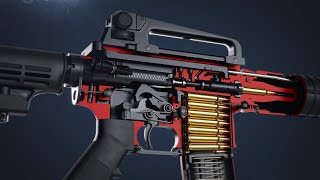
M14 Select-Fire Battle Rifle - Step By Step Disassembly & Reassembly
Автор: TheGreenLing
Загружено: 2020-07-29
Просмотров: 3102
Описание:
The M14 rifle, officially the United States Rifle, Caliber 7.62 mm, M14, is an American select-fire battle rifle that fires 7.62×51mm NATO (.308 in) ammunition. It became the standard-issue rifle for the U.S. military in 1959 replacing the M1 Garand rifle in the U.S. Army by 1958 and the U.S. Marine Corps by 1965 until being replaced by the M16 rifle beginning in 1968. The M14 was used by U.S. Army, Navy, and Marine Corps for basic and advanced individual training (AIT) from the mid-1960s to the early 1970s.
The M14 was the last American battle rifle issued in quantity to U.S. military personnel. It was replaced by the M16 assault rifle, a lighter weapon using a smaller caliber intermediate cartridge. The M14 rifle remains in limited service in all branches of the U.S. military, with variants used as sniper and designated marksman rifles, accurizing competition weapons, and ceremonial weapons by honor guards, color guards, drill teams and ceremonial guards. Civilian semi-automatic models are used for hunting, plinking, target shooting, and shooting competitions.
The M14 is the basis for the M21 and M25 sniper rifles which were largely replaced by the M24 Sniper Weapon System. A new variant of the M14, the Mk 14 Enhanced Battle Rifle (EBR), has been in service since 2002.
The M14 was developed from a long line of experimental weapons based upon the M1 Garand rifle. Although the M1 was among the most advanced infantry rifles of the late 1930s, it was not an ideal weapon. Modifications were already beginning to be made to the basic M1 rifle's design during the last months of World War II. Changes included adding fully automatic firing capability and replacing the eight-round en bloc clips with a detachable box magazine holding 20 rounds. Winchester, Remington, and Springfield Armory's own John Garand offered different conversions. Garand's design, the T20, was the most popular, and T20 prototypes served as the basis for a number of Springfield test rifles from 1945 through the early 1950s.
M14 rifles made by Springfield Armory and Winchester used forged receivers and bolts milled from AISI 8620 steel, a low-carbon molybdenum-chromium steel. Harrington & Richardson M14 production used AISI 8620 steel as well, except for ten receivers milled from AISI 1330 low-carbon steel and a single receiver made from alloy steel with a high nickel content.
After the M14's adoption, Springfield Armory began tooling a new production line in 1958, delivering the first service rifles to the U.S. Army in July 1959. However, long production delays resulted in the 101st Airborne Division being the only unit in the army fully equipped with the M14 by the end of 1960. The Fleet Marine Force finally completed the change from M1 to M14 in late 1961. Springfield Armory records reflect that M14 manufacture ended as TRW, fulfilling its second contract, delivered its final production increment in fiscal year 1965 (1 July 1964 – 30 June 1965). The Springfield archive also indicates the 1.38 million rifles were acquired for just over $143 million, for a unit cost of about $104.
The rifle served adequately during its brief tour of duty in Vietnam.Though it was unwieldy in the thick brush due to its length and weight, the power of the 7.62×51mm NATO cartridge allowed it to penetrate cover quite well and reach out to extended range, developing 2,560 ft·lbf (3,463 J) of muzzle energy. However, there were several drawbacks to the M14. The traditional wood stock of the rifle had a tendency to swell and expand in the heavy moisture of the jungle, adversely affecting accuracy. Fiberglass stocks were produced to resolve this problem, but the rifle was discontinued before very many could be distributed for field use. Also, because of the M14's powerful 7.62×51mm cartridge, the weapon was deemed virtually uncontrollable in fully automatic mode, so most M14s were permanently set to semi-automatic fire only to avoid wasting ammunition in combat.
The M14 was developed to replace seven different weapons—the M1 Garand, M1903 Springfield, M1917 Enfield, M1 carbine, M3 submachine gun, M1928/M1 Thompson, and M1918 Browning automatic rifle (BAR). The intention was to simplify the logistical requirements of the troops by limiting the types of ammunition and parts needed to be supplied. However, it proved to be an impossible task to replace all these weapons. The M14 was also deemed "completely inferior" to the World War II M1 Garand in a September 1962 report by the U.S. Department of Defense comptroller. The cartridge was too powerful for the submachine gun role and the weapon was simply too light to serve as a light machine gun replacement for the BAR.
Повторяем попытку...

Доступные форматы для скачивания:
Скачать видео
-
Информация по загрузке: