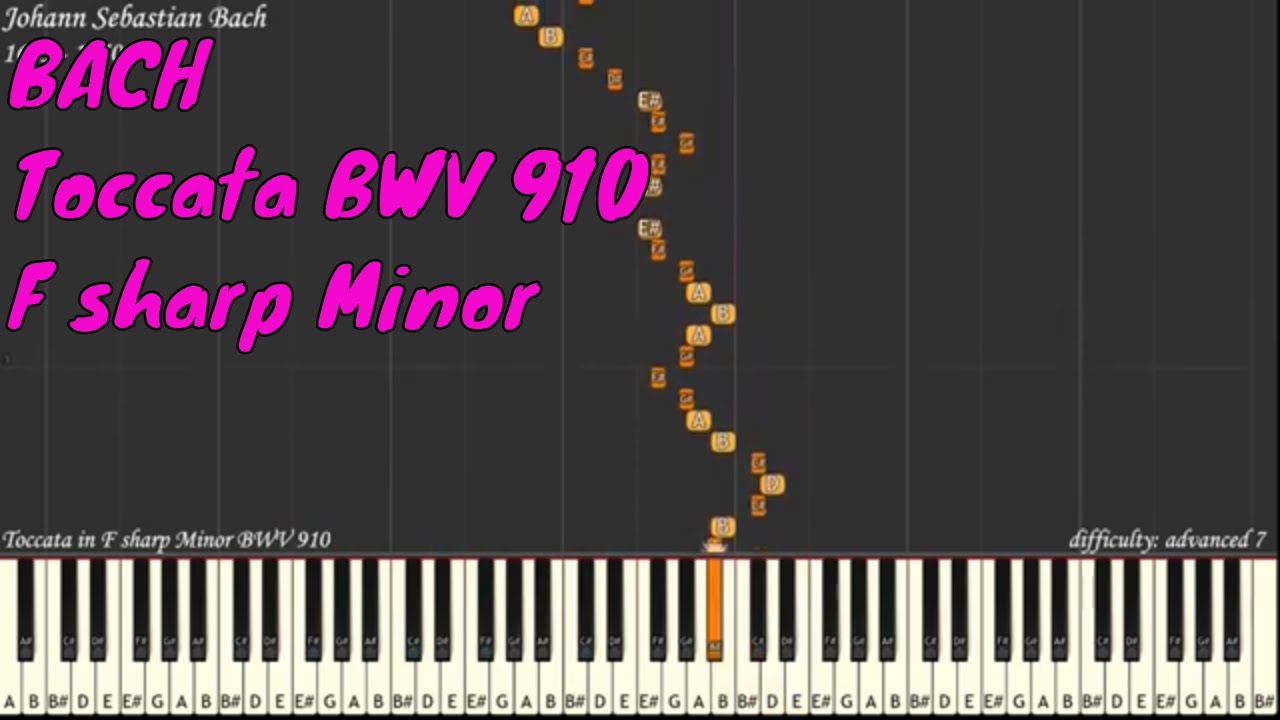
JS Bach - Toccata in F sharp Minor BWV 910 | Synthesia Piano Tutorial | Library of Music
Автор: Library of Music
Загружено: 2019-08-10
Просмотров: 5123
Описание:
At the request of David Hernandez Rivero
Toccata in F sharp Minor BWV 910 - difficulty: advanced 7
In his formative years, Johann Sebastian Bach composed many youthful pieces based on earlier models. Indeed, throughout his life he would use the formal models of other countries as structural guidelines for his own work. In the case of the Toccata in f-sharp minor, Bach used the North German Toccata as his model. While this work, along with the other keyboard toccatas, give the listener or performer glimpses into what would blossom into Bach's mature style, its quality is inconsistent, suggesting perhaps that its individual sections were composed separately and later assembled. The dating for this composition is problematic, though it might be the latest of the seven "manualiter" (or hands only) toccatas, judging by its mysterious key and chromatic fugue subject. In this work we observe the oscillation between freely composed sections and the more strict fugal sections.
The toccata opens with a rapid fantasia-like section and subsides into a dramatic adagio. This section, and the final fugue, led many early Bach scholars in incorrectly place this toccata much later than the other six in Bach's Coethen period (1717-1723). Modern scholars take this more advanced section, which has similarities to earlier compositions such as the Capriccio BWV 992, as evidence that Bach might have compiled fragmented pieces together into one work; furthermore, as the embellishment in the section is more advanced than earlier works, it is supposed that it was added later, perhaps for the benefit of his students. The fugue which follows, marked "presto e staccato" is one of Bach's least adventurous in this genre. The subject is rather uncreative, and the counterpoint equally simple. Despite this, Bach does modulate to remote key regions for the time period, including d-sharp minor, and uses an extended implied shift of meter from common time to 3/4 time (which is quite an advanced technique). The moderato bridge between this and the final fugue sounds a bit directionless, though it is clearly worked out from an easily deduced harmonic framework. At the same time, it seems almost too long. The final fugue, however, is worth waiting for. Perhaps the most advanced section in all of the manualiter toccatas, the chromatic fugue subject seems a precursor to the more famous Chromatic Fugue (BWV 903). Also, the underlying ground bass used by the dance form implied by this movement (the chaconne) appears to be used in the slightly later Cantata #12.
Description by Nemesio Valle
Library of Music grades piano music based on difficulty, in order to provide guidance for amateur pianists who want to climb the ladder and progress in an organized way.
Library of Music creates synthesia videos at request. If you want to see any particular piece in a synthesia video, ask for it in the comments section below.
Popular playlist:
Bach's Well Tempered Clavier book 1 playlist: https://bit.ly/2soGrqh
The grading system is as follows:
Beginner/Easy pieces: grades 1; 1.5; 2; 2.5; 3; 3.5
Intermediate pieces: grades 4; 4.5; 5; 5.5; 6; 6.5
Advanced/Difficult pieces: grades 7; 7.5; 8; 8.5; 9; 9.5; 10
Повторяем попытку...
Доступные форматы для скачивания:
Скачать видео
-
Информация по загрузке: