U-Boats Could Hear Every Ship — Until a 64-Year-Old Whaler Taught the Navy to Make Sound Lie
Автор: War Engineering Chronicles
Загружено: 2026-02-17
Просмотров: 2780
Описание:
Story #45 | War Engineering Chronicles | SERIES 4
Winter 1943. North Atlantic. U-boats were slaughtering convoys.
The Battle of the Atlantic was the longest continuous campaign of WWII. German submarines prowled shipping lanes, sinking the supplies Britain needed to survive. In 1942 alone, U-boats destroyed nearly 6 million tons of Allied shipping.
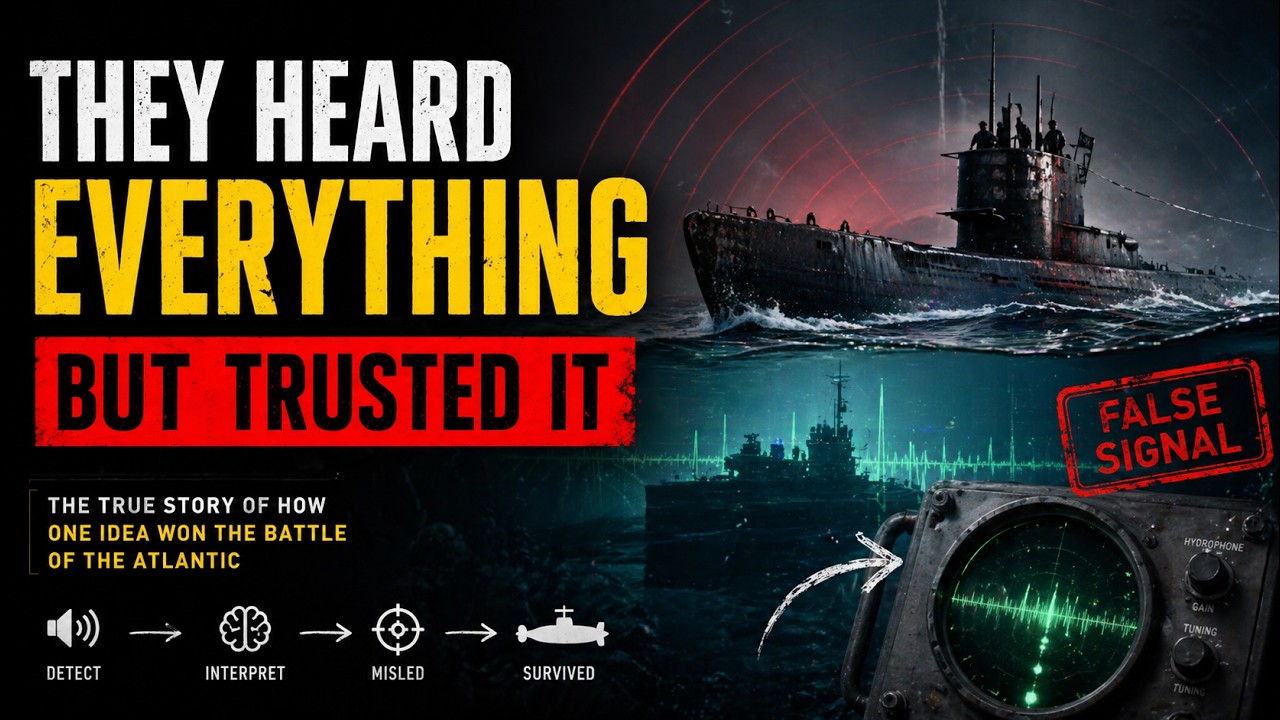
The submarines hunted by SOUND.
German sonar operators tracked ships by propeller noise alone. They could identify vessel types by acoustic signatures — the distinctive sounds each ship made. They didn't need to see targets. They only needed to listen.
Depth charges were failing. Submarines heard escorts approaching, tracked the splashes, calculated sinking patterns. They simply moved away.
Sound gave U-boats an advantage that seemed unbeatable.
Lt. Commander Robert Hayes searched for months. Then someone mentioned Scottish fishermen who had techniques for masking their approach from whales — creatures with hearing far more sensitive than any submarine sonar.
Angus MacLeod. 64 years old. 41 years hunting whales in Scottish waters.
"Whales hear you before you see them," Angus explained. "They know what a boat sounds like from five miles away. So you learn to be what you're not."
His insight: "The whale hears what it expects to hear. Its brain fills in the rest. You don't have to fool its ears completely. You just have to give its brain something wrong to work with."
His solution: Acoustic decoys using whale bones that resonated at propeller frequencies. Devices creating phantom ship sounds, drawing torpedoes away from real vessels.
The decoys worked because:
Whale bones naturally resonate underwater
Could be tuned to mimic propeller cavitation
Submarine commanders made split-second decisions
By the time they realized the deception, torpedoes were chasing phantoms
Results:
Convoy losses declined significantly
Torpedo expenditure increased, hit rates decreased
Submarines wasted time tracking phantom targets
2,900 sailors survived
—
⏱️ TIMESTAMPS:
0:00 - Winter 1943: North Atlantic graveyard
0:24 - U-boats hunting in wolf packs
0:43 - They could hear everything
0:45 - Atlantic convoys: lifeline of the war
1:31 - 6 million tons sunk in 1942
2:36 - Depth charges weren't working
3:50 - Sound: the key to undersea warfare
4:27 - German sonar operators: masters of detection
5:08 - The ocean was their element
5:14 - Lt. Cmdr. Hayes assigned the problem
6:30 - Angus MacLeod: 41 years whaling
7:30 - "Whales hear everything"
8:40 - "You learn to be what you're not"
10:00 - Whale bone acoustic resonators
12:00 - Deployment and tactics
13:31 - Results: 2,900 sailors saved
14:12 - Angus returns to Scotland
15:24 - Legacy: modern acoustic countermeasures
—
📚 SOURCES:
Battle of the Atlantic convoy records and loss statistics
Anti-submarine warfare development documentation
Acoustic countermeasures and decoy technology history
Scottish whaling industry traditional practices
—
🔔 SUBSCRIBE to War Engineering Chronicles
📖 Series 4, Story #45
🎬 New episodes weekly
#WWII #WW2 #BattleOfTheAtlantic #UBoat #Submarine #Whaler #Scotland #AcousticWarfare #ConvoyDefense #ForgottenHeroes #NavalWarfare #WarStories #Sonar #Torpedoes
Повторяем попытку...
Доступные форматы для скачивания:
Скачать видео
-
Информация по загрузке: