America Had No Seat Belt Law Until 1968 — So How Did Americans Survive the Road?
Автор: Not Boring History
Загружено: 2026-10-19
Просмотров: 181
Описание:
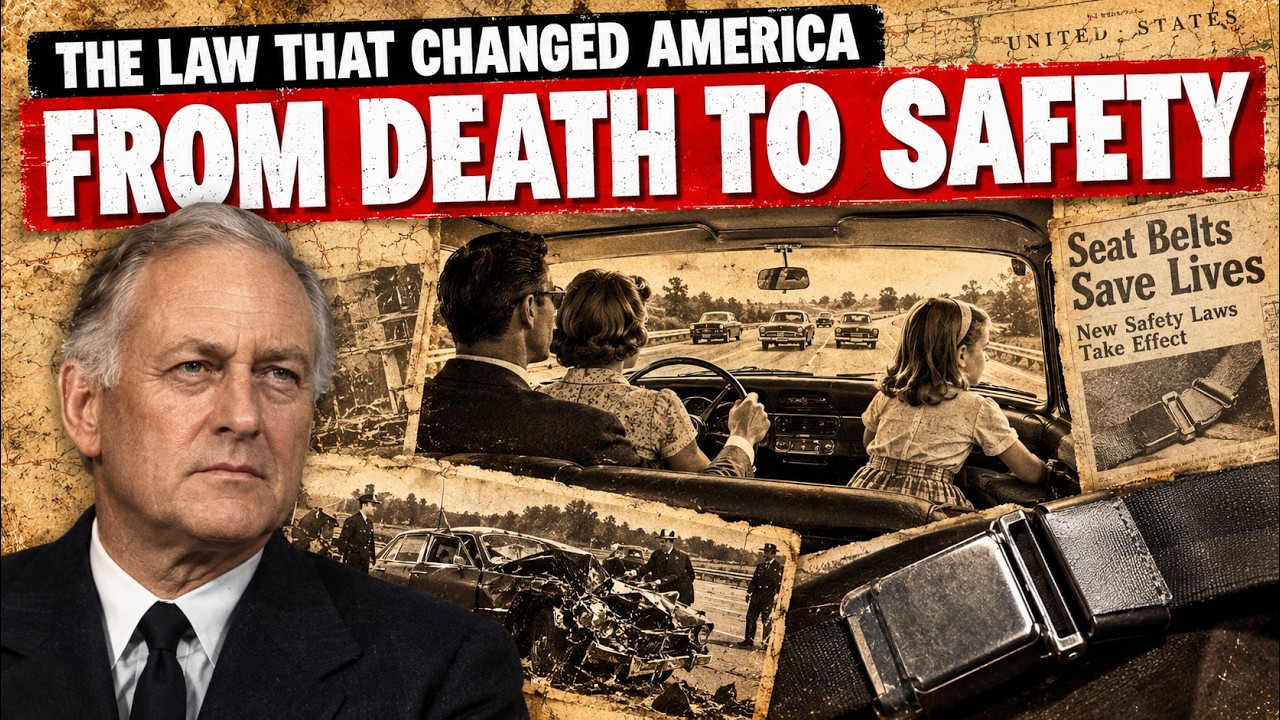
In 1966, a father loads his family into a station wagon, and in the front seat a little girl kneels on the cushion with one hand on the dashboard, watching the road roll by. Nobody in that car is breaking a rule, and by the standards of the day nobody is even being careless. That same year, 50,894 Americans died on the road. This is the strange, forgotten story of how a country that once cut seat belts out of its own cars, and sent its first belt-offering carmaker's customers back to the dealership to demand removal, ended up buckling up without a thought, thanks to a pilot who survived a crash, a Swedish engineer who gave away his patent, a lawyer followed by detectives, and two crash-test dummies.
Discover how Hugh DeHaven, a young military pilot, survived a mid-air collision in 1917 and spent years proving that a crash is really two collisions: the car hits the tree, then you hit the car. Learn how he founded the Crash Injury Research project at Cornell in 1942 and teamed up with the Indiana State Police in the 1950s. Understand why Nash Motors, in 1949, fitted roughly 40,000 cars with factory lap belts and found that only about 1,000 were ever used. See how Robert McNamara pushed Ford's Lifeguard safety package for the 1956 model year, with one in seven buyers ordering belts and 43 percent ordering padding.
This video dives deep into the myths that kept people unbuckled. We explore the belief "I'd rather be thrown clear," the fear of fire and water, and the data gathered by state policeman Elmer Paul showing that being thrown from the vehicle was the leading cause of fatal injuries, while fire and submersion account for less than one tenth of one percent. We uncover the early state laws in New York and Wisconsin that demanded anchors or belts in new cars but never required anyone to wear them, and the story of Nils Bohlin, who joined Volvo in 1958 and designed the three-point belt that Volvo introduced in 1959 and then offered free to every other carmaker.
Finally, we tell how Ralph Nader's 1965 book Unsafe at Any Speed and General Motors' clumsy investigation of him led to the National Traffic and Motor Vehicle Safety Act, signed on September 9, 1966, and to the first federal standard in 1968. We follow the buzzer of 1972, the ignition interlock of 1974 that raised belt use from 7 to 48 percent before an angry Congress killed it, the pinball match over airbags, the Supreme Court ruling of 1983, and Elizabeth Dole's 1984 rule that pushed states toward belt laws. New York led in 1985, and the Vince and Larry dummy campaign helped raise belt use from about 14 percent to 79 percent.
Today more than nine in ten front-seat occupants buckle up, and the federal figure for last year was 91.2 percent. Yet nearly half of those who die in passenger vehicle crashes were unbelted. A habit you perform without thinking took generations of research, lobbying, anger and humor to build.
If you love American history, automotive history, consumer rights, public policy, or untold stories of everyday life, this is a video you cannot miss.
#SeatBelt #SeatBelts #UnsafeAtAnySpeed #RalphNader #HughDeHaven #NilsBohlin #Volvo #ThreePointBelt #NashMotors #RobertMcNamara #FordLifeguard #CornellCrashResearch #VinceAndLarry #CrashTestDummies #ElizabethDole #NHTSA #FMVSS208 #Airbags #Corvair #CarSafety #RoadSafety #BuckleUp #AutomotiveHistory #AmericanHistory #USHistory #HistoryDocumentary #ForgottenHistory #HiddenHistory #TrafficSafety
Повторяем попытку...
Доступные форматы для скачивания:
Скачать видео
-
Информация по загрузке: