Electrofacies, a guided machine learning, for improving facies logs for the practice of geomodeling
Автор: GeoWhiz Tutorials
Загружено: 2020-09-20
Просмотров: 1267
Описание:
A key impact on reservoir studies is a rigorous strategy around facies for modeling. Decisions on facies, how to define them and how to model them are an important factor in creating reservoir models that are useful. The modeled facies provide local geological features, patterns and properties. Facies are derived from many sources with varied concepts, definitions, scales and purposes. Classically, facies are a visual interpretation of the face of a rock driven by geological concepts. In petroleum reservoirs, we commonly use surface observations of ancient analogues compared to modern settings, in addition to sparse and imprecise subsurface information to determine facies logs. Is this adequate? The under used application of electrofacies modeling provides a robust and encompassing framework of methods to bring consistency to facies logs thus enhancing the integration of multi-scale data for reservoir modeling.
The current industry best practice for modeling reservoir heterogeneities related to flow is to apply a hierarchical workflow of simulation of facies first, followed by property simulations within each modeled facies. The input facies categories each represent consistent statistical properties across a study area. Fluid distributions as well as flow and mechanical properties are dependent on the characterization by each facies. Accounting for known physical behavior when distributing properties by facies facilitates reasonable responses in flow models.
Methods and Workflow
The classification of lithofacies involves various approaches. There are visual methods such as combining rock fabric, pore space and petrophysics and these may include detailed description of depositional and diagenetic processes from core or image data. Petrofacies classification involves defining rules-based petrophysical categories, e.g. using log cutoffs or cross-plot polygons. E-facies classification typically applies multivariate statistics using wireline logs and visual core or image description. The advantage of e-facies is combining both the important geological classifications with the petrophysical data.
Visually interpreted facies must be checked for petrophysical consistency, i.e. the distinctness of petrophysical distributions, which is not guaranteed. Application of e-facies, multivariate classification can improve consistency and is beneficial for the hierarchy of modeling workflows. The result is to enforce the lithological characteristics based on distinct rock properties measured and to be distributed in models at the log curve scale. A brief discussion of five assumptions underlying standard discriminant analysis provides practical guidance on checking, cleaning and improving facies inputs whether the facies are used directly for modeling or as a part of a training set (visual facies and well logs) for classification methods. These five assumptions are all violated to some degree by the training sets.
Discriminant analysis, although useful to understand, is a parametric method applicable to simply organized data distributions and clusters, and is not optimal for typically complex geological facies log data distributions. When using visual facies and well logs as training sets for e-facies classifications, non-parametric methods tend to be most effective given the varied sizes and shapes of the facies in the multivariate distributions.
E-facies modeling workflow steps are not widely established in the industry practice or promoted by the software vendors. There is a lack of best practice guidance and training. Misuse and lack of dissemination of software to G&G staff holds back the technology. Treating the e-facies practice as interpretive, a guided process, is part of obtaining useful results.
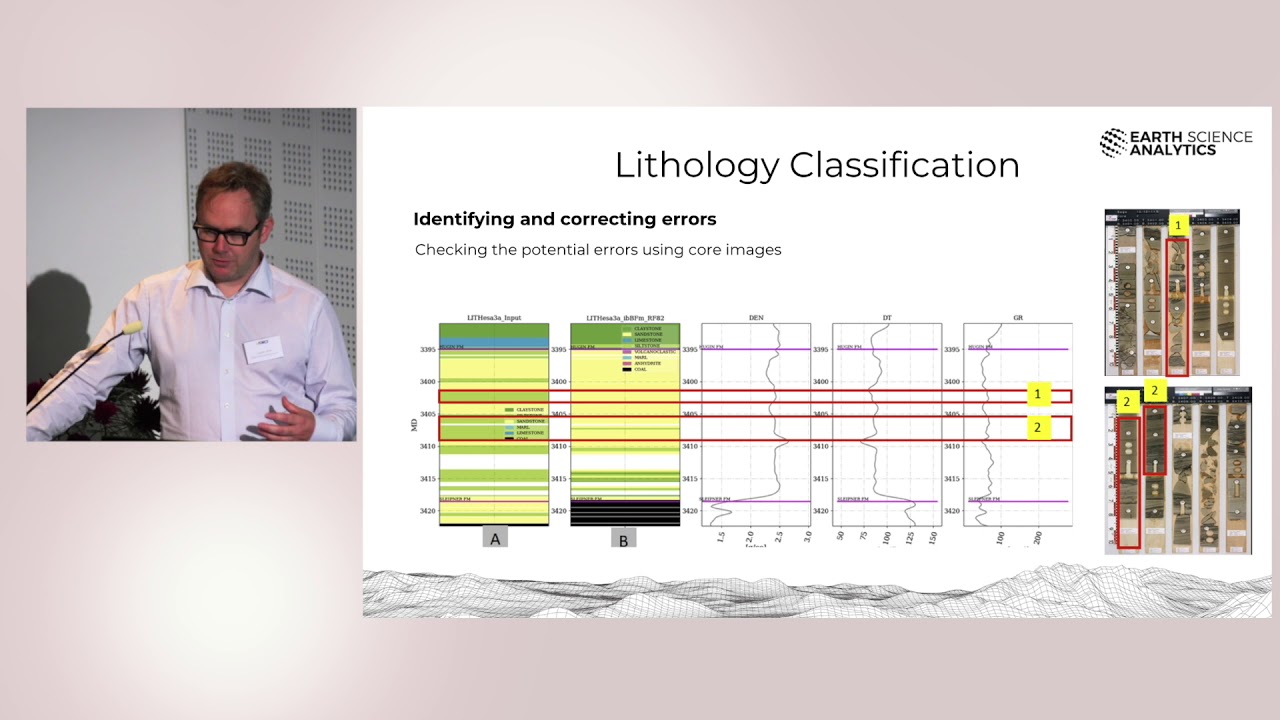
Thorough training set preparation is imperative. The visual facies may be considered to be at a different scale or resolution than well logs, are prone to slight errors, and have overlapping distributions. Cleaning involves inspecting and trimming input facies based on the outlier tails of the distributions for each log parameter. Paradoxically, cleaning the training set entails interpretive judgement and alters the statistical measures used to check the results, e.g. increasing the percentage of correctly assigned facies and changing initial facies proportions. However, once deemed cleaned, different model parameter options may be consistently compared. The final e-facies logs will be judged not only by correct assignment rates, reasonable proportions, but for consistency with the geological concepts. Assignment errors tend to be a reclassification to an adjacent quality facies, feasibly aiding consistency for geomodeling. Thus the process is guided and not statistically unbiased. Examples will be shown with aspects of the workflows. The industry practices around preparing facies logs for modeling are diverse and can benefit from the controlled application of electrofacies classification.
Повторяем попытку...

Доступные форматы для скачивания:
Скачать видео
-
Информация по загрузке: