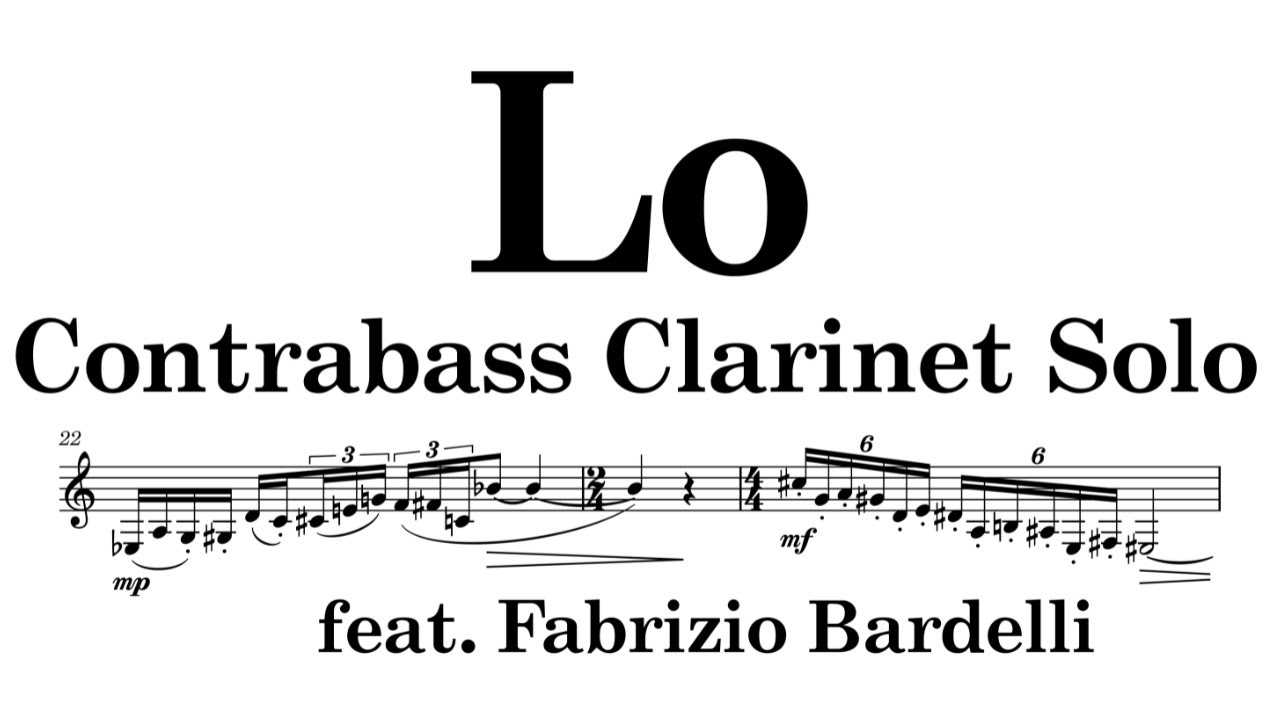
Lo (contrabass clarinet solo), by David Bennett Thomas
Автор: David Bennett Thomas
Загружено: 2025-12-26
Просмотров: 552
Описание:
I. Deeper Still 0:07
II. Rodents of Unusual Size 2:26
III. Soundings 3:59
IV. Leaky Faucet 6:37
V. Bird Backwards 9:13
Originally composed for contrabassoon, this version for contrabass clarinet was requested by Fabrizio Bardelli, whose performance you hear on this video. Thank you Fabrizio!
For score inquiries (I sell this piece as an inexpensive PDF), please contact me through my website: https://www.davidbthomas.com/contact/
Here is the first contrabass clarinet piece I composed, called Bottom Feeders • Bottom Feeders (contrabass clarinet solo),...
Here is the original version of Lo, for contrabassoon • Lo - Five Pieces for Contrabassoon, by Dav...
My clarinet playlist: • Music for clarinets, by David Bennett Thomas
My playlist of unaccompanied pieces: • Unaccompanied pieces for each instrument- ...
Program notes:
I composed Lo for Amelia del Caño in the winter of 2025. I had been working towards composing a solo piece for each instrument, and the mighty contrabassoon was next on my list. After releasing the contrabassoon version, I received requests the first day for contrabass clarinet and bass tuba versions. I love the low instruments, so it was pure joy to work on the piece with Amelia. The piece consists of five movements. It begins and ends with an elegy, and in between there are three character pieces.
The first movement is “Deeper Still (for Corrie)”. The piece is in memory of Corrie ten Boom, a woman who risked her life hiding Jewish people in her home during the days of the holocaust (for which she was later imprisoned and placed in solitary confinement). As I reflected on the depths of her life, and the profundity of a line she often spoke about God’s forgiveness- “There is no pit so deep that he is not deeper still,” and the depths of the instrument, “Deeper Still” felt like the fitting opening for this set of pieces.
The second movement is a scurrying one, driven by the sound of the punching sforzando low notes heard in the opening measures. They sounded to me like a large, mythical beast snorting air out of its nostrils. The title is from the 1987 adventure movie The Princess Bride, in which the hero is warned about the “Rodents of Unusual Size” that he might encounter in the forest.
Next up is “Soundings.” While composing the original version of this piece, the great depths of the contrabassoon (the lowest instrument in the orchestra) led me to an image of a ship measuring down to the bottom of the ocean to determine the depth of the water, which is depicted by descending intervals that create a sense of dropping a line into the water in order to measure down to the sea floor. In this movement I also have the player imitate the sound of foghorns as they play long tones. The last two lines of music are five descending intervals from the pitch F. Because the measurements become increasing deeper, the length of time required to hit the bottom note increases as the anchor drops through deeper and deeper ocean depths.
“Leaky Faucet” is the fourth movement. I once lived in an apartment where a slowly leaking faucet kept me awake. It dripped like clockwork, and entered my thoughts and dreams unescapably. In this movement, there is an A that sounds every eight beats. Other ideas and events float by freely, like little dream fragments, but that A is relentless, sometimes alone, sometimes interrupting an idea that has already started. It also fits into patterns of simultaneously ascending and descending scales of various types that crisscross past each other (chromatic, whole tone, diminished chord outlines). It’s always there, dripping away, sounding every eight beats.
The final movement is “Bird Backwards (for Charlie)”. This movement is in an elegy for Charlie Parker, and its pitches are Parker’s song Donna Lee in reverse order. Much like in the way a serial composer is given the next pitches they must use in their melodies, so was the case with my self-imposed challenge with this movement. Everything was optional (register, rhythm, articulation, tone color, dynamics) except the order of the 208 pitches. This resulted in a transformation of the tune in such a way that no one would hear or suspect that the tune was even in there- like a secret code that created a personal connection with the great artist Charlie Parker. I wasn’t even sure that I should reveal this, but there you have it.
Повторяем попытку...
Доступные форматы для скачивания:
Скачать видео
-
Информация по загрузке:


![Худшие музыкальные инструменты для игры [Рейтинг]](https://image.4k-video.ru/id-video/TI7DCnuAZiE)