From Local to Global: How Polarization Challenges the International Order
Автор: Paris Peace Forum
Загружено: 2025-10-29
Просмотров: 189
Описание:
(Session co-organized with The Harry Frank Guggenheim Foundation).
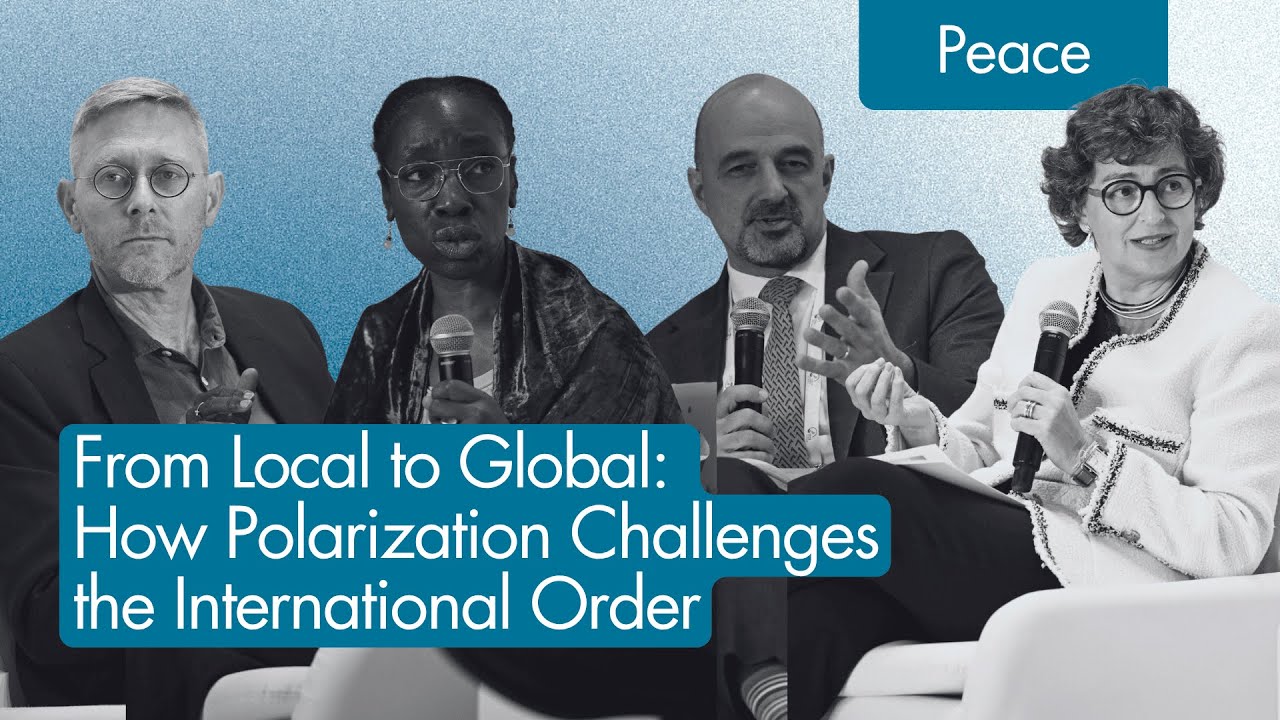
The Paris Peace Forum panel moderated by Daniel Wilhelm, President of Harry Frank Guggenheim Foundation traced a clear trajectory from the collapse of domestic trust to the rise of a transactional foreign policy that incapacitates cooperation. This panel framed the challenge of polarization as a "radical disconnect" at every level of society, fundamentally reshaping how states act beyond their borders.
The analysis first redefined the term 'polarization.' Shamil Idriss Chief Executive Officer at Search for Common Ground argued that the critical threshold is crossed "when major groups see one another as an existential threat." This perception transforms political disagreement into a precursor for violence, making confrontation seem necessary. He compared this phenomenon to a fever: a dangerous symptom that complicates treatments, yet is not the root cause of the illness. The underlying disease, Idriss argued, is the collapse of trust—both in institutions and between communities. Citing a landmark Lancet study on COVID-19 responses, he noted the most effective variable was not a country’s wealth or political system, but its levels of social and institutional trust, underscoring that societal resilience is built on a foundation of shared confidence, which is now rapidly eroding.
The link between this internal decay and outright violence is neither new nor inevitable, but its foundational elements are consistent. Comfort Ero, President and Chief Executive Officer of the International Crisis Group cautioned against a simple linear progression from populism to conflict, pointing to historical precedents like the Rwandan genocide and apartheid South Africa, where hate speech and systemic exclusion—long before the current populist wave—drove catastrophic violence. According to her, the most important factors are a winner-takes-all political culture, the breakdown of mediating institutions, and narratives of exclusion. Citing the example of Kenya, Ero observed that these dynamics are only now being treated as a global crisis because they are afflicting Western nations. The problem is not new, "it was the old-fashioned radio that was the source of the worst kind of crimes that we've seen in the last 30 years," she stated, reminding that the mechanisms of division adapt, but the underlying social fractures are timeless.
Arancha González Laya, Dean of the Paris School of International Affairs (PSIA), Sciences Po Paris and Former Minister of Foreign Affairs, Kingdom of Spain articulated how this domestic "radical disconnect" translates directly into a dysfunctional foreign policy. She identified four common characteristics of states gripped by this internal crisis. First is the primacy of an "us versus them" worldview that leads to the dehumanization of the other, particularly visible in migration debates. Second is a marked preference for raw "power over law," undermining the rules-based order. Third is a reliance on "transactionalism over systemic investments," where long-term global challenges are approached with a short-term, price-tag mentality. Finally, she highlighted the construction of a false dichotomy between sovereignty and solidarity, arguing that these forces are not antagonistic but symbiotic, as the international order was created by sovereigns precisely to manage their interdependence.
This shift toward transactionalism and nationalism is fueled by a profound crisis of performance in liberal democracies. Nils Gilman, Senior Vice President of Programs at the Berggruen Institute argued that liberalism has become overly focused on procedure instead of delivering substantive outcomes for its citizens, creating a vacuum that populists are eager to fill. Gilman noted that technology acts as an accelerant, with new media platforms enabling both constructive community-building and the rapid organization of extremist movements.
The panel illuminated a vicious feedback loop: domestic institutional failure erodes public trust, fueling a divisive politics, which in turn generates a foreign policy that undermining the international cooperation essential to solve the very problems driving domestic discontent. The core challenge for policymakers is to re-establish the link between rules-based international engagement and tangible domestic prosperity, proving that cooperation is key to safeguarding sovereignty.
Follow us on social media
• 𝗧𝘄𝗶𝘁𝘁𝗲𝗿 - / parispeaceforum
• 𝗟𝗶𝗻𝗸𝗲𝗱𝗜𝗻 - / parispeaceforum
• 𝗙𝗮𝗰𝗲𝗯𝗼𝗼𝗸 - / parispeaceforum
• 𝗜𝗻𝘀𝘁𝗮𝗴𝗿𝗮𝗺 - / parispeaceforum
• 𝗧𝗶𝗸𝗧𝗼𝗸 - / parispeaceforum_
Повторяем попытку...
Доступные форматы для скачивания:
Скачать видео
-
Информация по загрузке: