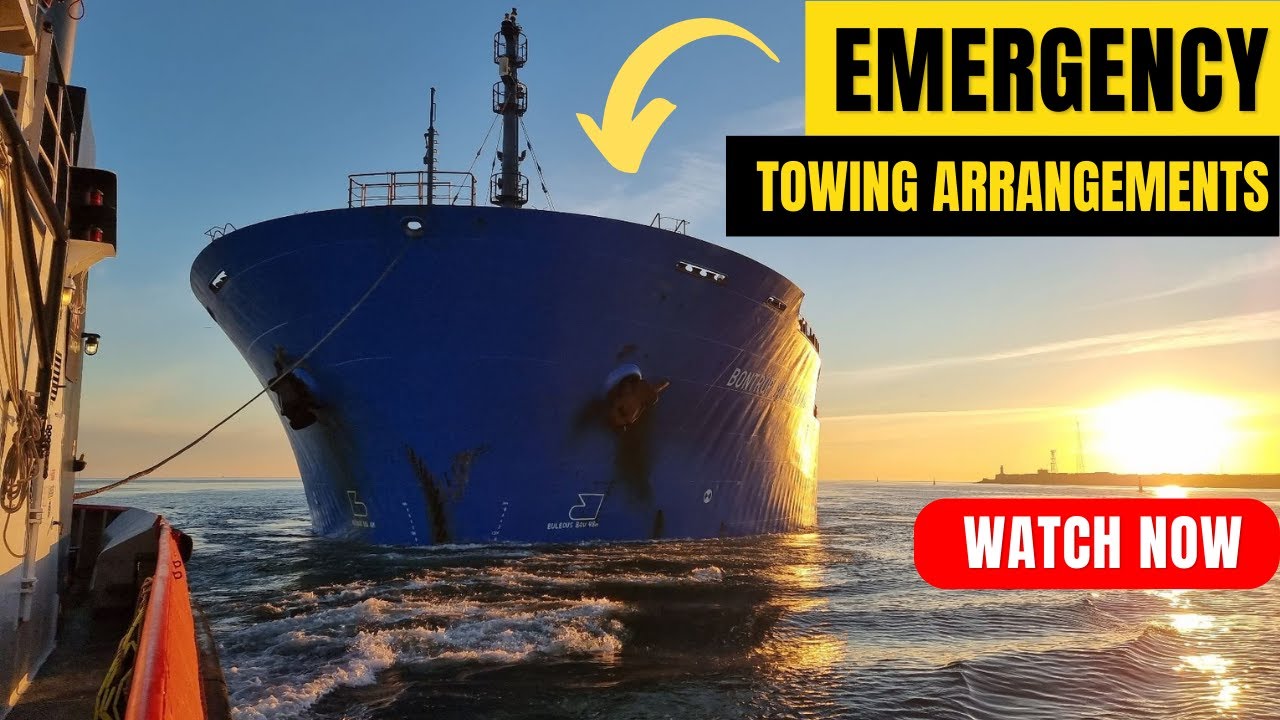
Emergency Towing Arrangements: Preparations and Best Practices
Автор: Merchant Navy Knowledge
Загружено: 2023-05-01
Просмотров: 4420
Описание:
#EmergencyTowing #TowingEquipment #CrewTraining #CommunicationProtocols #WeatherConditions #CrewSafety
Emergency towing arrangements are important to have in place to ensure the safety of vessels and crew in case of an emergency. Here are some key preparations to consider for emergency towing arrangements:
1.
Identify potential towage providers: It is important to identify potential towage providers and establish relationships with them ahead of time. This will save time and resources in case of an emergency.
2.
Assess towing requirements: Assess the towing requirements of your vessel, including the size and weight of the vessel, the distance to be towed, and the weather conditions. This will help you determine the appropriate towing equipment and provider.
3.
Develop a towing plan: Develop a towing plan that includes communication protocols, safety procedures, and contingency plans in case of unforeseen circumstances.
4.
Train crew members: Train crew members on emergency towing procedures, including how to deploy towing equipment and communicate with the towage provider.
5.
Conduct regular drills: Conduct regular emergency towing drills to ensure that crew members are familiar with the procedures and can respond quickly and effectively in case of an emergency.
By following these preparations, you can ensure that your vessel and crew are prepared for emergency towing situations and can respond quickly and effectively in case of an emergency.
Emergency towing arrangements are essential for the safe and efficient movement of vessels in distress. Here are some preparations that you should make for emergency towing arrangements:
Familiarize yourself with the vessel's towing equipment: Before embarking on any voyage, ensure that you are familiar with the towing equipment available on board. This includes the towing winch, towline, shackles, and other associated equipment.
Check the towing equipment regularly: Regular checks of the towing equipment are crucial to ensure its reliability and safe operation. Check for any signs of wear and tear, and replace any damaged equipment promptly.
Train the crew on emergency towing procedures: The crew should be trained on the procedures for deploying and operating the towing equipment in an emergency. This includes the proper use of the towing winch, handling the towline, and communication procedures.
Keep the towing equipment accessible: The towing equipment should be kept accessible and ready for immediate deployment in an emergency. This includes ensuring that the towline is coiled neatly and secured, and that the towing winch is operational.
Maintain good communication: Good communication between the towing vessel and the vessel in distress is critical. Ensure that communication equipment, such as radios or satellite phones, are working correctly, and that communication protocols are established.
Consider the weather and sea conditions: Before commencing any towing operation, consider the weather and sea conditions. Ensure that the towing vessel and crew are capable of handling the prevailing conditions.
Ensure the safety of the crew: Safety should be the top priority during any towing operation. Ensure that the crew is adequately trained and that appropriate safety equipment is available, such as life jackets and safety harnesses.
By making these preparations, you can help ensure that your vessel is well-equipped to handle any emergency towing situation safely and effectively.
Emergency Towing Arrangements (ETA) are an essential safety feature on ships that allow them to be towed to safety in the event of an emergency. These arrangements consist of equipment and procedures designed to ensure that a ship can be towed safely and efficiently, even in adverse weather conditions.
The ETA typically includes a towing bridle, which is a set of heavy-duty ropes or chains that are attached to the ship's hull and used to connect it to the towing vessel. The towing bridle should be strong enough to withstand the forces of towing and should be positioned to ensure that the ship is towed in a straight line.
In addition to the towing bridle, the ETA may also include a towing winch, which is used to control the tension on the towing bridle and ensure that the ship remains stable during the tow. The towing winch should be capable of handling the weight of the ship and the towing bridle, and should be operated by trained personnel.
Finally, the ETA should include procedures for deploying and using the towing arrangements, as well as contingency plans in the event of an emergency. These procedures should be tested and practiced regularly to ensure that they can be executed safely and efficiently when needed.
Overall, Emergency Towing Arrangements are an important safety feature that can help to prevent accidents and ensure that ships can be towed to safety in the event of an emergency.
Повторяем попытку...
Доступные форматы для скачивания:
Скачать видео
-
Информация по загрузке: