KAYSERI: Doner Dome /Döner Kümbet, Kayseri Castle, Vezir Hanı, Ulu Camii/Camikebir, Kursunlu Mosque,
Автор: Kedi Channel
Загружено: 2024-10-18
Просмотров: 91
Описание:
1. Doner Dome, Döner Kümbet
https://maps.app.goo.gl/5Xozp7ehaTdje...
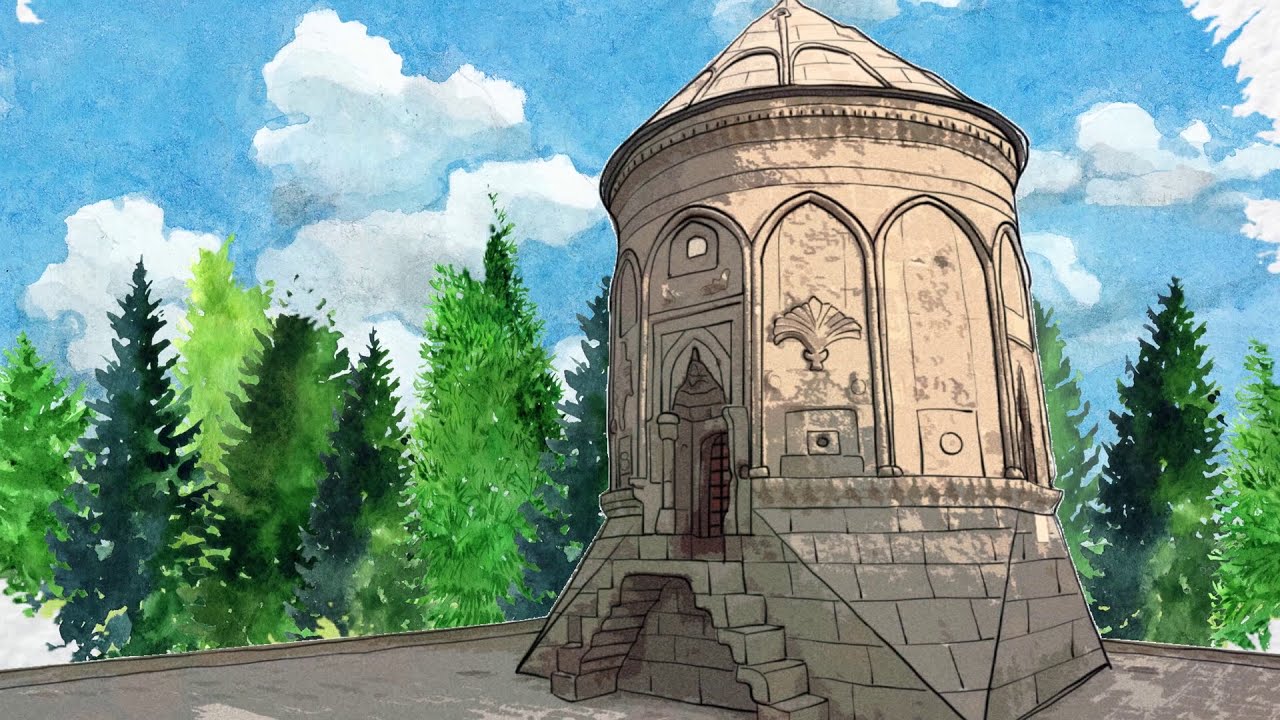
The Döner Kümbet, literally the rotating tomb, was built in the last quarter of the thirteenth century for Princess Sah Cihan Hatun. A short marble inscription gives her name, but omits the date. Stylistic similarities to tombs in Ahlat suggest that the tomb was built around 1276. It is one of the more striking and decorated tombs of Kayseri, where some of the most remarkable tombs of the Seljuk Empire are located.
The tomb is twelve-sided on the exterior and cylindrical on the interior. The square foundation slopes in toward the base of the twelve-sided structure, which is accessed by twin stairways that meet at a small landing in front of the doorway, facing north-northwest. Each of the twelve façades is carved in high relief with floral and geometric motifs, with additional panels containing flora and animal figures, including two sphinxes and a double-headed eagle.
The faces are accentuated by small columns at each corner that are joined to shallow pointed arches over each face. The transition from the dodecahedron of the main shaft to the conical roof is achieved with the arches. Two geometric decorative bands encircle the tomb below the muqarnas cornice.
2. Kayseri Castle, Kayseri Kalesi
https://maps.app.goo.gl/3bFzs71Bfi4N6...
The impressive walls of Kayseri Castle were originally constructed by Roman Emperor Gordian III in the 3rd century, and later reconstructed by Byzantine Emperor Justinian. However, it was mostly built in the 13th century by Seljuk Sultan Alaattin Keykubat I, after being repaired twice due to collapses by Karamanoğulları and Osmanoğulları. During the Turkish period, the surrounding walls and bastions of the Inner Castle were upgraded, and changes were made to its use. Since there was no longer a need to defend the city during the Ottoman period, neighborhoods were established within the Inner Castle, and the Fatih Mosque was built during this time.
3. Vezir Hanı
https://maps.app.goo.gl/6hFF7cCjrbC8y...
4. Kayseri Grand Mosque, Kayseri Ulu Camii (Camikebir)
https://maps.app.goo.gl/mWE8Z9EdvZ23j...
Kayseri's Ulu Cami (grand mosque) was begun in 1142 by the Danışmend Turkish emirs and finished by the Seljuks in 1205. Despite all the 'restoration' over the centuries, it's still a good example of early Seljuk style.
5. Kursunlu Mosque, Kurşunlu Camii
https://maps.app.goo.gl/5wnWffspJ7wrT...
This mosque was named "Kurşunlu” Mosque" because its central dome was covered with lead. Kurşunlu Mosque and Fountain is the only work of Mimar Sinan, who made 12 works in the city, which has survived to the present day in Kayseri. It attracts attention with its interior decorations, pulpit and domed fountain with pointed arches on eight columns in the courtyard. Kurşunlu Mosque, which is a classical Ottoman period architectural work, is one of the most beautiful mosques in Kayseri in terms of embroidery and ornaments.
The last congregation place of the mosque, which was built of smooth cut stone, has a double portico, as in Mimar Sinan's Mihrimah, Atik Valide and Eminönü Rüstem Paşa mosques in Üsküdar, Istanbul.
0:00 Doner Dome (Döner Kümbet)
0:36 Kayseri Castle
1:21 Vezir Hanı
1:35 Ulu Camii (Camikebir)
6:54 Kursunlu Mosque
#islamicart
#islamicarchitecture
#mimarsinan
#seljuk
#ottoman
#kayseri
Повторяем попытку...

Доступные форматы для скачивания:
Скачать видео
-
Информация по загрузке:







![Новосибирск (фильм о городе) СССР, 1976 год. [Редкая хроника, предназначена для показа за рубежом]](https://imager.clipsaver.ru/VLu2dyy2C48/max.jpg)