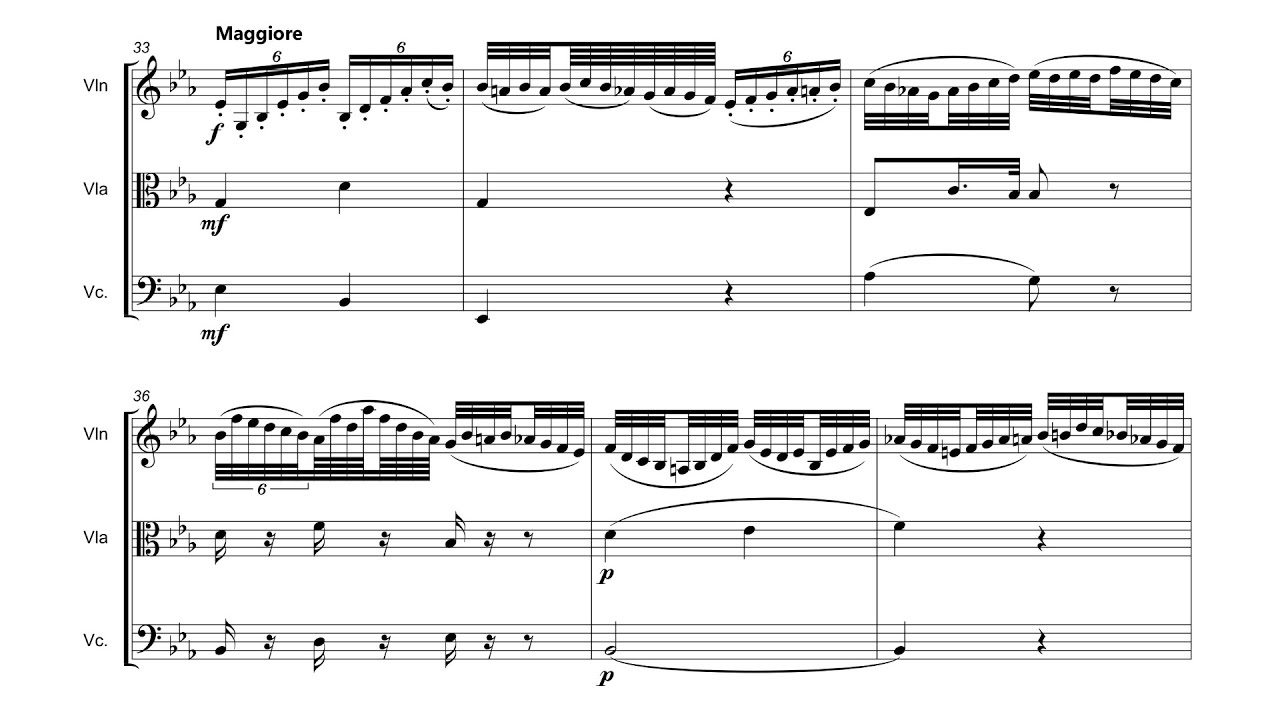
Jan Baptysta Kleczyński - String Trio in Bb-Major Op. 4 No. 5 (Trio Alegrija)
Автор: Polish Scores
Загружено: 2026-02-05
Просмотров: 41
Описание:
Jan Baptysta Kleczyński - Piąte trio smyczkowe
1797
Performance: Trio Alegrija
Violin: Maria Miłkowska
Viola: Magdalena Sierpień-Wywrocka
Cello: Przemysław Wierzba
0:00 - I. Allegro
7:41 - II. Adagio non troppo
11:38 - III. Rondo: Allegretto
Kleczyński, Kletzinsky Jan Baptysta, *14 June 1756 Freistadt (now Karviná, Czech Republic), †6 August 1828 Vienna, Polish violinist and composer working in Vienna. He was a son of Anna and Jan Kleczyński, a municipal butcher in Freistadt. There is no information about J. Kleczyński’s youth. He studied composition (according to unconfirmed evidence it could be in Lviv or Krakow) and knew 5 languages (Polish, Czech, German, Italian, French), which was noted in 1803 in “Conduite Liste” of musicians of the imperial court in Vienna. Around 1786, he worked for 6 years as a violinist and conductor of a home orchestra composed of court employees of Countess Maria Józefa Breuner (†1796), who was a good violinist, wife of the Austrian minister and ambassador in Venice Charles Borromeo von Breuner-Enkevoirt, previously an envoy in Turin; it can be assumed that this orchestra also accompanied the Breuners on trips to their Vienna residence. Around 1793, Kleczyński was associated as a musician with the court of the Hungarian magnate Anton Grassalkovich de Gyarak father (1733–1794) or son (*1771), who resided in Bratislava and Vienna. Before 1795, he also worked for Baron von Braun for 2 years. He probably lived in Vienna from February 1795, gaining recognition as a violinist and composer. On 16 November 1796, he was admitted to the Wiener Tonkünstler-Societät, an organization providing benefits and pensions to widows and orphans of musicians. From 1803 to the end of his life, J. Kleczyński was a member of the committee, and in 1811–25 the first violinist of the orchestra of this association and conductor of the violin group; in December 1801, he passed with distinction (“ganz besonders ausgezeichnet”) the examination for the position of violinist in the court band called Kaiserlich-Königliche Hofmusik (from 1855 Hofmusikkapelle); he was its member from 6 January 1802 until the end of his life. He also belonged to the orchestral group of the Hofburgtheater, where he started working perhaps around 1796; he was quickly promoted: in 1808 he was the third director (out of four) of the theatre orchestra, in 1811–14 the second director, from 1815 to around 1822 he was an assistant director, and from around 1823 he was the only director of the orchestra; due to his function, he had numerous musical responsibilities, e.g. he conducted (already in 1804) concerts and ballet performances. He was married twice. With his first wife, Tekla († 1807), he had a son, Leopold, and with his second wife, Elisabeth Reinhardt († before 1821) – four children: Moritz, Alexander, Izabella and Adelheida. Leopold was an active member of the Gesellschaft der Musikfreunde and probably played violin in the Wiener Tonkünstler-Societät orchestra; one of J. Kleczyński’s sons also sang in the choir of this association. J. Kleczyński died suddenly; he was buried in the cemetery in Matzleinsdorf.
J. Kleczyński was a talented violinist, in official correspondence addressed to the emperor’s office he was called a virtuoso and an “extraordinaire” performer. J. Kleczyński’s mastery of performance is reflected in his works for violin, which he probably created for himself, especially cycles of variations with a high level of technical difficulty. His chamber works demonstrate a keen sense of the texture of string instruments, and in terms of form, melody, and especially harmony, they do not differ from the conventions of the classical style; traces of the Baroque style are still visible in the Concertino.
(polskabibliotekamuzyczna.pl)
Повторяем попытку...
Доступные форматы для скачивания:
Скачать видео
-
Информация по загрузке:







![Grażyna Bacewicz - Divertimento for Strings / Divertimento na Smyczki (1965) [audio + score]](https://imager.clipsaver.ru/7GSBt6jG8qA/max.jpg)


