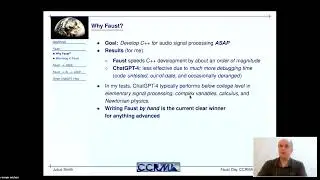
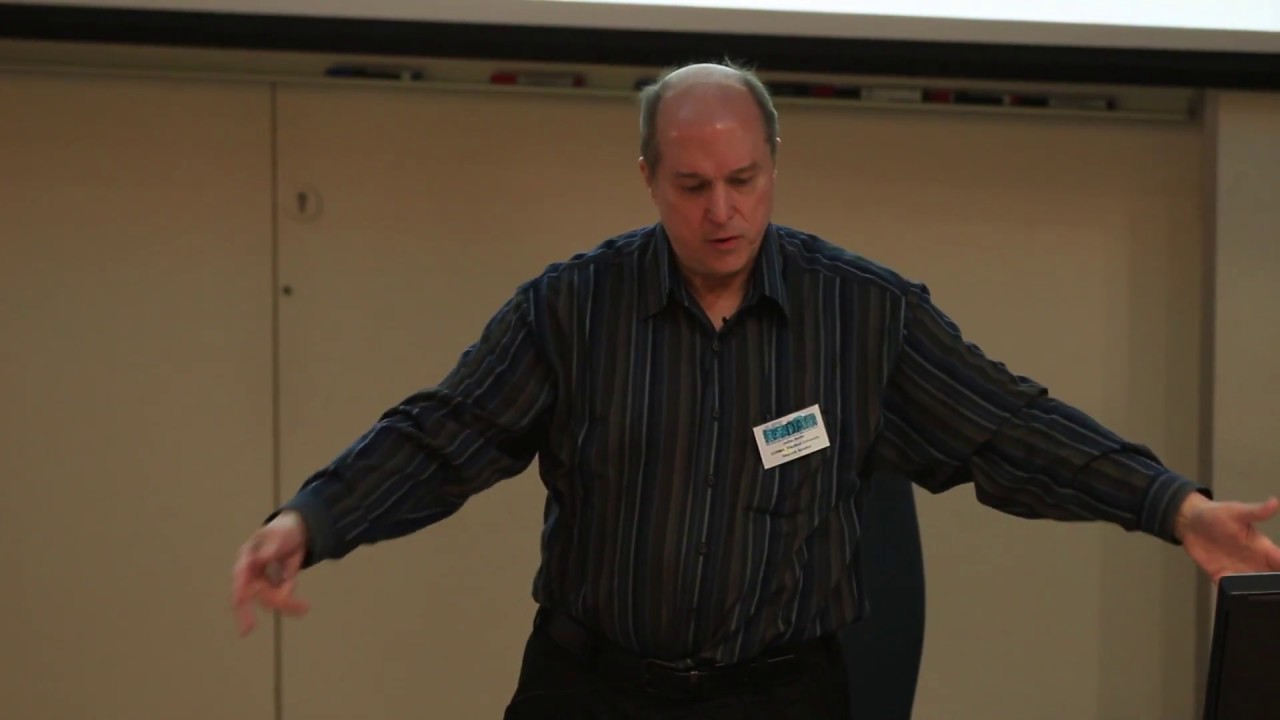
DAFx17 Keynote 1: Julius Smith - History of Virtual Musical Instruments Based on Physical Modeling
Автор: AAG Edinburgh
Загружено: 2017-10-18
Просмотров: 3931
Описание:
Presented at the 20th International Conference on Digital Audio Effects (DAFx17)
Tuesday 5th September 2017, Edinburgh
http://dafx17.eca.ed.ac.uk/
Tutorial Abstract:
This presentation visits historical developments leading to today’s virtual musical instruments and effects based on physical modeling principles. It is hard not to begin with Daniel Bernoulli and d’Alembert who launched the modal representation (leading to both “additive” and “subtractive” synthesis) and the traveling-wave solution of the wave-equation for vibrating-strings, respectively, in the 18th century. Newtonian mechanics generally suffices mathematically for characterizing physical musical instruments and effects, although quantum mechanics is necessary for fully deriving the speed of sound in air. In addition to the basic ballistics of Newton’s Law f = ma, and spring laws relating force to displacement, friction models are needed for modeling the aggregate behavior of vast numbers of colliding particles. The resulting mathematical models generally consist of ordinary and partial differential equations expressing Newton’s Law, friction models, and perhaps other physical relationships such as temperature dependence. Analog circuits are similarly described. These differential-equation models are then solved in real time on a discrete time-space grid to implement musical instruments and effects. The external forces applied by the performer (or control voltages, etc.) are routed to virtual masses, springs, and/or friction-models, and they may impose moving boundary conditions for the discretized differential-equation solver. To achieve maximum quality per unit of computation, techniques from digital signal processing are typically used to implement the differential-equation solvers in ways that are numerically robust, energy aware, and minimizing computational complexity. In addition to reviewing selected historical developments, this presentation will try to summarize some of the known best practices for computational physical modeling in existing real-time virtual musical instruments and effects.
Speaker Bio:
Julius O. Smith teaches a music signal-processing course sequence and supervises related research at the Center for Computer Research in Music and Acoustics (CCRMA). He is formally a professor of music and (by courtesy) electrical engineering at Stanford University. In 1975, he received his BS/EE degree from Rice University, where he got a solid grounding in the field of digital signal processing and modeling for control. In 1983, he received the PhD/EE degree from Stanford University, specializing in techniques for digital filter design and system identification, with application to violin modeling. His work history includes the Signal Processing Department at Electromagnetic Systems Laboratories, Inc., working on systems for digital communications, the Adaptive Systems Department at Systems Control Technology, Inc., working on research problems in adaptive filtering and spectral estimation, and NeXT Computer, Inc., where he was responsible for sound, music, and signal processing software for the NeXT computer workstation. Prof. Smith is a Fellow of the Audio Engineering Society and the Acoustical Society of America. He is the author of four online books and numerous research publications in his field.
Повторяем попытку...
Доступные форматы для скачивания:
Скачать видео
-
Информация по загрузке: