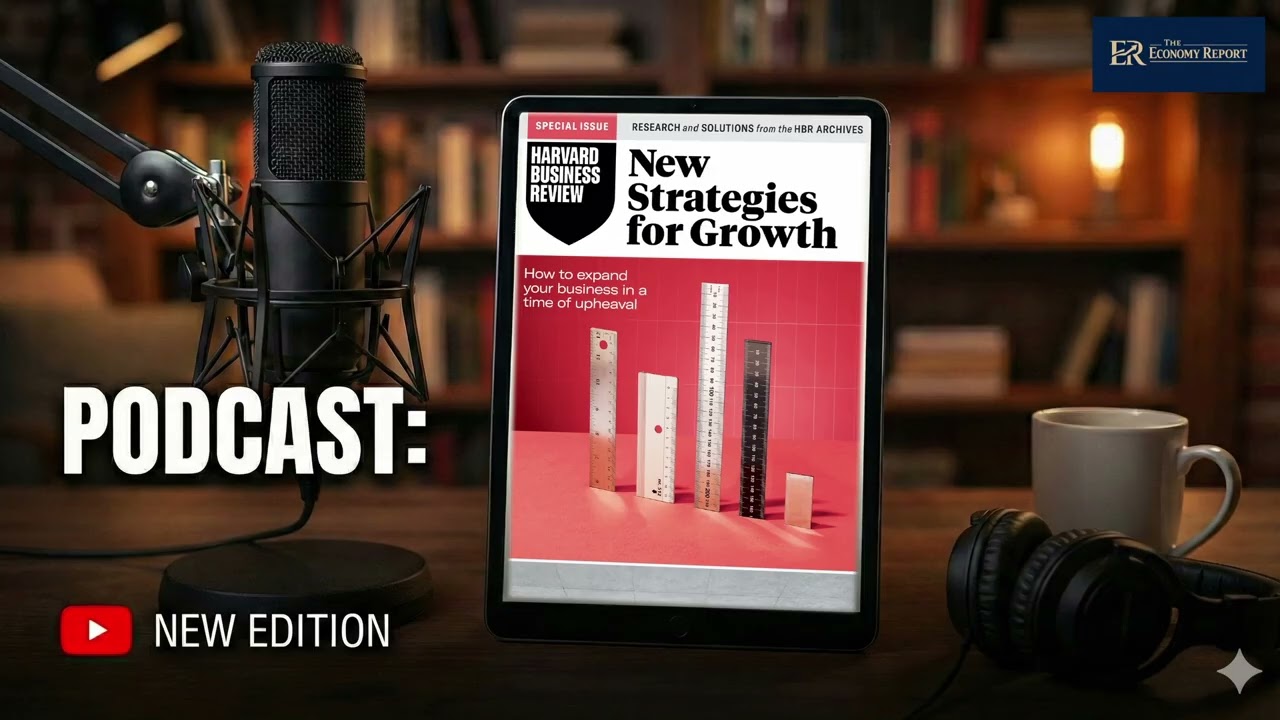
How to Grow Your Business in a Crisis (Harvard Business Review)
Автор: The Economy Report
Загружено: 2026-02-07
Просмотров: 1
Описание:
1. Strategic Frameworks for Growth
• Building a Second Growth Engine ("Engine Two"): As core businesses stall due to disruption, companies must build a second growth engine. Successful "Engine Twos" typically target markets with large, expanding profit pools and leverage the assets of the original core (like Ecolab using its sales force to enter water purification). Success requires a proprietary competitive advantage and an entrepreneurial mindset separate from the bureaucracy of the core.
• The RDM Framework: A strategic approach to growth involves three interconnected decisions: Rate (how fast to grow based on supply-side constraints like talent), Direction (scale in core vs. scope in adjacencies), and Method (organic vs. acquisition vs. partnering). Misalignment here causes failure, such as growing faster than operations can handle.
• Platform Growth: Platforms grow through four avenues: increasing engagement, adding new interactions (e.g., Facebook Marketplace), adding new "sides" (e.g., Amazon adding authors), or bundling both. Managers often err by trying to own all interactions; partnering or allowing affiliates can accelerate growth without capital intensity.
2. Execution, Timing, and Discipline
• Sustainable Growth (The Costco Model): Costco prioritizes being the "best" over being the "biggest," practicing "intelligent loss of sales" by avoiding products or growth rates that compromise their value proposition or operational capacity. They grow only as fast as they can develop strong managers.
• Timing Acquisitions: Contrary to the "blitzscaling" mentality, research shows that spacing out acquisitions improves performance. Companies that expand the time between deals allow for organizational learning and absorption, preventing "growth indigestion".
• Startup Scaling Risks: Premature scaling (before achieving product-market fit) increases the risk of failure by 20% to 40%. Startups, especially platforms, benefit from delaying scaling to experiment and avoid "commitment risk" to the wrong strategy.
• Due Diligence Mindset: Companies should analyze their own growth plans with the rigor of a private equity investor. This includes using reference points from competitors and examining revenue and cost initiatives simultaneously to fund growth through efficiency.
3. Customer and Market Dynamics
• Managing Customer Segments: Attracting new customer segments can alienate existing ones (e.g., Bud Light, Kohl's). Companies must identify if segments are "incompatible" and manage them by creating distance (separate brands/channels) or hierarchies (leader-follower models) to avoid value-destroying conflict.
• The Limits of Scale in Networks: "Get big fast" strategies often fail in network economies if they ignore customer differences. For example, eBay failed in China because it didn't account for the lack of mutual attraction between tech-focused users and fashion-focused users. Smart entrants exploit "asymmetric attraction" (e.g., focusing on star designers to attract buyers).
• Nondisruptive Creation: Innovation doesn't always require disruption. Companies can create new markets without displacing existing ones (e.g., Sesame Street created preschool edutainment; Viagra created a lifestyle drug market). This approach avoids external backlash and internal resistance.
4. Leadership and Talent
• The ABCs of Innovation Leadership: Leading innovation at scale requires three roles: Architect (building culture/capabilities), Bridger (connecting internal/external talent), and Catalyst (activating ecosystems beyond the organization's control).
• Talent Density: Instead of hiring for headcount ("hire to grow"), leaders should hire "force multipliers"—high performers who raise the team's overall productivity. Smaller, talent-dense teams often outperform larger ones.
• The CRO Turnover Cost: Firing a Chief Revenue Officer (CRO) when growth stalls often backfires, leading to an average 4% decline in growth due to the disruption of relationships and strategy. Internal promotions for this role tend to perform better than external "playbook" hires.
• Internal Buy-In: Growth strategies often fail execution because they are designed by consultants without employee input. Involving broad segments of the organization in strategy creation ensures the team understands and supports the plan.
5. Technology and AI
• Intelligent Experience Engines: In the age of AI, competitive advantage comes from "intelligent experience engines" that use data to personalize every customer touchpoint. Success requires connecting data signals, reimagining journeys as flows, and relentless testing.
• AI for Entrepreneurs: Ambitious entrepreneurs use AI not just for efficiency but to scale "smarter" by automating complex tasks (via agentic AI) and democratizing technical capabilities (e.g., coding assistants), allowing small teams to compete with giants.
Повторяем попытку...
Доступные форматы для скачивания:
Скачать видео
-
Информация по загрузке:










![ARMIA PUTINA DRUGĄ ARMIĄ ŚWIATA? PRAWDZIWA SIŁA ROSJI [WOLSKI I BOJKE]](https://imager.clipsaver.ru/-0hLR4R3gvk/max.jpg)