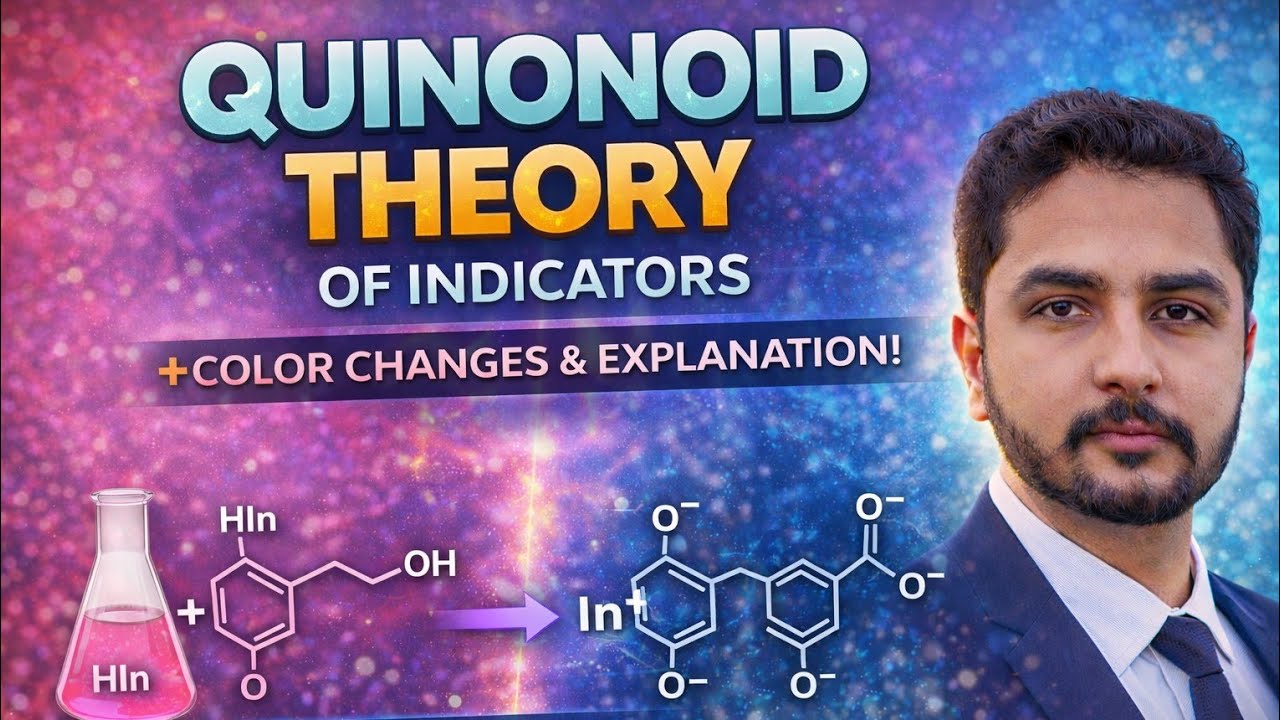
Quinonoid Theory of Indicators | Stability & Color Change Explained by Cogitavers
Автор: CogitaVerse-Urdu Hindi
Загружено: 2026-01-13
Просмотров: 23
Описание:
In this advanced and academically rich lecture by Cogitavers, we explore the deeply conceptual and mechanistic foundations of the Quinonoid Theory of Indicators, a cornerstone topic in acid–base chemistry that connects molecular structure, resonance stabilization, electron displacement, and pH-driven color transitions. This video front-loads essential GOC keywords such as Stability, Mechanism, Resonance, and Electronic Effects, ensuring an SEO-optimized and highly informative learning experience ideal for students preparing for competitive exams or advanced coursework.
In this detailed session, we analyze why indicators undergo a dramatic color shift in response to changes in hydrogen ion concentration and how the quinonoid form becomes central to this transformation. The quinonoid theory proposes that many pH indicators exist in equilibrium between a benzenoid form and a quinonoid form, each possessing distinct absorption characteristics, polarity differences, conjugation pathways, and resonance contributors. As the surrounding medium becomes more acidic or basic, proton transfer or withdrawal adjusts the electron distribution, tipping the stability of one form over the other. With Cogitavers’ conceptual clarity, we examine how this structural shift—without writing formal chemical equations—relies on delocalization of electron density, intramolecular charge stabilization, and the broader interplay of inductive and resonance-like influences.
The lecture further highlights how substituents attached to the aromatic ring modulate the indicator’s sensitivity, altering the pH range in which the color change becomes visible. Electron-withdrawing groups enhance quinonoid stability under certain pH conditions, whereas electron-donating units favor the benzenoid form, making the indicator’s mechanism a compelling application of GOC principles. Cogitavers provides an in-depth breakdown of how molecular rigidity, conjugation length, lone pair availability, and protonation sites synergistically determine whether the absorbing species is the colored or colorless form.
Students will gain deep clarity on why some indicators exhibit sharp transitions, why others display broader ranges, and how structural features control their behavior. Through conceptual reasoning, the session connects the quinonoid theory with broader acid-base principles, including equilibrium shifts, solvation effects, molecular geometry, aromaticity, and chromophoric activation. Every concept is woven naturally with Cogitavers’ signature academic delivery style, ensuring the explanation remains accessible but intellectually rigorous.
This description also integrates all essential keywords for organic chemistry learners, strengthening the video’s discoverability while maintaining authentic educational value. As always, Cogitavers ensures that complex topics feel intuitive, connected, and exam-relevant—making this video an indispensable part of your GOC conceptual foundation.
🌐 Website: CogitaVerse.com
📘 Facebook: Facebook.com/cogitaverse
📸 Instagram: Instagram.com/cogita_verse
Повторяем попытку...
Доступные форматы для скачивания:
Скачать видео
-
Информация по загрузке: