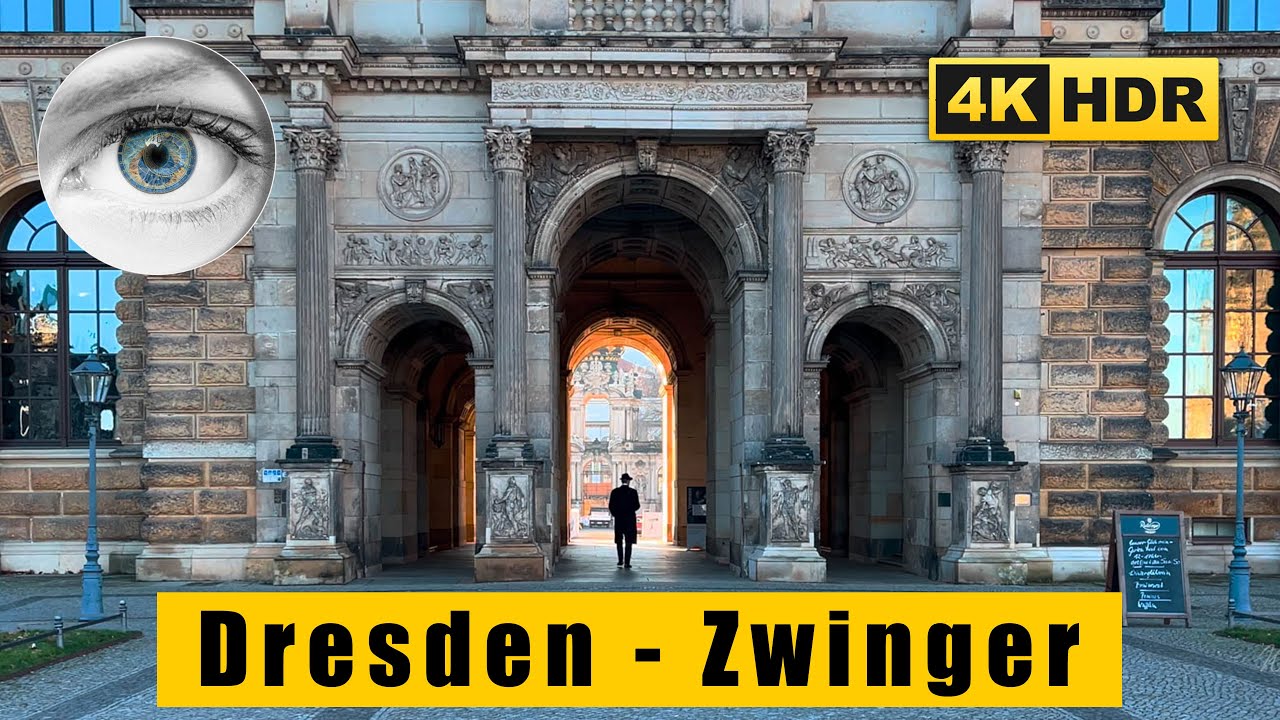
Dresden walk 4k HDR - Zwinger, SchlossPlatz, Katholische Hofkirche, Dresden Castle, Elbe - Germany🇩🇪
Автор: Perception Philosophy
Загружено: 2022-01-22
Просмотров: 2448
Описание:
Today we continue our walk around Dresden. Saxony met us with beautiful weather. We will walk from the Elbe embankment, through the SchlossPlatz, past the Dresden Castle and Katholische Hofkirche, towards the Zwinger Palace, and enjoy the spirit of German history.
Zwinger (German: Dresdner Zwinger) is a palatial complex with gardens in Dresden, Germany. Designed by architect Matthäus Daniel Pöppelmann, it is one of Germany's most important buildings in the Baroque period. Along with the Frauenkirche, the Zwinger is Dresden's most famous architectural monument. The name "Zwinger" goes back to the term used in the Middle Ages for a fortress between the outer and inner fortress walls, even though the Zwinger no longer had a function corresponding to the name at the start of construction. The Zwinger was built in 1709 as an orangery and garden and a representative festival area. Its richly decorated pavilions and the galleries lined with barriers, figures, and vases testify to the splendor during Augustus the Strong, Elector of Saxony, and elected King of Poland. In the original conception of the elector, the Zwinger was the forecourt of a new castle that would take up the area between it and the Elbe; therefore, the Zwinger remained undeveloped on the Elbe side (provisionally closed with a wall). The plans for a new castle were abandoned after the death of Augustus the Strong, and with the departure from the Baroque period, the Zwinger initially lost importance. Only over a century later, the architect Gottfried Semper completed it with the Semper Gallery towards the Elbe. The Sempergalerie, opened in 1855, was one of the most important German museum projects of the 19th century and made it possible to expand the use of the Zwinger as a museum complex, which had grown under the influence of time since the 18th century. The Bombing of Dresden on February 13 and 14, 1945, hit the Zwinger extensively and led to extensive destruction. Since the reconstruction in the 1950s and 1960s, the Gemäldegalerie Alte Meister (Old Masters Picture Gallery), the Dresden Porcelain Collection (Dresdener Porzellansammlung), and the Mathematisch-Physikalischer Salon (Royal Cabinet of Mathematical and Physical Instruments). The original intended use as an orangery, garden and representative festival area has taken a back seat; the latter continues to be cultivated with the performance of music and theater events.
Dresden is the capital city of the German state of Saxony and its second-most populous city, after Leipzig. It is Germany's 12th most populous city, the fourth-largest area (after Berlin, Hamburg, and Cologne), and the third most populous city in former East Germany, after Berlin and Leipzig. Dresden's urban area comprises the towns of Freital, Pirna, Radebeul, Meißen (Meissen), Coswig, Radeberg and Heidenau and has around 790,000 inhabitants. The Dresden metropolitan area has approximately 1.34 million inhabitants.
Dresden has a long history as the capital and royal residence for the Electors and Kings of Saxony. For centuries furnished the city with cultural and artistic splendor and was once by personal union the family seat of Polish monarchs. The city was known as the Jewel Box because of its baroque and rococo city center. The controversial American and British bombing of Dresden in World War II towards the end of the war killed approximately 25,000 civilians and destroyed the entire city center. After the war, restoration work helped reconstruct parts of the historic inner city.
Perception Philosophy 2022
21 of January 2022
Recorded in 4K 60fps HDR
Повторяем попытку...
Доступные форматы для скачивания:
Скачать видео
-
Информация по загрузке:


![12 ЛУЧШИХ МЕСТ В БАВАРИИ [РЕЙТИНГ] - ГЕРМАНИЯ 2025 - не только Мюнхен, Нюрнберг и Нойшванштайн](https://image.4k-video.ru/id-video/cNLNmpk8ORE)


![25 ЛУЧШИХ МЕСТ ГЕРМАНИИ [РЕЙТИНГ] - Германия 2025 - Не только Берлин и Мюнхен](https://image.4k-video.ru/id-video/Lfk15cA2EOc)


